
Killed for bait
Botos have been harpooned to bait the piracatinga catfish fishery. Brazil suspended that fishery in 2015, but enforcement across a river system this size is thin.
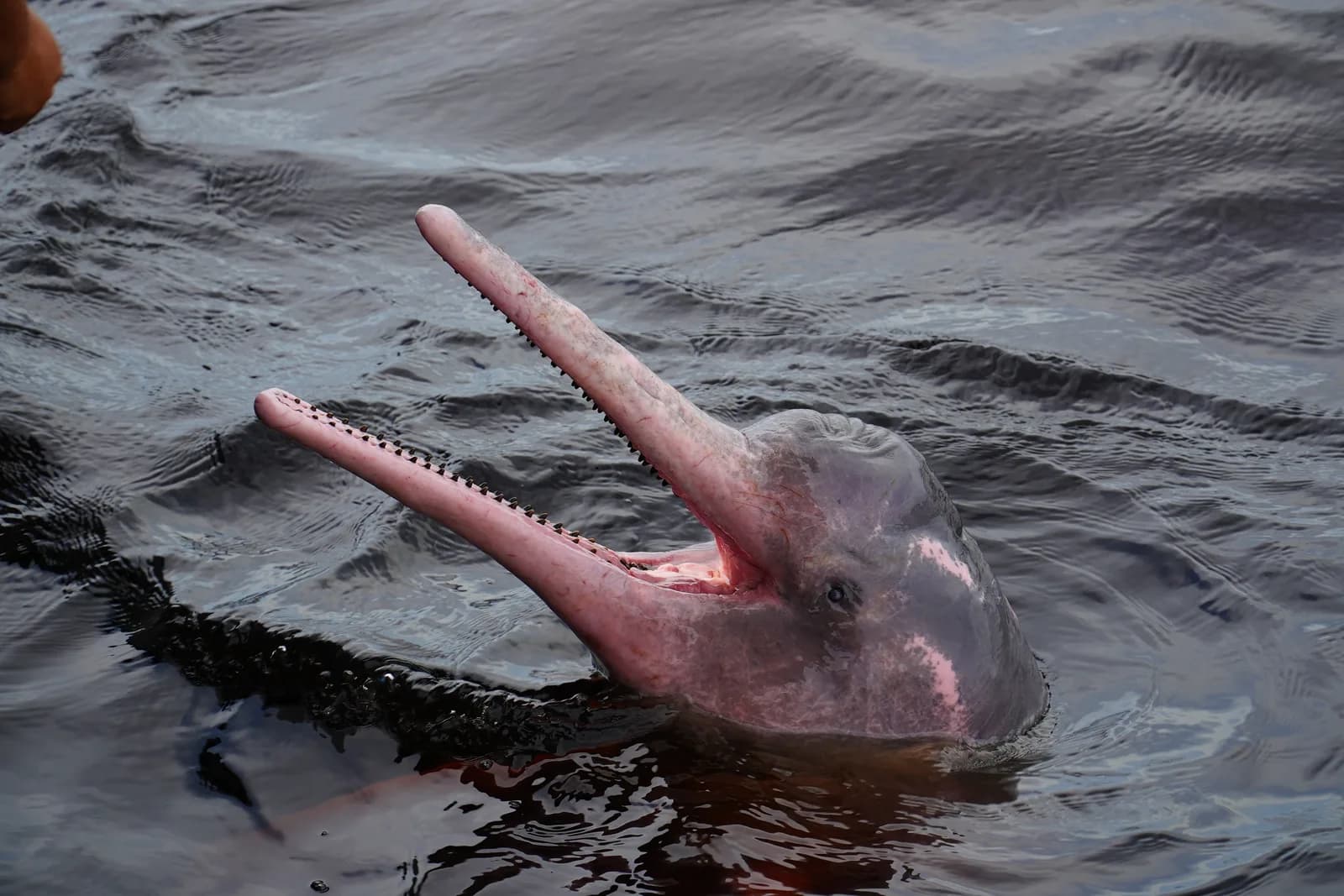
The Amazon river dolphin (Inia geoffrensis), known across its range as the boto, is the largest river dolphin in the world, reaching two and a half metres and 180 kilograms. It is also the strangest looking. Unlike ocean dolphins, its neck vertebrae are unfused, so it can turn its head almost ninety degrees. Its flippers are broad and paddle-like, its dorsal fin is a low ridge rather than a blade, and its long beak carries stiff bristles that help it find prey by touch in water where visibility is close to zero.
The pink is not present at birth. Calves are grey and lighten with age, and in adult males the colour deepens with scar tissue from fighting, so the pinkest animals tend to be the oldest and most battle-worn. Males also carry branches, clumps of grass or lumps of clay at the surface in what researchers interpret as a sexual display, one of very few examples of object carrying in cetaceans.
When the rivers rise, the boto swims into forest that was dry ground months earlier, moving between trunks to hunt fish other predators cannot reach. That flexibility is exactly what makes it vulnerable now. The IUCN moved the species to Endangered in 2018, and long-term monitoring in the Mamiraua Reserve in Brazil found numbers halving roughly every decade.
Botos have been harpooned to bait the piracatinga catfish fishery. Brazil suspended that fishery in 2015, but enforcement across a river system this size is thin.
Nets set across channels catch dolphins as well as fish. Entanglement is a leading cause of death across the range, and most of it is accidental.
Illegal gold mining releases mercury into the water, which concentrates up the food chain. Botos are top predators and carry some of the highest measured burdens.
Hydroelectric dams cut the basin into sections, isolating populations that can no longer mix and blocking the seasonal movements the species depends on.
They are not born pink. Calves are grey and lighten with age, and in males the colour intensifies as scar tissue builds from fighting, so the pinkest animals are usually older males.
Yes. The IUCN listed the species as Endangered in 2018. Long-term surveys in the Mamiraua Reserve found numbers halving approximately every decade.
Up to about 2.5 metres long and 180 kilograms, making the boto the largest river dolphin in the world.
Yes. When seasonal floods raise water levels by several metres, botos leave the main channel and move among the trunks of submerged forest, hunting fish that shelter there.
More than 50 species of fish, along with river turtles and crabs. Their unfused neck and flexible body let them manoeuvre in tight, cluttered water.
Being killed for use as bait in the piracatinga fishery, alongside entanglement in gillnets, mercury from gold mining, and dams that cut the river into isolated sections.
No projects have listed this species yet.