
Forest cut into fragments
Cattle pasture, farmland and roads have broken Central American forest into patches. A canopy specialist that will not cross open ground is stranded by gaps a deer would walk across.
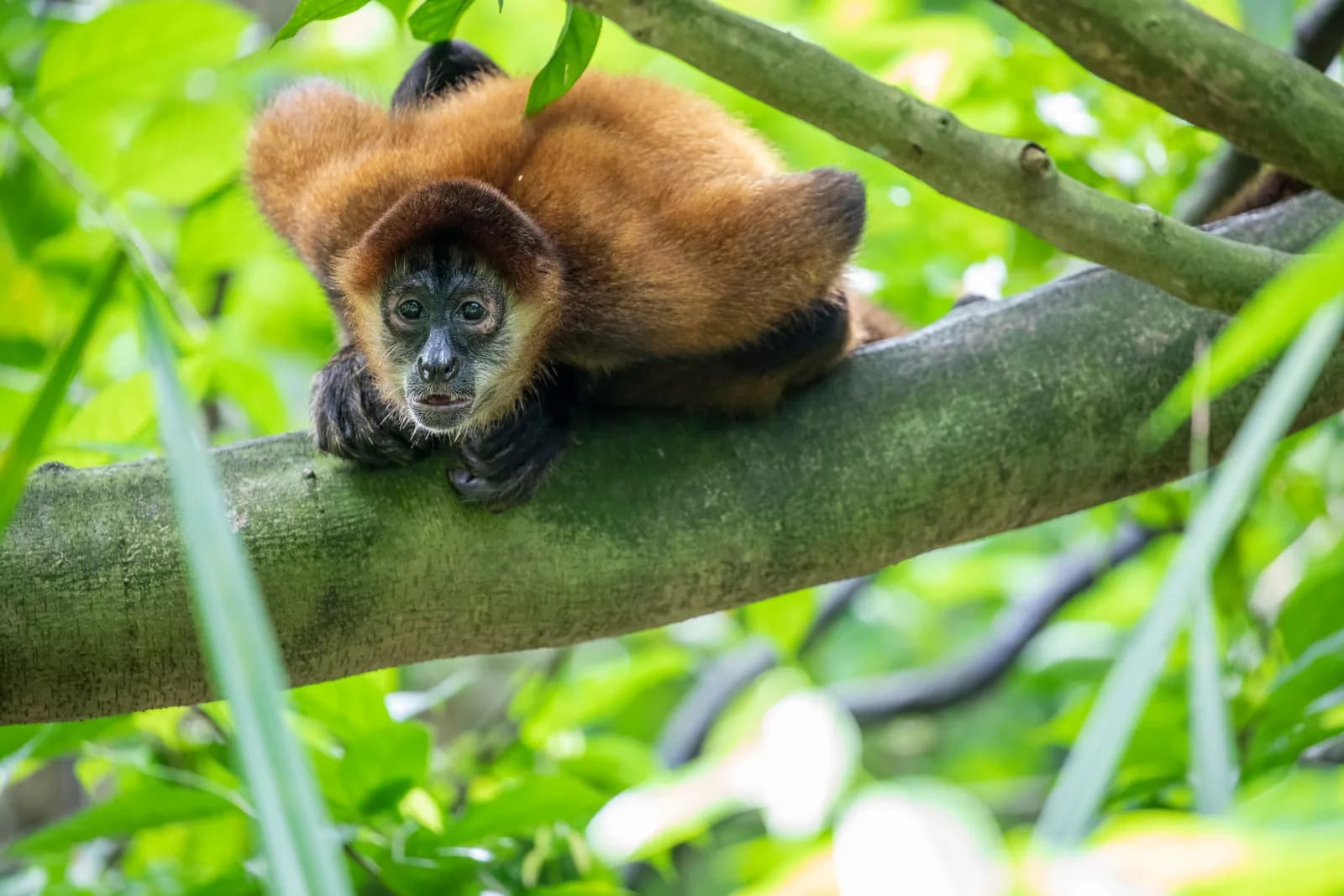
Geoffroy's spider monkey (Ateles geoffroyi) lives in the upper canopy of forests from southern Mexico to Panama, and it is built for almost nothing else. Its arms are longer than its legs, its thumb has been reduced to a stub so the hand can hook over branches without catching, and its prehensile tail carries a bare, ridged patch of skin on the underside that grips like a palm. A spider monkey can hang by that tail alone and still feed with both hands.
They live in fission-fusion societies, which is to say the troop is a loose idea rather than a fixed group. Thirty or more animals share a home range, but on any given morning they split into small parties of two to six to forage, then rejoin and reshuffle. Ripe fruit makes up most of what they eat, and because they swallow seeds whole and travel long distances before passing them, they are among the most effective seed dispersers in the Neotropics. Forests lose something measurable when they go.
Reproduction is slow enough to matter. Females give birth to a single infant roughly every three to four years, and the young stay dependent for well over a year. A population cut in half does not come back quickly, and that arithmetic is why hunting and habitat loss hit this species harder than its intelligence and adaptability would suggest.
Cattle pasture, farmland and roads have broken Central American forest into patches. A canopy specialist that will not cross open ground is stranded by gaps a deer would walk across.
Spider monkeys are among the largest primates in their range, which makes them a preferred target where bushmeat hunting persists.
Infants are captured for sale, and because a mother is usually killed to reach her young, each animal in a market represents more than one lost from the forest.
One infant every three to four years means a population reduced by hunting takes decades to rebuild, even where the forest is left standing.
Yes. The IUCN Red List classifies it as Endangered, driven by habitat loss across Central America and hunting for meat and the pet trade.
The thumb is reduced or absent so the four remaining fingers form a simple hook. It is an adaptation for brachiation, swinging hand over hand beneath branches, where a thumb would catch.
Strong enough to carry the animal's entire weight. The underside of the tip is bare and ridged, giving it grip comparable to a palm, and it is used as a fifth limb for feeding and travel.
In forest canopy from southern Mexico through Belize, Guatemala, Honduras, El Salvador, Nicaragua, Costa Rica and Panama.
Mostly ripe fruit, supplemented with young leaves, flowers, bark and the occasional insect. Their reliance on fruit makes them vulnerable when forests are fragmented.
They swallow seeds whole and travel long distances before passing them, making them one of the most effective large-seed dispersers in Central American forests. Trees with big seeds have few other couriers.
No projects have listed this species yet.