
Diamonds under the dunes
Much of the coastal strip sits over diamond-bearing gravel. Mining strips the dune surface the frog burrows into, and the range is too narrow to absorb the loss.
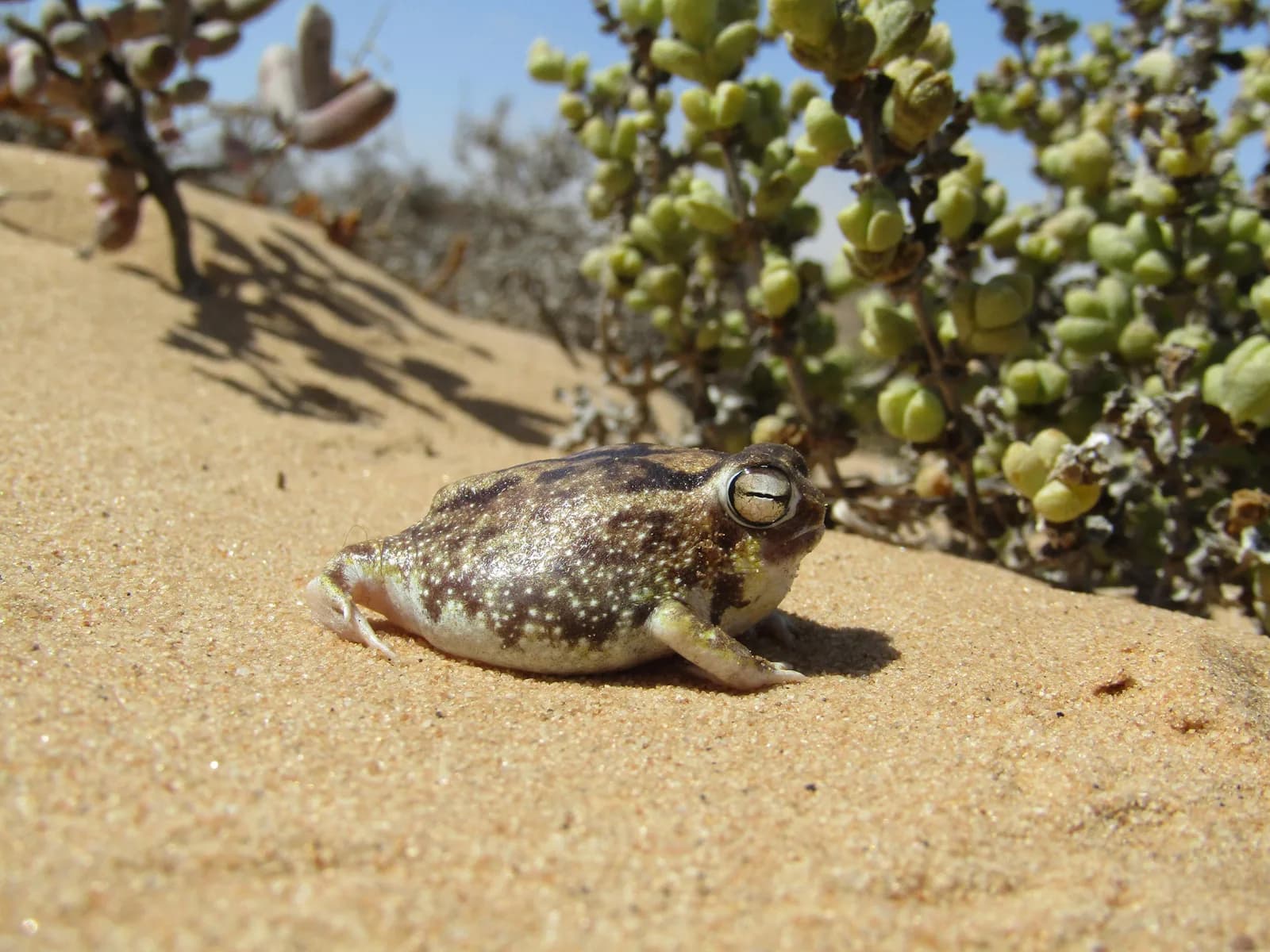
The desert rain frog (Breviceps macrops) lives in a strip of sand dune barely ten kilometres wide, running along the Atlantic coast of Namibia and South Africa between Luderitz and the Olifants River. It is small, round, almost neckless, and translucent enough on the underside that the organs show through. It is best known for the sound it makes when threatened, a high squeak entirely unlike a frog's croak, which carried it around the internet a decade ago and is otherwise barely documented.
Almost everything about it is shaped by the absence of standing water. It never visits a pond. There is no tadpole stage at all: eggs are laid in a damp burrow and the young emerge as fully formed froglets, a strategy called direct development. The webbed feet are for digging rather than swimming, and the frog spends daylight buried up to half a metre down, emerging at night to hunt insects across the sand.
What it needs is fog. Cold Atlantic water drives coastal fog inland most nights, and that moisture is the only reliable water in the system, condensing on sand and keeping the burrow layer damp. The IUCN lists the species as Near Threatened, and the reason is simple geography: a range this narrow leaves no margin, and much of it sits over diamond-bearing gravel.
Much of the coastal strip sits over diamond-bearing gravel. Mining strips the dune surface the frog burrows into, and the range is too narrow to absorb the loss.
The whole species lives in a band of sand roughly 10 kilometres wide. There is no second population elsewhere to fall back on.
Nightly fog off the Benguela current is the only reliable moisture here. Shifts in that upwelling would remove the water the species depends on, with no rain to replace it.
Off-road driving and coastal development compact the loose sand the frog needs to dig into, and crush animals resting just below the surface.
The high squeak is a defensive call made when the frog is threatened. It is unusual among frogs, most of which croak, and it is thought to startle predators.
In a narrow coastal dune strip along the Atlantic, between Luderitz in Namibia and the Olifants River in South Africa, rarely more than 10 kilometres from the sea.
It depends on fog rather than rain. Cold Atlantic water drives nightly coastal fog inland, which dampens the sand, and the frog spends the day burrowed up to half a metre down where that moisture is held.
No. They lay eggs in a damp burrow and the young hatch as fully formed froglets, skipping the tadpole stage entirely. This is called direct development.
It is listed as Near Threatened by the IUCN. Its range is extremely small, and coastal diamond mining has removed or disturbed parts of the dune habitat it depends on.
Small and round, usually between four and six centimetres long, with short limbs, a flattened face and almost no visible neck.
No projects have listed this species yet.