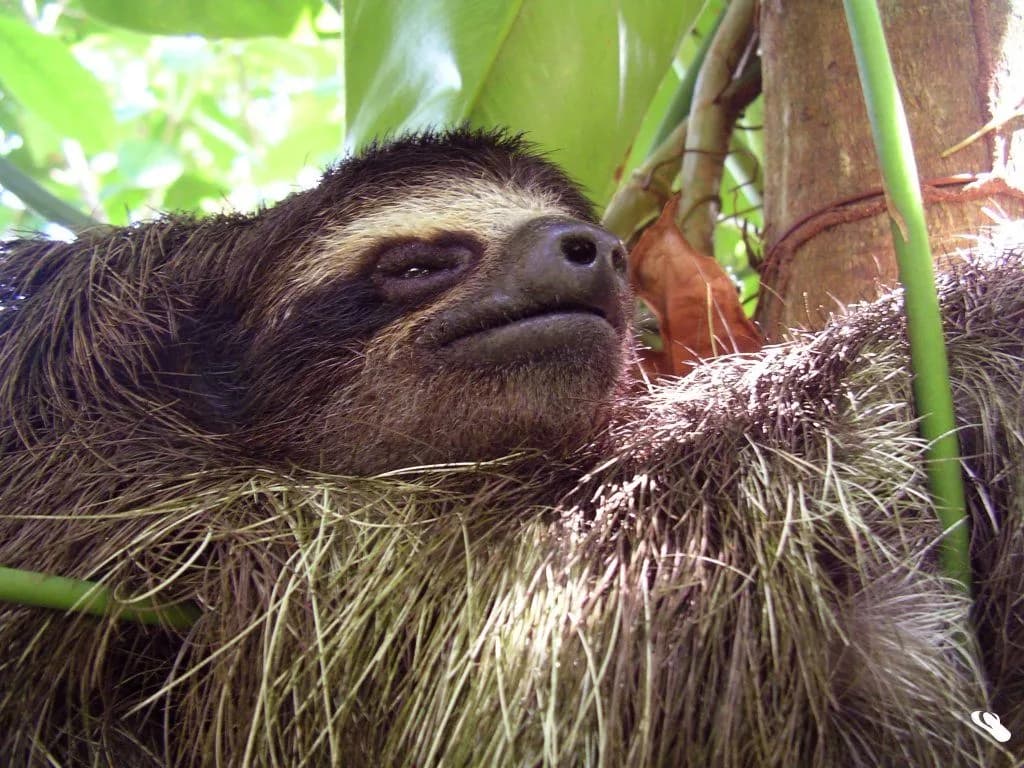
The pygmy three-toed sloth lives on Isla Escudo de Veraguas, a 4.3 square kilometer island off the Caribbean coast of Panama, and nowhere else on Earth. Rising seas cut the island off from the mainland around 10,000 years ago, and the sloths stranded there grew smaller over the generations, as island mammals often do. An adult is 48 to 53 centimeters long and weighs 2.5 to 3.5 kilograms. The brown-throated sloth, its closest mainland relative, is nearly 40% heavier.
It was described as its own species only in 2001, by Robert Anderson and Charles Handley. It lives in the red mangroves fringing the island, eating leaves that are tougher and less nourishing than anything its mainland cousins have to manage. That diet is part of why it moves as little as it does: 15 to 20 hours a day in the trees, traveling at about a quarter of a kilometer per hour.
The IUCN Red List assesses it as Critically Endangered. A 2012 census counted 79 individuals in the coastal mangroves, while a later study put the total somewhere between 500 and 1,500. Nobody is certain, and the uncertainty is part of the problem. The entire species occupies one small island with no second population anywhere, so mangrove cutting, visiting boats, and hunting all land on the same few hundred animals at once.
Yes. The Pygmy Three-toed Sloth is assessed as Critically Endangered on the IUCN Red List, the last category before a species is considered Extinct in the Wild. It lives on a single 4.3 square kilometer island in Panama and nowhere else, so there is no second population to fall back on if that one fails.
Nobody knows precisely. A 2012 census counted 79 individuals in the island’s coastal mangroves, and a later study estimated the total at somewhere between 500 and 1,500. The IUCN Red List treats the population as very small and declining. The uncertainty matters as much as the number, because decisions about the island are being made without a reliable count.
Only on Isla Escudo de Veraguas, an island of about 4.3 square kilometers off the Caribbean coast of Panama. Within the island it keeps almost entirely to the red mangroves along the shoreline.
Rising seas separated Isla Escudo de Veraguas from the Panamanian mainland roughly 10,000 years ago, and the sloths left behind shrank over the generations. Biologists call this insular dwarfism, and it is common in mammals isolated on small islands. An adult weighs 2.5 to 3.5 kilograms, where a brown-throated sloth on the mainland is nearly 40% heavier.
It was described as a separate species in 2001, by Robert Anderson and Charles Handley. Sloths on the island had been seen long before that. What changed was the recognition that they were not simply small brown-throated sloths.
Its whole range is one small island, so every threat arrives in the same place. Cutting the red mangroves removes the only habitat it uses, visitors and seasonal fishing camps disturb the shoreline, and hunting takes animals from a population that may number only in the hundreds.
No projects have listed this species yet.
