How to spot a real ethical elephant sanctuary in Chiang Mai
In 2010, 92% of Thailand's captive tourism elephants were used for rides. By 2024 that figure had fallen to 43%, according to World Animal Protection, which surveyed 236 venues holding 2,849 elephants between February 2024 and January 2025.
Its 2026 assessment found that nearly two in three captive elephants are still kept in poor conditions.
That is real progress, driven almost entirely by tourists refusing to ride. It is also incomplete, because something replaced riding, and most visitors do not recognize it as a problem.
The word sanctuary means nothing on its own
No Thai law reserves the word for facilities meeting a welfare standard. A camp that offered rides in 2015 can call itself a sanctuary in 2026 without changing anything except its signage and its pricing.
The legal position underneath this is stranger than most visitors expect. Wild Asian elephants in Thailand are strictly protected. Captive elephants are classified as livestock, under a framework dating to 1939. The roughly 4,000 captive elephants in the country are, legally speaking, closer to cattle than to protected wildlife. That is the gap the tourism industry operates in.
Bathing is the new riding
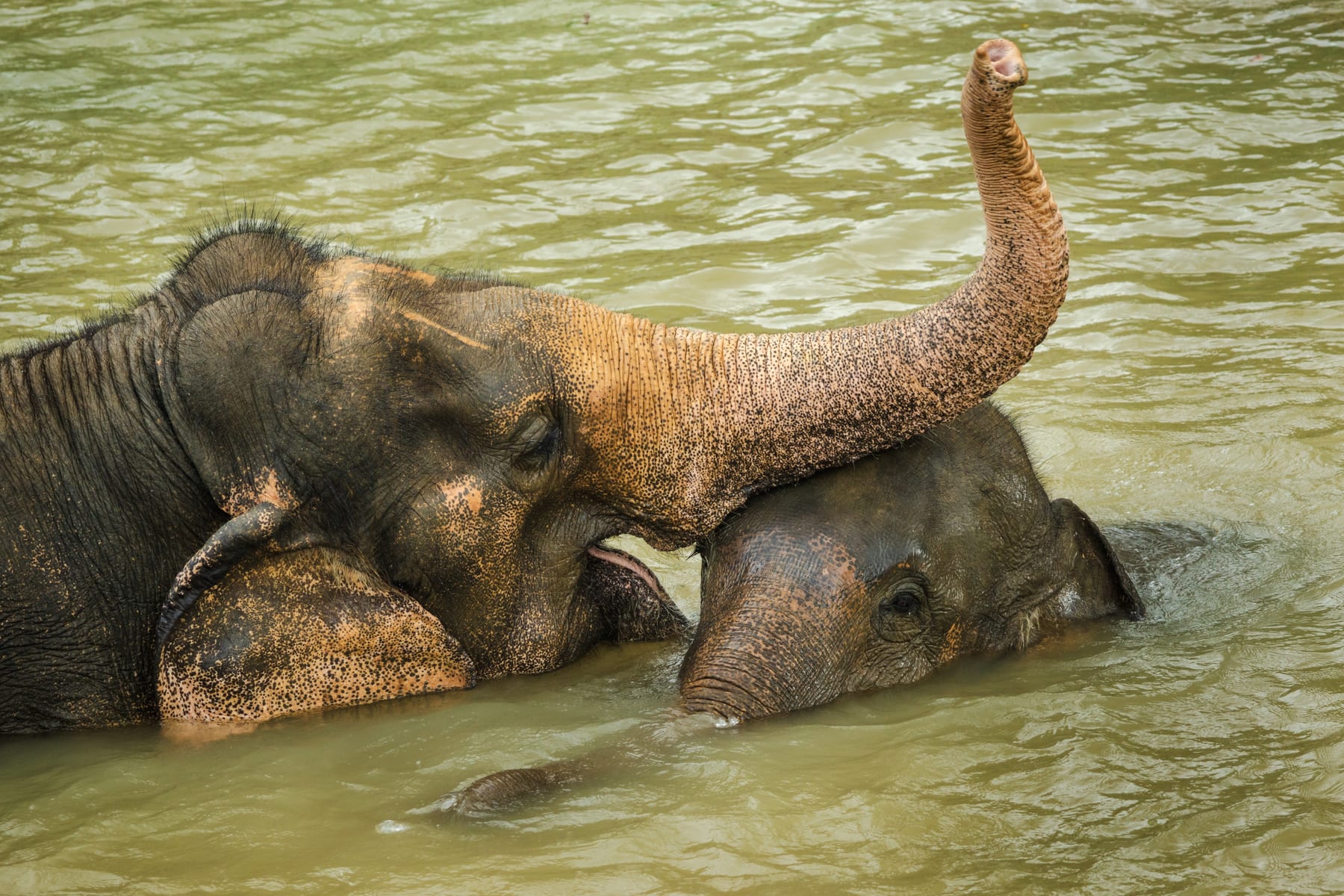
This is the part worth knowing before you book anything. In 2024, more than half of Thailand's captive tourism elephants were at venues offering washing or feeding experiences, and those venues overwhelmingly market themselves as sanctuaries or rescue centers.
An elephant being bathed by twelve strangers in rotation, all day, every day, is not doing something it chose. It is performing a task it was trained to accept, in water it did not pick, at a frequency no elephant would select. The training that makes an elephant reliably tolerate close human contact happens before the tourist arrives, which is why the visible activity looks gentle while the underlying arrangement has not changed.
Venues offering observation only held 7.3% of captive elephants in 2024, up from 4.6% in 2010. That is the category growing for the right reasons, and it is still small.
The people in the picture
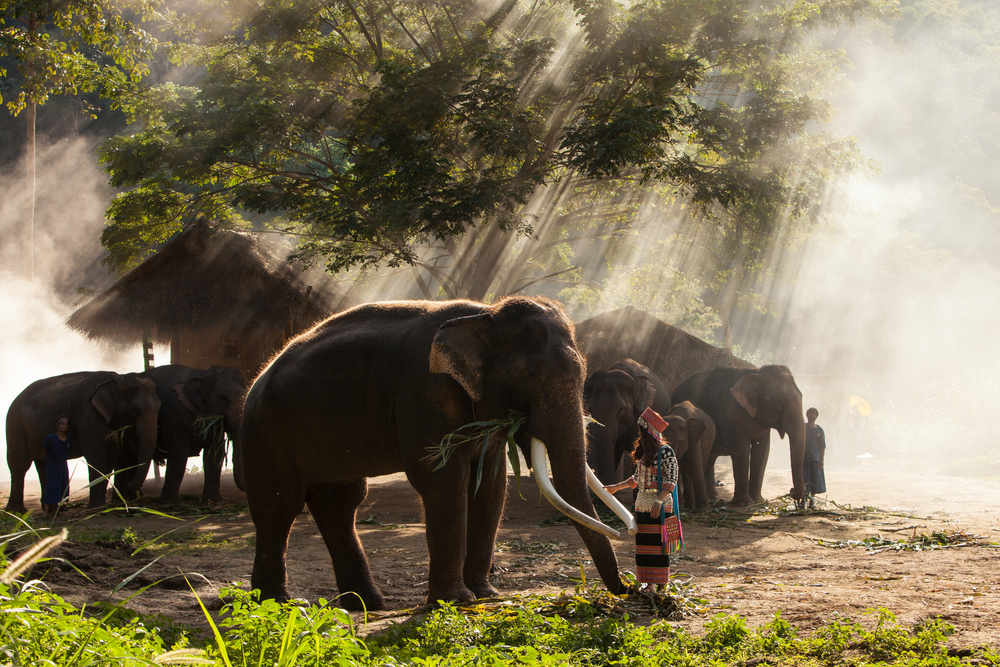
Most coverage of elephant tourism leaves out the mahouts, and any version of this that ignores them is not going to work.
A mahout is the person who lives and works with an individual elephant, often for decades and often across generations of the same family. In Thailand the relationship predates the tourism industry by centuries. When logging was banned in 1989, thousands of elephants and the families who worked with them lost their income almost overnight, and tourism is what absorbed them. A campaign that succeeds in shutting camps without replacing that income does not produce free elephants. It produces unemployed mahouts and 4,000 kilogram animals nobody can afford to feed.
This is not an argument for tolerating bad venues. It is the reason the credible organizations in this space work on mahout wages, training, and village economics alongside elephant welfare. When you are evaluating a venue, how it treats its staff is a reasonable proxy for how it treats its animals, and it is usually easier to observe.
What happens when a camp closes
The pandemic ran this experiment at national scale. When international tourism stopped in 2020, camps across Thailand lost their entire revenue in a matter of weeks. Elephants were walked back to home villages, sometimes for days, because there was no money for food where they stood. Some were put back into illegal logging. A few were chained for months with minimal feed.
An adult Asian elephant eats roughly 150 kilograms of vegetation a day and can live past 60. Taking one out of tourism means committing to feed it for decades with no revenue attached to it, which is why genuinely non-commercial sanctuaries are rare and why the ones that exist depend on donations rather than gate receipts.
It is also why "we rescued this elephant" deserves a follow-up question: rescued into what, funded by whom, for how long.
What a genuine sanctuary looks like
Observation only. You watch elephants from a distance and they are free to walk away from you. The industry treats hands-off as the gold standard, and a venue that has adopted it has given up its most profitable selling point on purpose.
No riding, no bathing, no shows, no painting, no photo ops. Any activity that requires an elephant to be somewhere specific at a specific time requires control established beforehand.
No breeding, and no calves being introduced to visitors. A sanctuary's population should shrink over time, not grow. A calf on site is a business decision.
Independent certification. Asian Captive Elephant Standards audits venues on welfare, staff conditions, environment, and community impact. World Animal Protection maintains its own assessments. Certification is not a guarantee, but a venue that has invited outside auditors is telling you something a marketing page cannot.
Straight answers about the elephants' histories. A real sanctuary knows where each animal came from, usually logging or a riding camp, and will tell you.
Questions worth asking before you pay
Ask what happens if an elephant walks away from visitors, and whether staff retrieve it. Ask whether bullhooks are on the property. Ask how many elephants there are per hectare, and whether they are chained overnight, which is common even at well-regarded venues and is worth an honest answer. Ask what the venue does in low season, when income falls but a 4,000 kilogram animal still eats roughly 150 kilograms of food a day.
The last one matters more than it sounds. Elephant care is expensive and constant, and a venue that has no answer for the lean months is likely to reintroduce the activities it dropped.
Where to find a genuine elephant sanctuary
Save Elephant Foundation (saveelephant.org), based in Chiang Mai, is the best known organization in this space and has spent years moving elephants out of riding and logging work while pushing other venues to drop tourist contact. Animals Asia and Wildlife Alliance work on captive wildlife welfare across the region.
Outside Asia, the same principles produce recognizable results. The Elephant Sanctuary in Tennessee and Global Sanctuary for Elephants in Brazil are both closed to public contact entirely. Neither offers a visitor experience, which is exactly why they are worth using as a mental benchmark for what the animals' interests look like when nothing is being sold.
The same industry, other borders
Thailand gets the attention because it has the most captive elephants and the most visitors, but the pattern crosses borders. Camps in Laos, Cambodia, and Vietnam run comparable operations with less scrutiny and weaker regulation, and elephants move between countries when demand shifts. Wildlife Alliance works on captive wildlife and trafficking in Cambodia, and Save Vietnam's Wildlife handles confiscated animals in Vietnam. Booking an observation-only venue in Chiang Mai and an elephant ride in Luang Prabang funds both sides of the same argument.
If you are booking a broader trip, our guide to ethical wildlife tourism covers the same reasoning applied to other species and destinations, and the volunteer vacations guide applies it to placements, where the same gap between a program's marketing and its actual work shows up in who is allowed to touch the animals. The Thai captive population is almost entirely Asian elephants, a species with a long history of being worked rather than hunted, which is why its conservation problem looks so different from the African one. Asian elephants are Endangered on the IUCN Red List, and roughly a third of the remaining population lives in captivity, which means decisions made by tourists are a meaningful share of what happens to the species.
The decline in elephant riding happened because enough travelers asked one question at the point of booking and then spent their money elsewhere. The same mechanism is available for bathing.