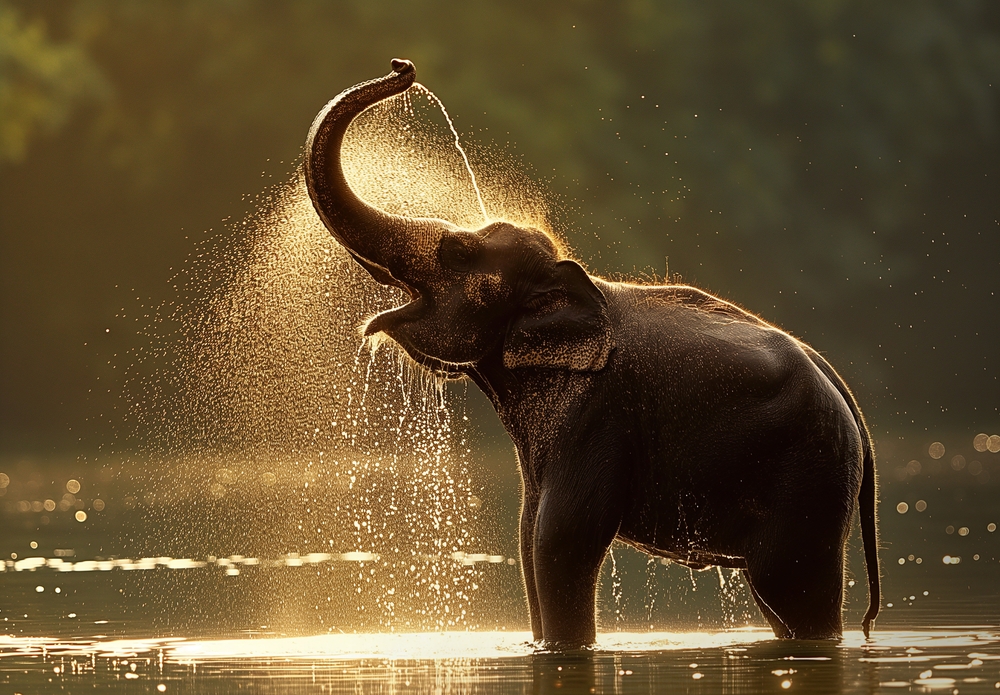
Most people cannot tell an African elephant from an Asian one
Start with the correction that matters most: African vs Asian elephant is not a two-way comparison. There are three living elephant species, because in 2021 the IUCN assessed Africa's elephants separately for the first time and confirmed that the forest elephant and the savanna elephant are distinct species that diverged millions of years ago.
So the three are the African savanna elephant, the African forest elephant, and the Asian elephant. All three are threatened, and the forest elephant is in the worst position of any of them.
Ears are the classic tell
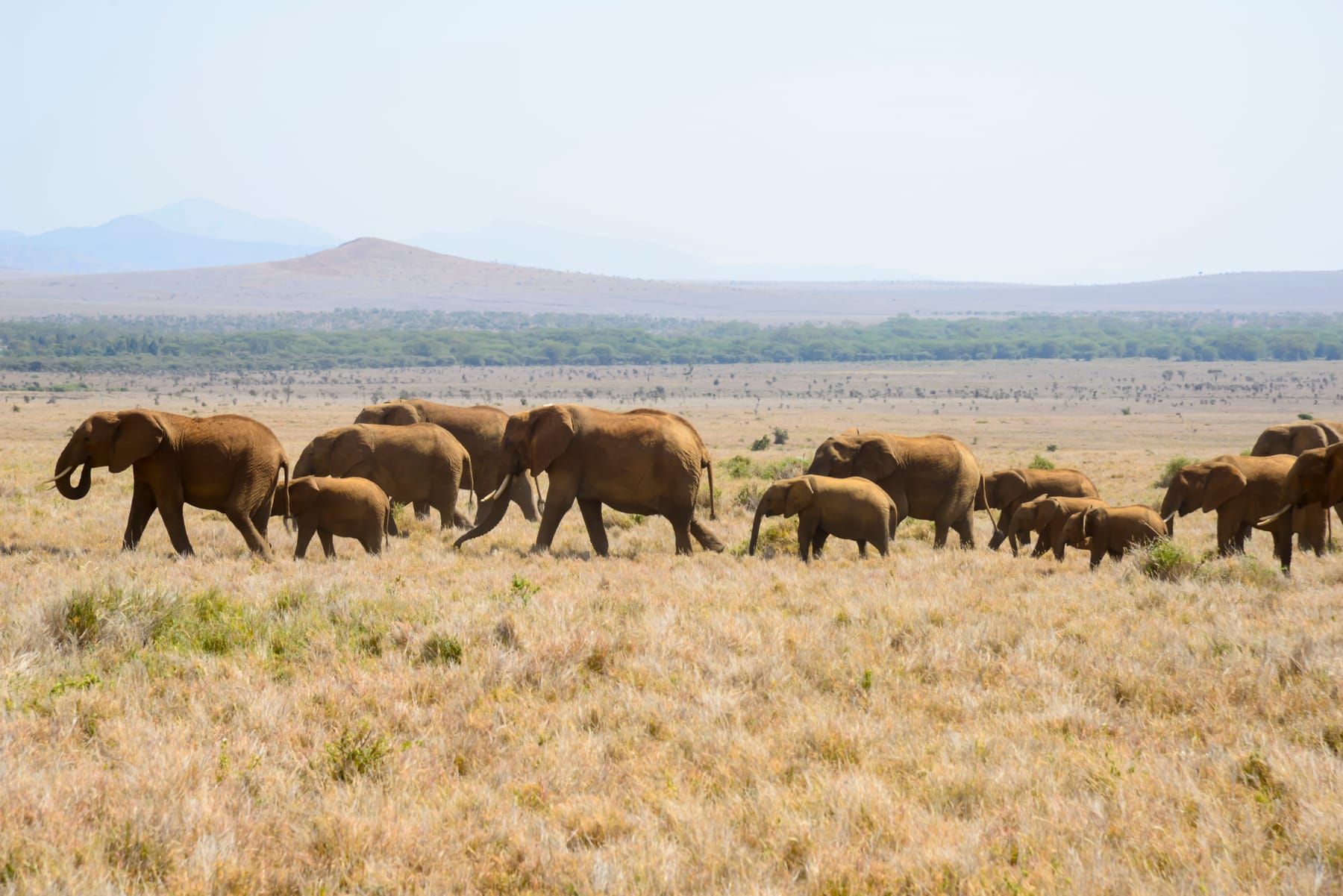
African elephants have large ears that fan out well above the shoulder and are often said to resemble the shape of the African continent. Asian elephants have much smaller, rounder ears that sit closer to the head.
The reason is heat. Elephant ears are radiators, laced with blood vessels that dump heat when the animal fans them. A savanna elephant standing in open sun in Kenya needs a bigger radiator than a forest-dwelling Asian elephant in shaded, humid habitat.
African vs Asian elephant at a glance
| African savanna | African forest | Asian | |
|---|---|---|---|
| Ears | Very large | Large, rounder | Small |
| Height | Up to 4 m | Up to 3 m | Up to 3.5 m |
| Back | Saddle-shaped dip | Straighter | Domed, highest point |
| Trunk tip | Two "fingers" | Two "fingers" | One "finger" |
| Tusks | Both sexes | Both sexes, straighter | Mostly males only |
| Head | Single dome | Single dome | Twin domes |
| IUCN status | Endangered | Critically Endangered | Endangered |
The trunk tip settles it
This is the detail most people have never noticed and it is completely reliable.
An African elephant's trunk ends in two finger-like projections, one above and one below, which it uses like a pair of tweezers to pinch objects.
An Asian elephant's trunk ends in one, and it grips by curling the trunk around an object and pressing it against the underside, more like a hook than tweezers.
Both approaches work. It is simply two different solutions to the same problem, and it is visible in any decent photograph of a trunk tip.
Back and head shape
Look at the silhouette.
An African savanna elephant's back dips in the middle, giving a saddle or concave profile, with the highest point at the shoulder. An Asian elephant's back is convex, humped, and the highest point of the whole animal is the top of the head.
Asian elephants also have a distinctly twin-domed forehead with a groove down the middle. African elephants have a single rounded dome.
Tusks
In African elephants, both males and females usually grow tusks.
In Asian elephants, tusks are mostly limited to males, and even then many males have none at all. Tuskless males, called makhnas, are common in some populations. Female Asian elephants may have tiny tushes that barely show.
There is a grim wrinkle here. Because ivory poaching removes tusked animals preferentially, tusklessness has become more common in heavily poached African populations, which is evolution running in fast-forward under hunting pressure.
Behavior and social structure
The differences are not only anatomical.
All three species live in matriarchal family groups led by the oldest female, and in all three the matriarch carries the knowledge the group depends on: where water is in a drought year, which routes are safe, which individuals from other herds can be trusted. That knowledge is why poaching an old female costs a herd more than the loss of one animal.
African savanna elephants form the largest and most fluid groups, sometimes gathering in hundreds where water is plentiful. Forest elephants live in much smaller units, typically a female and her offspring, because dense forest does not support large aggregations. Asian elephants sit in between.
All three are also among the few animals that show behavior around their dead, returning to carcasses and handling the bones, which Save the Elephants has documented repeatedly in its long-term study herds.
Size
African savanna elephants are the largest land animals alive, reaching around 4 meters at the shoulder and up to 6 metric tons. Asian elephants are smaller, at up to about 3.5 meters. African forest elephants are the smallest of the three, up to roughly 3 meters, with straighter, downward-pointing tusks suited to moving through dense vegetation.
The difference that decides how they are treated
Asian elephants have been kept and worked by people for thousands of years, in logging, ceremony, and now tourism. African elephants have not, in any comparable way.
That history is the reason nearly every captive elephant welfare issue in the world involves Asian elephants, and why Thailand alone holds roughly 4,000 of them, most in the tourism industry. If you are deciding where to visit, our guide to choosing an ethical elephant sanctuary covers what separates a real sanctuary from a venue using the word.
How each species is actually doing
The IUCN Red List assessments tell three different stories.
The African forest elephant is Critically Endangered, having lost more than 86% of its population in 31 years. It is the most threatened of the three by a wide margin, and the least discussed, partly because it lives in dense Congo Basin forest where it is hard to count and harder to photograph. It disperses the seeds of large forest trees that have no other disperser, so its loss changes the forest itself for centuries.
The African savanna elephant is Endangered, down roughly 60% over 50 years, with poaching for ivory and habitat conversion as the main drivers. Save the Elephants in Kenya tracks herds by GPS collar to counter both, and Sheldrick Wildlife Trust runs the orphan rescue and reintegration program in Tsavo.
The Asian elephant is Endangered, with fewer than 50,000 estimated in the wild. Its problem is less about ivory and more about space: its range crosses some of the most densely populated countries on Earth, so human-elephant conflict over crops and land is the dominant threat. An elephant that raids a farmer's field at night is a livelihood problem before it is a conservation problem, and the solutions that work are the ones that address both, such as beehive fences and compensation schemes. Save Elephant Foundation works on the captive population in Thailand.
Because the threats differ, so does what a donation buys. Most of the symbolic elephant adoption programs fund either orphan care and anti-poaching in Kenya or captive rescue in Asia, and the two are not interchangeable. Our complete guide to elephants covers the biology and behavior all three share, from the 22-month gestation to the matriarchal herd structure.
Are there other differences worth knowing
A few smaller ones come up often enough to be worth settling.
Skin. Asian elephants often show depigmented pink patches, particularly around the ears, face, and trunk, which are much less common in African elephants.
Toenails. African elephants typically have four on the front feet and three on the back. Asian elephants usually have five in front and four behind. It is a real difference and a completely impractical one, since you would need the animal to stand still on clean ground.
Ribs. Asian elephants have more pairs, which is invisible in life and only matters to anatomists.
Vocalization. All three produce infrasonic rumbles below the range of human hearing that travel several kilometers, which is how separated family groups stay coordinated. WWF notes this long-distance communication as one reason habitat fragmentation harms elephants beyond the simple loss of space: herds that can no longer hear each other stop behaving as one population.
Why the split into three species mattered
Recognizing the forest elephant as a separate species was not taxonomic housekeeping. It changed the conservation picture immediately.
While the two were assessed as one African elephant, the savanna population's larger numbers masked the forest elephant's collapse. Splitting them revealed that one of the two was Critically Endangered and had been for some time. A single averaged number had been hiding it.
That is a useful thing to know about conservation data generally, and it is the same effect our guide to what wildlife conservation is for describes with IUCN categories: the unit you measure decides what you can see.