The deep sea creatures we have barely started to meet
Deep sea creatures live in the largest habitat on the planet and the one we know least about. Below 200 meters sunlight effectively stops. Below 1,000 meters it is entirely gone. That leaves roughly 95% of the ocean's volume in permanent darkness, at pressures that would crush a submarine, at temperatures close to freezing, with no plants and therefore no photosynthesis at the base of the food chain.
More people have been to the Moon than to the bottom of the Mariana Trench. We have mapped the surface of Mars in better resolution than our own seabed.
Where deep sea creatures actually live
The twilight zone, 200 to 1,000 meters, still has faint blue light. It holds the largest fish biomass on Earth and a daily vertical migration of animals rising to feed at night and dropping before dawn, which is the biggest movement of biomass anywhere on the planet.
The midnight zone, 1,000 to 4,000 meters, has no sunlight at all. Most of the animals here are small, black or red, and slow.
The abyss, 4,000 to 6,000 meters, is the flat plain covering most of the seafloor. Below that, the trenches reach almost 11,000 meters.
Pressure is the constraint that shapes everything. At 4,000 meters it is around 400 times what you are standing in now. Animals here have no air spaces to collapse, so most have no swim bladder, and their cell membranes contain compounds that keep them functioning under a load that would stop the same biochemistry at the surface. It is why a fish brought up in a net arrives ruined: the animal was never fragile, it was simply built for a different pressure.
The hunters of the dark
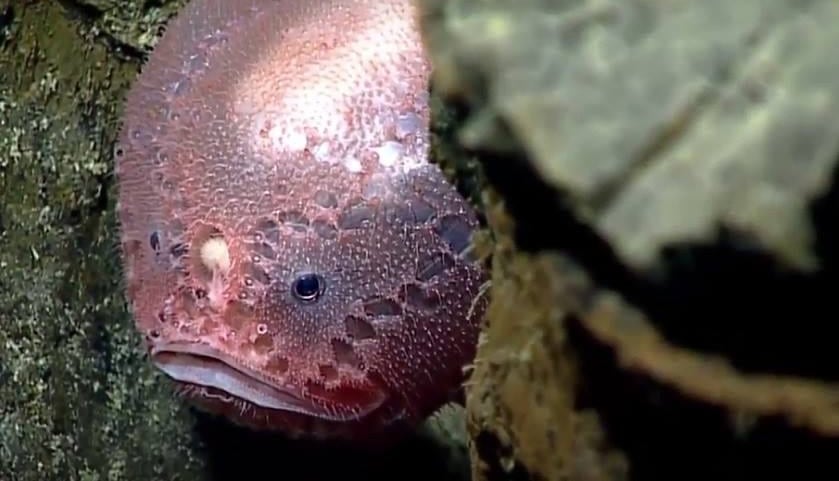
A coffinfish, one of the anglerfish relatives, photographed alive on the seafloor. Photo: NOAA Okeanos Explorer (public domain).
The anglerfish carries a lure on a modified fin spine, lit by symbiotic bacteria, dangled in front of a mouth that can swallow prey larger than itself. Food is scarce enough down here that an animal cannot afford to reject anything.
Its reproduction is the part worth knowing. In many species the male is a fraction of the female's size, finds her by smell, bites on, and then fuses. His circulatory system merges with hers, his eyes and most organs degenerate, and he persists as little more than a sperm-producing appendage. A single female may carry several.
The gulper eel has a mouth larger than the rest of its body and a stomach that distends enormously. The viperfish has teeth too long to fit inside its mouth, which fold back alongside its head.
The scavengers
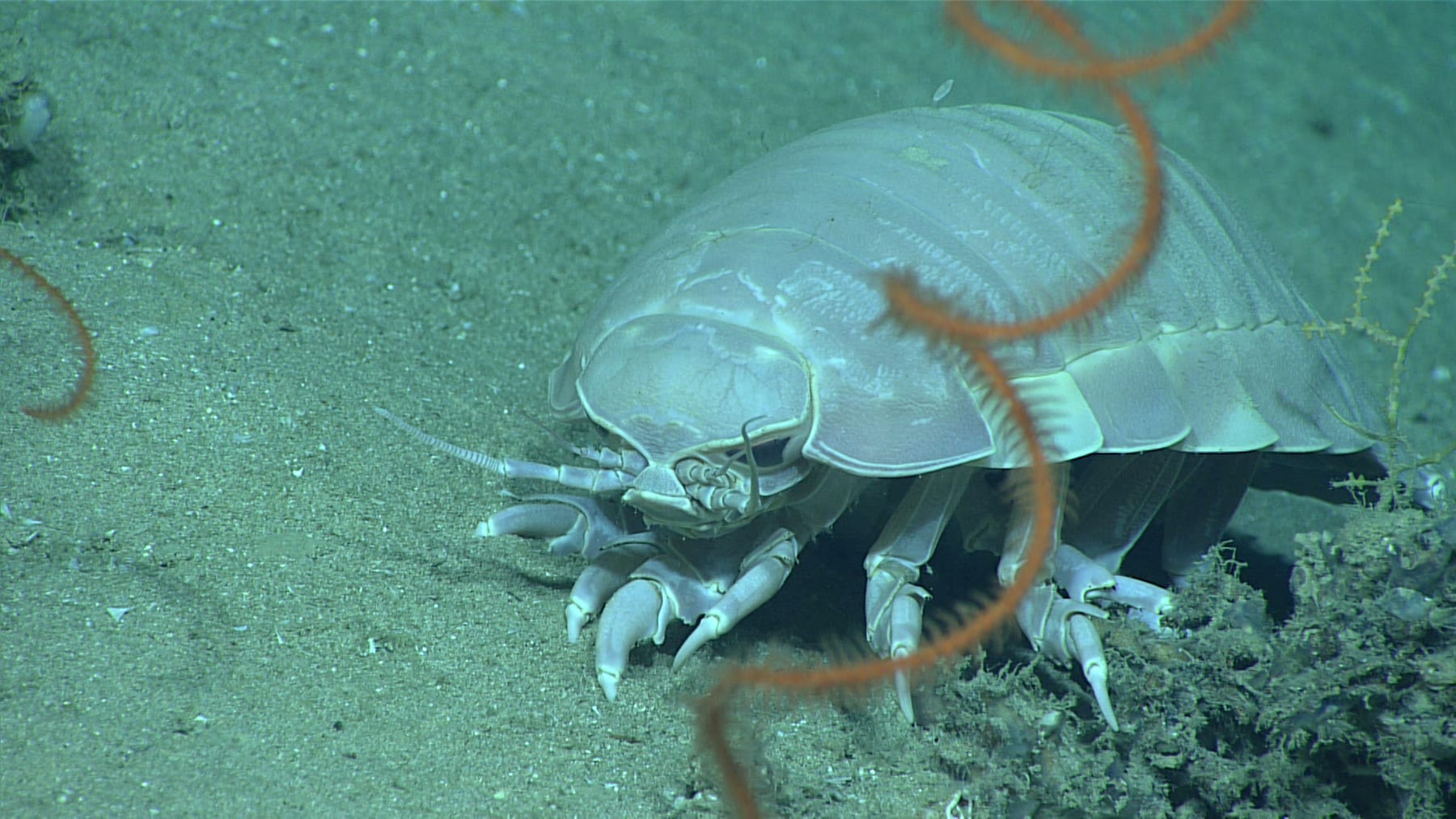
Photo: NOAA (public domain).
Nothing grows down there, so almost everything eats what falls from above. This constant drizzle of dead plankton, faecal matter, and fragments is called marine snow, and it is the entire food supply for most of the deep sea.
The giant isopod is a crustacean related to the woodlouse, reaching 50 centimeters, and it demonstrates deep-sea gigantism: the tendency for animals here to grow far larger than shallow-water relatives, probably because cold slows metabolism and food is too unpredictable to waste on rapid growth. One specimen in a Japanese aquarium famously refused food for five years and stayed healthy.
Occasionally a whale dies and sinks. The sperm whale is the deepest-diving of the toothed whales, routinely working past 1,000 meters to hunt squid, and it is one of the few animals that crosses between the lit ocean and this one. A whale fall delivers decades of food to one spot and creates an entire temporary ecosystem, passing through distinct successional stages as scavengers, then bone-eating worms, then bacterial mats work through the carcass over 50 years or more.
The ones that make their own light
Bioluminescence is not a curiosity in the deep sea, it is the norm. Estimates suggest that around 75% of animals below 200 meters produce light, which makes it one of the most common traits in the animal kingdom rather than an oddity.
It does several jobs at once. A lure attracts prey. A sudden flash startles a predator. Light on the underside of a body cancels the silhouette against faint light from above, which is called counter-illumination. And some species eject glowing clouds as a decoy, the deep-sea equivalent of ink.
The dumbo octopus does not use light at all. It lives deeper than any other octopus, past 4,000 meters, and swims by flapping two ear-like fins, feeding on worms and crustaceans it swallows whole.
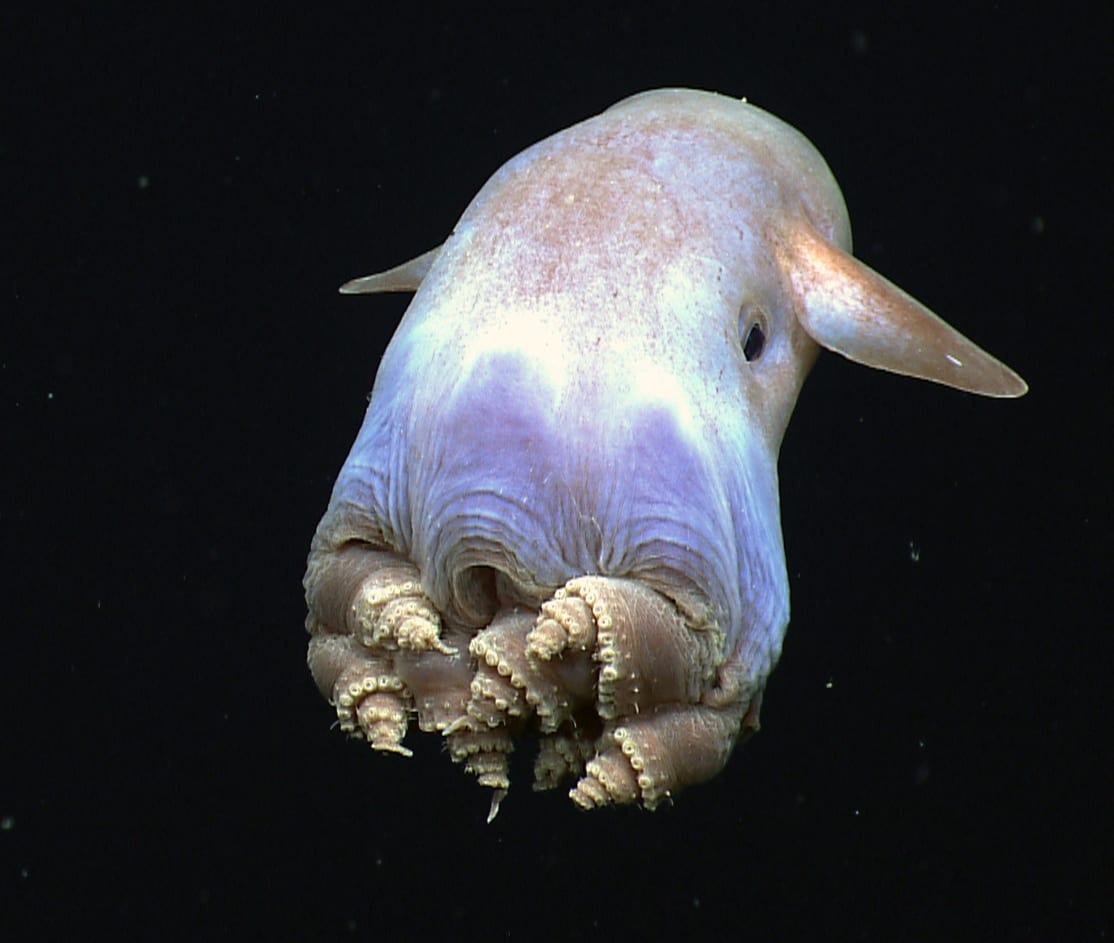
Photo: NOAA Okeanos Explorer (public domain).
The coelacanth is a lobe-finned fish that was assumed extinct for 65 million years until one was landed off South Africa in 1938. It lives in deep caves along continental slopes, and it is Critically Endangered.
The vampire squid is neither a squid nor a vampire. It lives in oxygen minimum zones where almost nothing else can, has the largest eyes relative to body size of any animal, and eats marine snow rather than hunting.
The ones that do not need the sun at all
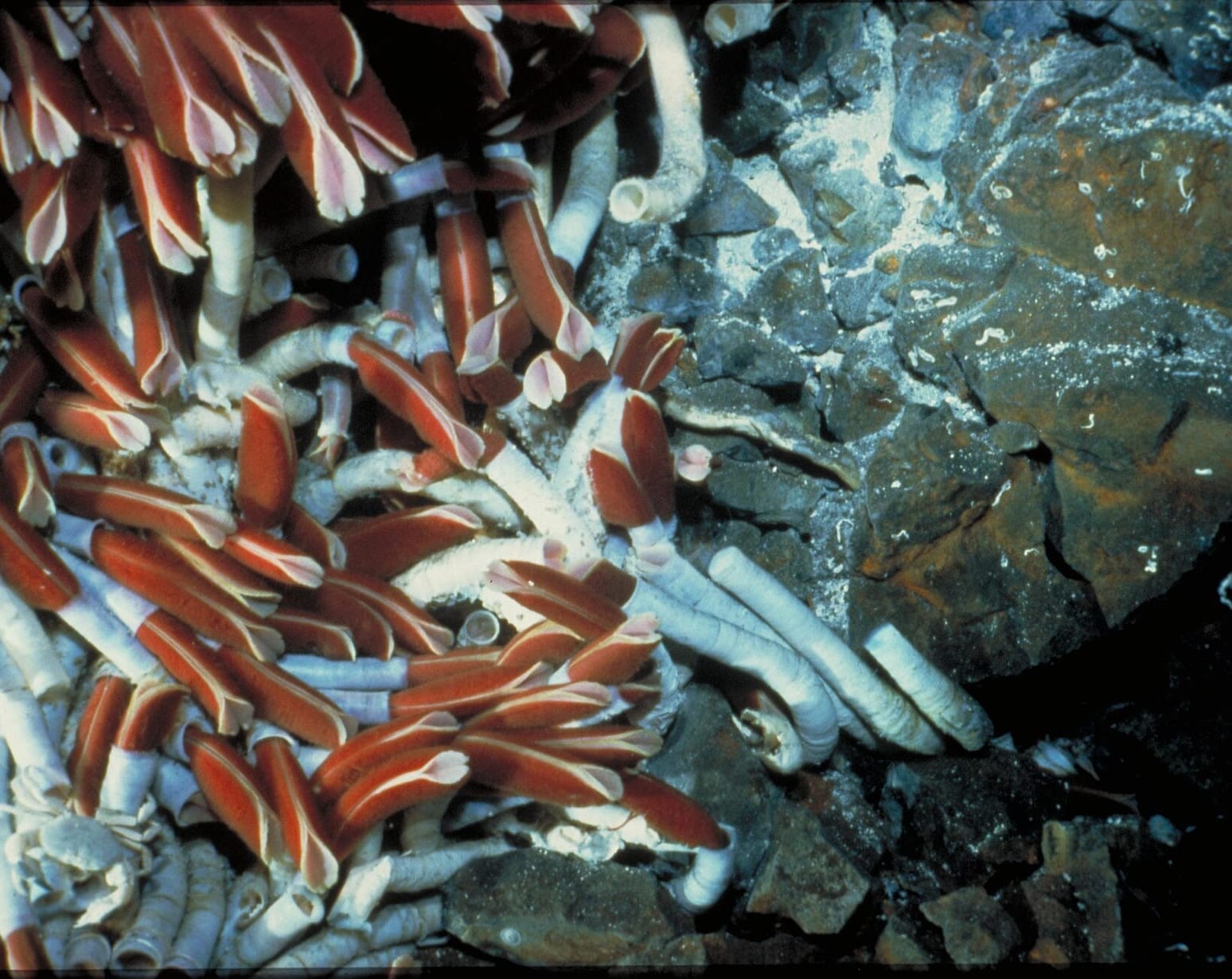
Photo: Ifremer, CC BY 4.0.
This is the discovery that changed biology. In 1977 a submersible at the Galápagos Rift found hydrothermal vents surrounded by dense animal communities, in total darkness, thousands of meters down.
They were not living on marine snow. Bacteria there use chemosynthesis, drawing energy from hydrogen sulfide venting out of the seafloor, and everything else feeds on the bacteria. It was the first ecosystem found on Earth that does not ultimately depend on sunlight.
The giant tube worm grows to over two meters, has no mouth, no gut, and no anus. It houses billions of symbiotic bacteria in an internal organ and absorbs the chemicals they need through a plume of red gills. It grows faster than almost any marine invertebrate known.
The yeti crab farms bacteria on hairy claws, waving them through vent fluid to help the colony grow, then eating them.
What we are doing to a place we have barely seen
The deep sea is remote enough to feel safe, and it is not.
Deep-sea trawling drags weighted nets across seabed, flattening cold-water coral that can be thousands of years old and does not regrow on any human timescale.
Deep-sea mining targets polymetallic nodules on the abyssal plain for the metals in them. Those nodules take millions of years to form and are the hard surface a whole community grows on, and the sediment plumes from mining spread far beyond the mined area. The International Seabed Authority is still writing the rules, and several states have called for a moratorium until the ecology is better understood.
Plastic. A plastic bag was filmed at the bottom of the Mariana Trench, and amphipods from the deepest trenches carry microplastics in their guts. Persistent industrial pollutants banned decades ago turn up in those same animals at concentrations comparable to some of the most polluted rivers on Earth, because the deep sea is where everything eventually settles.
Fishing moving deeper. As shallow stocks are exhausted, fleets have moved to species like orange roughy, which lives past 1,000 meters, matures at around 30 years old, and can live over 150. A population of an animal like that is closer to a mineral deposit than a renewable resource, and several were fished to collapse within a decade of being found.
Warming and acidification. Deep water is warming and absorbing carbon dioxide, which dissolves the shells and skeletons of calcifying animals.
The Monterey Bay Aquarium Research Institute has done more than anyone to film these animals alive rather than examine them dead in nets, which is how most early descriptions were made and why so many older drawings look mangled.
The part that should be uncomfortable
We are making decisions about mining an ecosystem we have not finished discovering. Most deep-sea species encountered on a given expedition are new to science. The vent communities that rewrote our understanding of where life is possible were found less than 50 years ago.