18 types of penguins, and almost none live where you think
There are 18 types of penguins, and the mental image most people hold, a bird standing on Antarctic sea ice in a blizzard, describes exactly two of them. There are none at all at the other pole.
The rest live in temperate water, on rocky coasts, in burrows, in forests, and in one case on the equator. Penguins are a Southern Hemisphere group defined by cold currents rather than by ice, and once you sort them by where they actually breed, the group makes far more sense.
The two that really do live on the ice
The emperor penguin is the largest, at up to 1.2 meters and 40 kilograms, and it is the only bird that breeds through the Antarctic winter. The female lays one egg and leaves. The male balances it on his feet under a fold of skin for around 65 days in darkness and temperatures below minus 40, eating nothing, losing close to half his body weight, huddling with thousands of other males in a formation that rotates so each bird takes a turn on the cold outside edge.
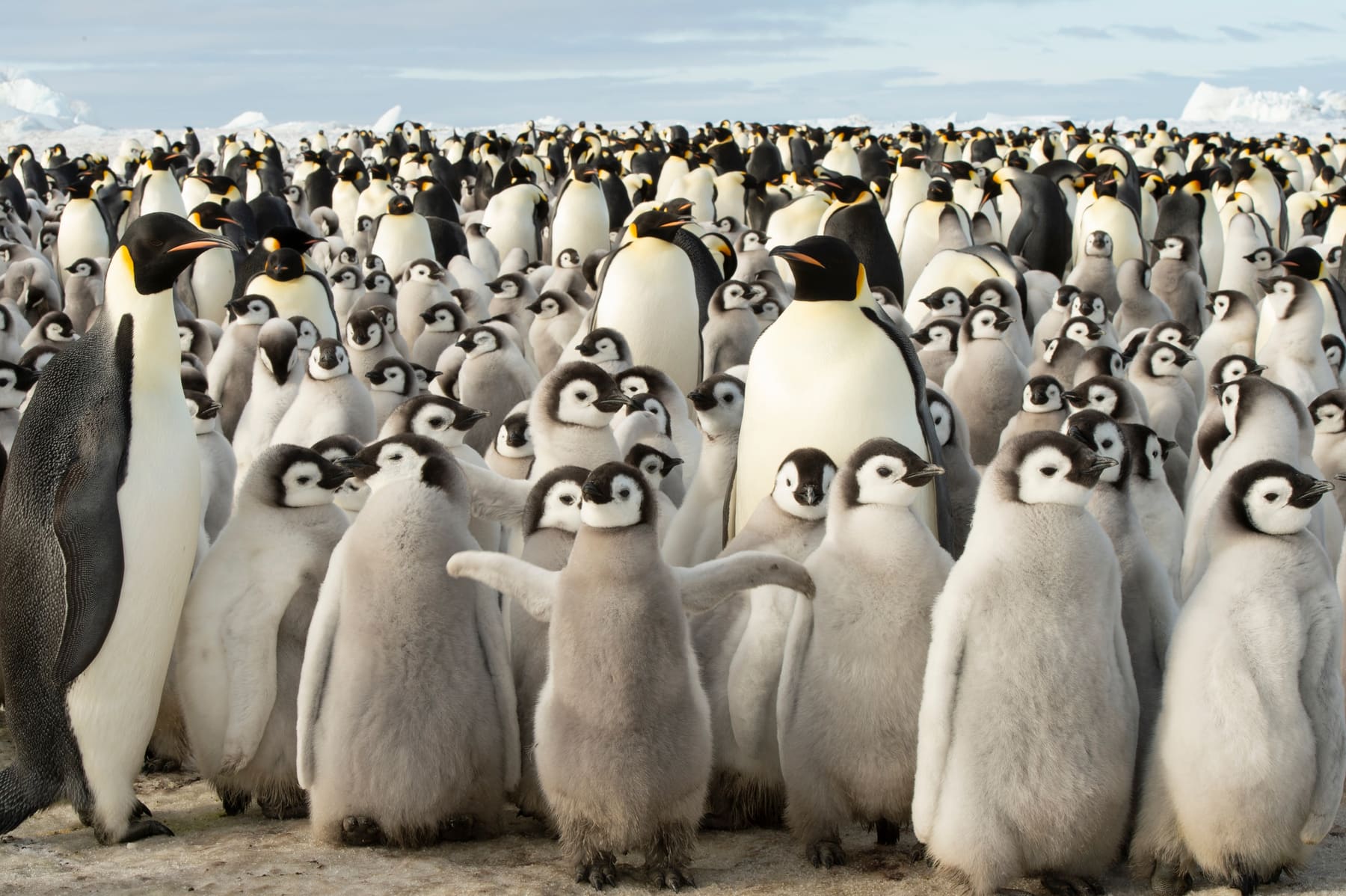
It is Near Threatened and the threat is specific: emperors breed on fast ice attached to the shore, and if that ice breaks up before the chicks have waterproof feathers, an entire colony's chicks drown in a season. That has already been recorded in several colonies.
The Adélie penguin is the other true ice bird, smaller and more numerous, and it is doing well in some parts of Antarctica and poorly in others depending entirely on what the local sea ice is doing.
The sub-Antarctic islands: the biggest colonies
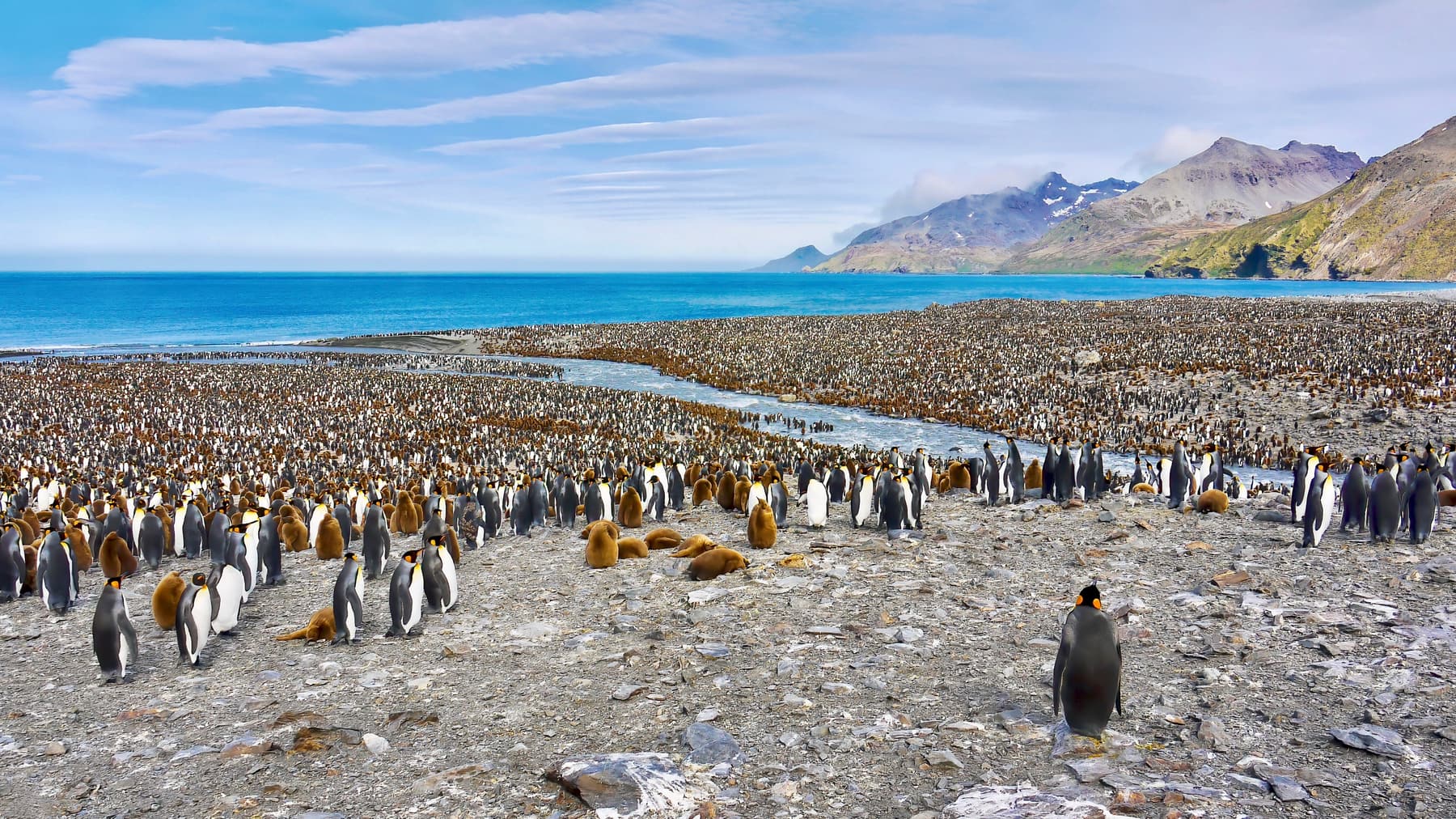
The king penguin is the second largest and breeds on sub-Antarctic islands like South Georgia and the Crozets, in colonies that run to hundreds of thousands of birds. It takes over a year to raise a chick, which means kings breed twice every three years rather than annually, and colonies contain birds at every stage at once.
King penguin chicks are covered in thick brown down and were described by early sailors as a separate species entirely, the "woolly penguin".
Penguins are also the group most often described as mating for life, and for most species that reputation is stronger than the evidence behind it.
Gentoo penguins are the fastest swimming birds alive at around 35 kilometers per hour. Chinstrap penguins are named for the thin black line under the chin and nest on some of the most inhospitable volcanic slopes in the region. Macaroni penguins have orange crest feathers and are among the most numerous penguins on Earth, which does not stop them being Vulnerable.
The temperate and tropical types of penguins
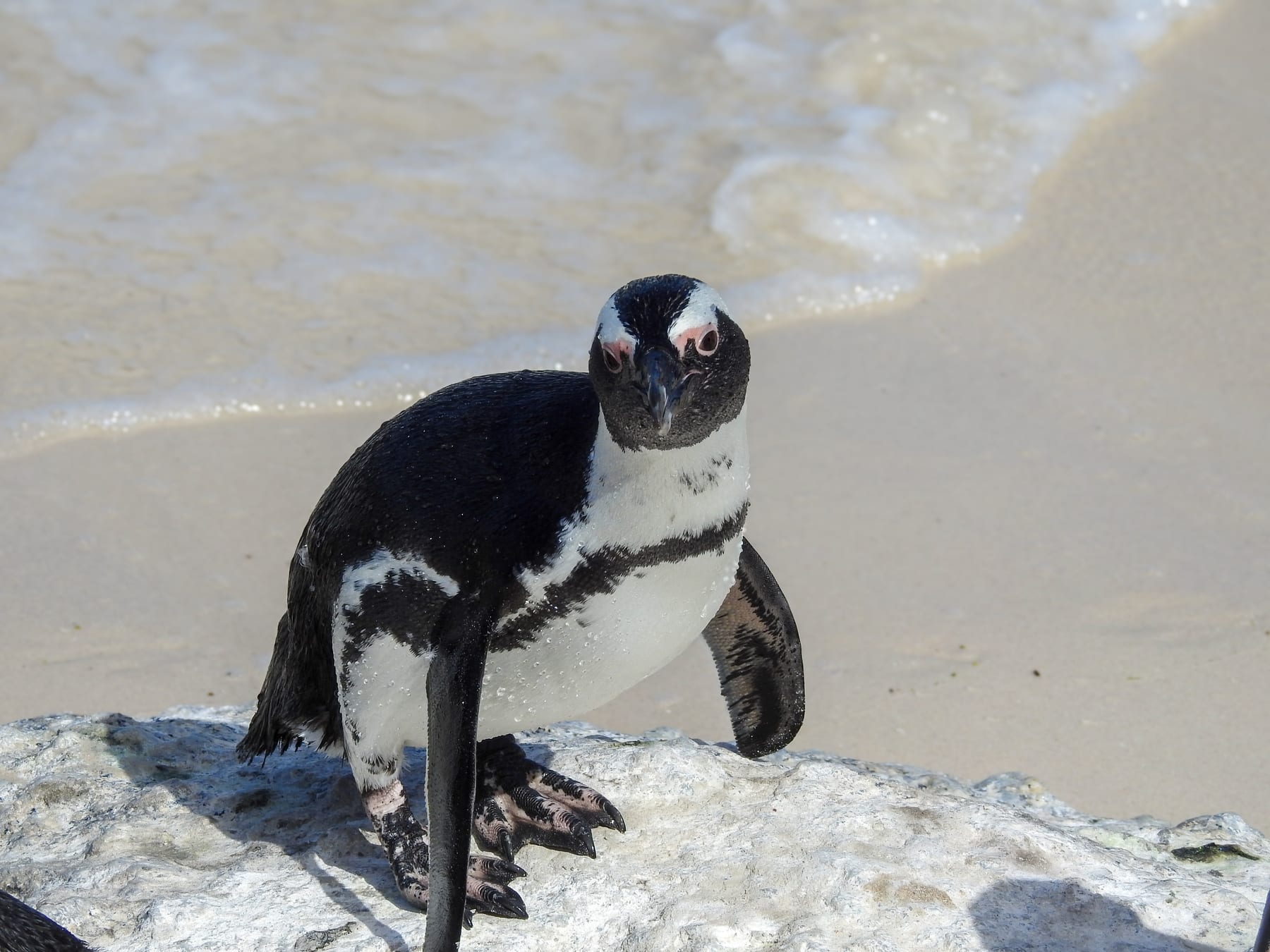
This is the group most people do not know exists.
The African penguin breeds on the coast of South Africa and Namibia, including a beach in a Cape Town suburb. It is Endangered and its problem is food. Commercial purse-seine fishing has taken the sardines and anchovies it depends on, and the population has fallen by more than 95% over the last century. The birds are not being hunted. They are starving.
The Humboldt and Magellanic penguins nest along the coasts of Peru, Chile, and Argentina, in burrows they dig into guano or soil. The little penguin of Australia and New Zealand is the smallest at around 30 centimeters, and comes ashore after dark in groups.
The yellow-eyed penguin of New Zealand nests in coastal forest, alone rather than in colonies, and is one of the rarest penguins alive.
The Galápagos penguin breeds on the equator, kept alive by the cold Humboldt Current, and is the northernmost penguin on Earth. There may be fewer than 1,200 of them, which makes it the rarest species in the group.
The crested penguins nobody can tell apart
Seven of the 18 species belong to one genus, Eudyptes, and they are the ones field guides spend the most pages on because they all have yellow head plumes and differ mainly in where the plumes start.
The rockhopper is the smallest and the most aggressive, and it climbs cliffs by jumping rather than by using the gentler routes other penguins take. The Fiordland and Snares penguins breed in New Zealand temperate rainforest. The erect-crested and royal penguins breed on a handful of remote islands and almost nowhere else, which is the whole of their risk profile in one sentence.
Most crested penguins lay two eggs of noticeably different sizes and almost always raise only the chick from the larger one. Nobody has fully explained why the smaller egg is laid at all.
Why penguins swim rather than fly
A penguin wing is a stiff flipper with fused joints, and a swimming penguin is doing something mechanically close to flying, generating lift on both the upstroke and the downstroke. Most birds only generate lift on the downstroke.
The reason none of them fly in air is straightforward. A wing efficient in water, which is roughly 800 times denser than air, is far too small and stiff to work in air. Modeling suggests a bird cannot be good at both, and every penguin ancestor that traded flight for diving got better food access in return. Our guide to flightless birds covers where that trade shows up elsewhere.
The results are extreme. An emperor penguin dives beyond 500 meters and stays under for over 20 minutes, with solid bones rather than the hollow ones flight requires, and the ability to shut down blood flow to non-essential organs.
Which types of penguins are in the most trouble
Roughly two thirds of penguin species are threatened, which is a worse share than almost any other bird family, and the causes cluster in the ocean rather than on land.
Fisheries taking their food. Penguins compete directly with industrial fishing for the same small schooling fish much of the ocean runs on. This is the African penguin's problem and it is increasingly everyone's. Penguins feed on small schooling fish that are also the target of industrial fishing for fishmeal.
Sea ice change. For emperors and Adélies the ice is the nest site. Too little and the colony fails; the timing matters more than the average.
Warming water moving prey. Krill and small fish shift with temperature. A penguin colony is fixed in place and its foraging range is not negotiable, so prey moving 100 kilometers offshore is the same as prey disappearing.
Introduced predators. Rats, cats, dogs, and stoats on breeding islands. This one is solvable, and island eradications have already turned around several colonies.
Oil spills. A single tanker grounding off South Africa in 2000 oiled around 19,000 African penguins, and roughly the same number again were relocated by hand before the slick reached them. Most survived, which was a remarkable operation and also a demonstration of how narrow the margin is.
The IUCN Red List holds the current assessments, BirdLife International coordinates the seabird work behind them, and SANCCOB in South Africa runs the rehabilitation that hand-rears abandoned African penguin chicks each season.
The thing worth remembering
Penguins are not an Antarctic story with a few exceptions. They are a cold-current story, and cold currents run up the west coast of South America and Africa into warm latitudes, which is why a penguin can stand on the equator.
That also means the group's fate is tied to what happens to those currents and to the fish in them, rather than to ice alone. The species in the worst trouble, the African and the Galápagos, are the two furthest from any ice at all.