Alligator or crocodile? There is a tell, and it is not size
There is exactly one place on Earth where you can see an alligator and a crocodile in the same water: the Everglades in southern Florida. Everywhere else, the alligator vs crocodile question answers itself by geography, because the two groups almost never overlap.
Both are crocodilians, an order that has been around for roughly 95 million years and looks much as it did when dinosaurs were still here. They are not, though, the same animal, and the differences are consistent enough that you can tell them apart from a photograph.
The snout is the reliable tell
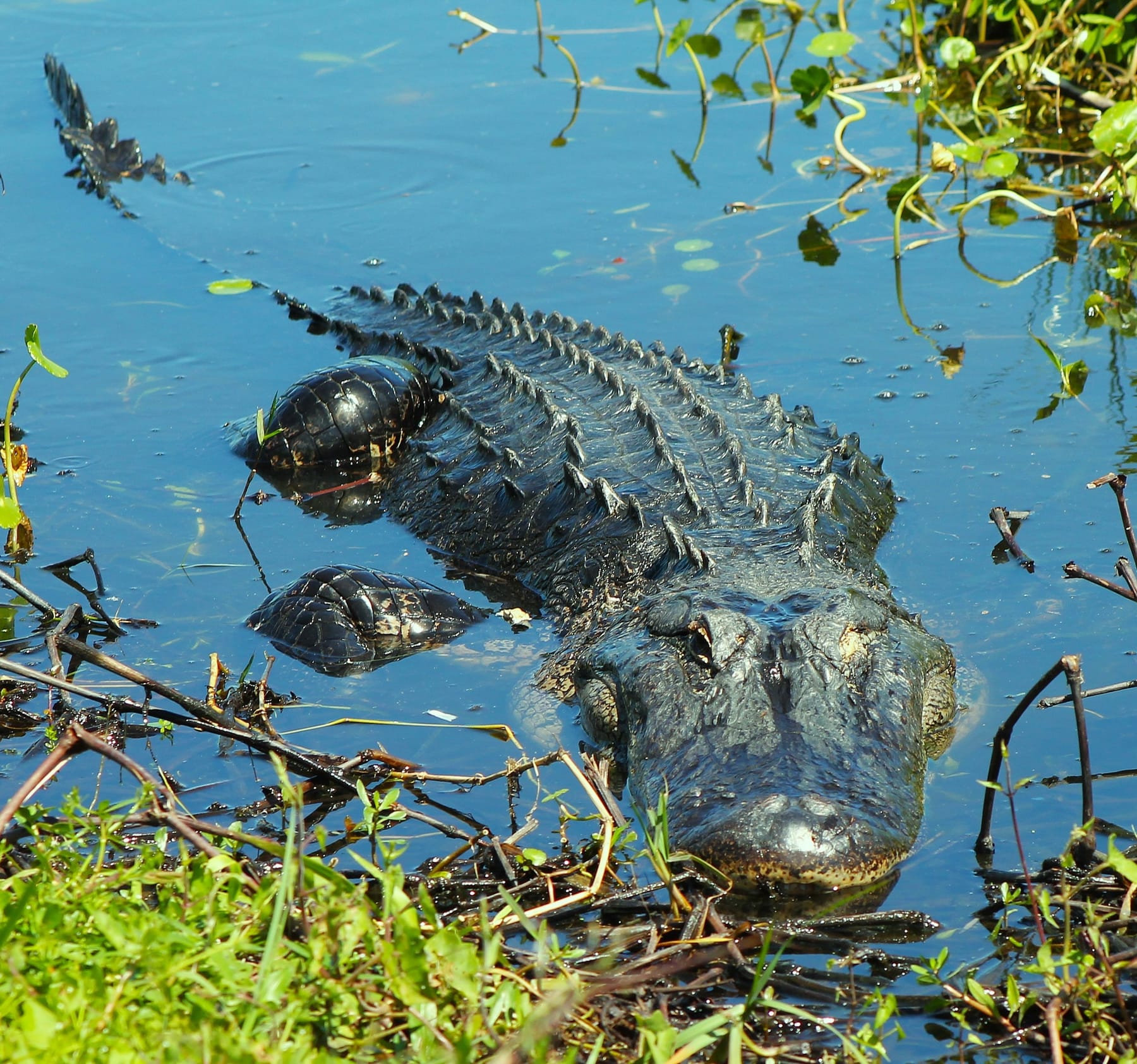
Look at the shape of the head from above.
An American alligator has a broad, rounded, U-shaped snout, built for the bite force needed to crush turtle shells. A saltwater crocodile has a narrower, more pointed V-shape, better suited to catching fish and grabbing large prey at the water's edge.
This holds across the families rather than just these two species, which is why it is the tell worth learning. There is one confusing exception: the mugger crocodile of South Asia has an unusually broad snout and looks alligator-like at a glance.
The teeth give it away when the mouth is closed
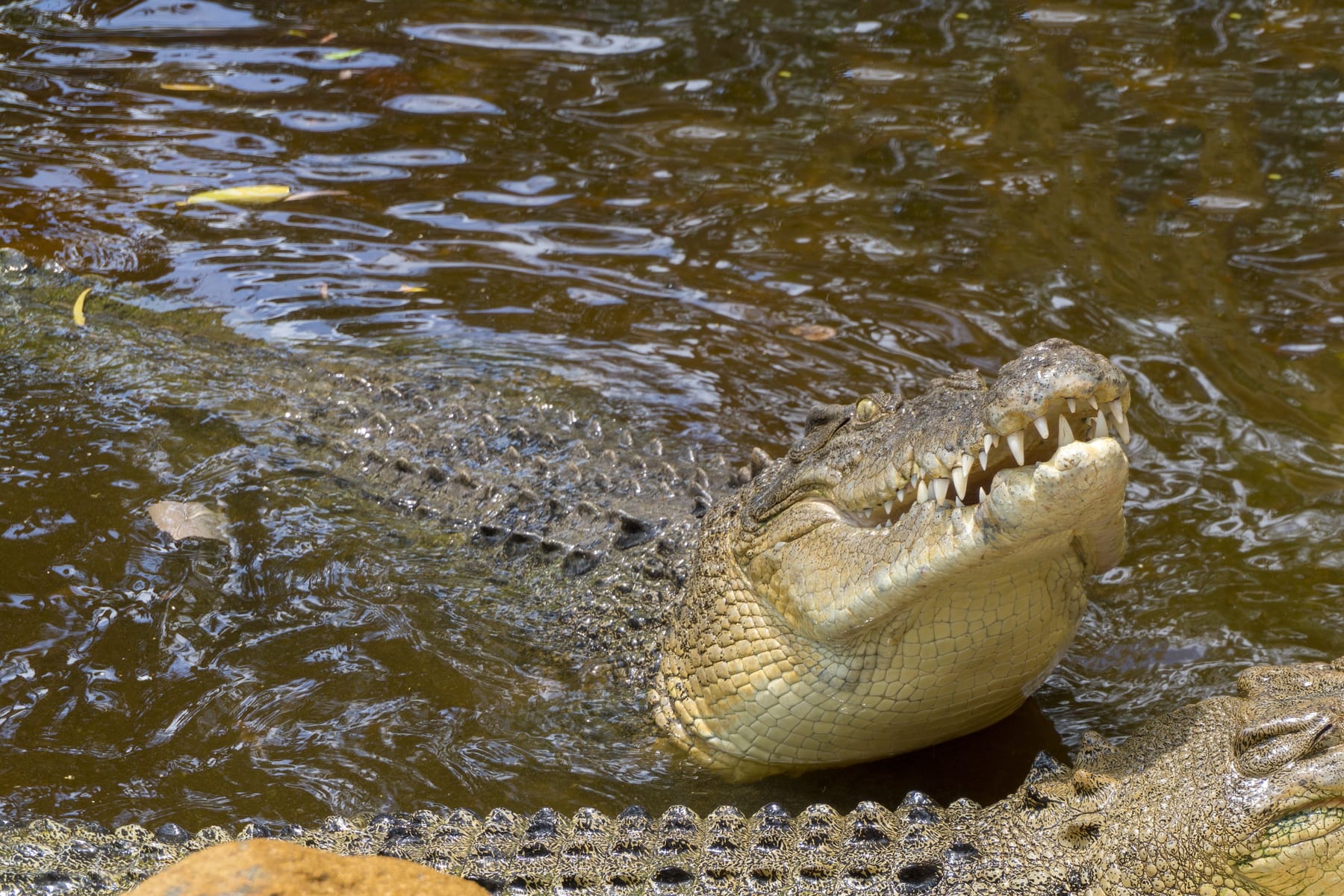
This is the difference most people can actually use in the field.
An alligator's upper jaw is wider than its lower jaw, so when the mouth closes, the upper jaw covers the bottom teeth completely. You see a fairly clean upper lip line.
A crocodile's jaws are closer to the same width, so when the mouth closes the large fourth tooth on each side of the lower jaw sticks up outside the snout, visible even at rest. If you can see a big lower tooth pointing up past the lip, you are looking at a crocodile.
Alligator vs crocodile at a glance
| Alligator | Crocodile | |
|---|---|---|
| Snout | Broad, rounded U | Narrower, pointed V |
| Teeth when closed | Lower teeth hidden | Fourth lower tooth visible |
| Salt tolerance | Freshwater only | Estuaries and open sea |
| Species | 2 | ~18 |
| Largest | ~4 m (American) | ~6 m (saltwater) |
| Range | US southeast, Yangtze | Africa, Asia, Australia, Americas |
Where alligators and crocodiles live
Geography settles most cases before you ever look at the animal.
Alligators exist in only two species. The American alligator lives in the southeastern United States, and the Chinese alligator survives in a small stretch of the lower Yangtze, where it is Critically Endangered on the IUCN Red List. That is the entire genus.
Crocodiles are far more widespread, with 18 or so species across Africa, Asia, Australia, and the Americas. The saltwater crocodile ranges from eastern India through Southeast Asia to northern Australia, and it genuinely does swim in the ocean, which is how it reached islands across that range.
So: if you are in Louisiana or Georgia, it is an alligator. In Australia, it is a crocodile. In Florida, look at the snout.
The Everglades overlap is genuinely unusual. The American crocodile reaches the southern tip of Florida at the very northern edge of its Caribbean range, and the American alligator reaches the same wetlands at the southern edge of its own. The two occupy the estuary differently, with crocodiles in the saltier coastal mangroves and alligators in the freshwater interior, so even here they mostly avoid each other. Everglades National Park is the only protected area where both are routinely seen.
Salt is the real dividing line
The habitat difference comes down to physiology rather than preference.
Crocodiles have functioning salt glands on their tongues that excrete excess salt, which lets them live in estuaries, mangroves, and open sea. Alligators have the same glands but they do not work well, so alligators are freshwater animals that can tolerate brackish water only for short periods.
That single difference explains most of the range map. It is also why the saltwater crocodile could colonize islands thousands of kilometers apart while alligators stayed put on two continents.
Size, speed, and temperament
Saltwater crocodiles are the largest living reptile. Males commonly exceed 5 meters and the largest verified individuals approach 6 meters and a metric ton. American alligators are substantial but smaller, with large males around 4 meters.
Both are ambush predators that can move faster over short distances than most people expect, and both are far quicker in water than on land. The often-repeated claim that crocodilians are more aggressive than alligators is broadly true of the saltwater crocodile and the Nile crocodile specifically, both of which account for attacks on people every year. It is not a useful generalization about crocodiles as a group, several of which are shy fish-eaters.
Neither should be approached, and neither is interested in you as food unless you are in the water.
One behavioral difference does hold up. Alligators are more tolerant of cold. The American alligator survives winter in North Carolina by entering a dormant state and can hold its snout above the surface as ice forms around it, a behavior called icing. No crocodile does this, which is part of why crocodilian ranges stop where they do.
Color, and why it is a weak tell
You will read that alligators are darker and crocodiles are lighter or more olive. This is roughly true and almost useless in practice. Crocodilian color varies with age, water chemistry, algae, and light. A muddy crocodile looks black. Use the snout and the teeth.
What this means for conservation
The alligator is one of the clearest recoveries in American conservation history. The American alligator was listed as endangered in 1967 after decades of hunting for hides, and it recovered so thoroughly that the US Fish and Wildlife Service removed it from the endangered list in 1987. It is now Least Concern.
Two things drove that. Hunting was regulated rather than merely discouraged, and the wetlands the species depends on were given protection at the same time. Neither would have worked alone: an alligator with legal protection and no marsh is still a dead alligator.
Crocodiles are a more mixed picture. The saltwater crocodile is also Least Concern, having recovered strongly in Australia after protection in the 1970s. But the family includes some of the most threatened reptiles alive. The gharial, a fish-eating crocodilian with a distinctive narrow snout, is Critically Endangered and largely confined to a few Indian river systems. The Chinese alligator is in similar trouble.
Crocodilians as a group are also more threatened than their reputation suggests. The IUCN Crocodile Specialist Group assesses the family, and roughly a third of its species are threatened, which is a higher share than most people would guess for animals widely regarded as thriving.
The pattern is worth noting, because it is the same one that shows up across conservation. The crocodilians that recovered are the ones that got specific legal protection, enforcement, and time. Where that did not happen, the numbers did not move.
Both of the species in this comparison came back. That is the useful thing to take from an alligator vs crocodile question: these animals respond to protection when somebody funds it, which is the argument our guide to what wildlife conservation is actually for makes at greater length.
Both also depend on a habitat that is disappearing faster than forest, and our guide to wetland animals covers the marsh and floodplain species that go with them, including the gharial, which had no recovery at all.
The other reptile pair people ask about goes the opposite way on that measure. Turtles and tortoises are, as a group, among the most threatened vertebrates on Earth, and unlike the crocodilians they have not had the recovery.