What is the goal of wildlife conservation?
The goal of wildlife conservation is to keep wild populations large enough, genetically diverse enough, and connected enough to persist without permanent human management.
That sentence does a lot of work, and each part of it rules something out. It is not the same as saving individual animals. It is not the same as protecting scenery. And it is not an attempt to freeze ecosystems in whatever state we found them in, which is neither possible nor desirable.
Why the unit is the population, not the animal
A rescued animal returned to the wild is a good outcome for that animal. It changes very little for the species unless the population it rejoins is viable. Which interventions actually deliver that is a question with a clear evidence ranking.
Viability is a numbers problem. Below a certain size, a population starts losing genetic diversity faster than mutation can replace it. Close relatives breed, harmful recessive traits surface, disease resistance narrows, and fertility drops. The population can then decline even when the original threat is removed, which is the trap the Sumatran rhinoceros is in now. Poaching is no longer the main problem for that species. Fewer than 50 animals scattered across fragmented forest, unable to find each other, is the problem.
This is why conservationists talk about hectares and corridors rather than rescues. A wildlife corridor connecting two reserves does something no amount of individual care can do: it makes two small populations behave like one larger one.
The four things conservation work actually consists of
Protecting habitat, which is the only intervention that helps every species in a place at once, including the ones nobody has assessed.
Removing the specific threat. Threats are particular, not general. The vaquita is dying in gillnets set for a different fish. The Christmas Island shrew was killed by a parasite carried by introduced rats. "Habitat loss" as a catch-all explanation hides the actual mechanism, and you cannot fix a mechanism you have not named.
Restoring numbers and diversity through breeding, translocation, and reintroduction. This is the most visible work and usually the last resort, because it means the population can no longer recover on its own.
Making conservation pay for the people who live there. Community conservancies give people who share a landscape with wildlife a financial stake in it. This is the least photogenic item on the list and it is frequently the one that determines whether the other three hold.
How conservation measures itself
The IUCN Red List categories are the shared vocabulary, and they describe risk of extinction rather than population size or how much anyone cares.
Least Concern, Near Threatened, Vulnerable, Endangered, Critically Endangered, Extinct in the Wild, Extinct. A species moves between them based on criteria including population size, rate of decline, and how restricted its range is. This is why a species with 100,000 individuals can be listed as Endangered while one with 3,000 is Least Concern. The Bornean orangutan numbers over 100,000 and is Critically Endangered, because the trend and the rate of loss are what the assessment measures.
Reading the list this way changes what a listing tells you. Critically Endangered is not a statement that a species is rare. It is a statement about the slope.
In the wild, or in a facility
Conservation splits into two settings, and the distinction determines what a donation buys.
In situ work happens where the animals live: protecting habitat, funding rangers, removing snares, restoring corridors. It is the primary approach, because a protected landscape carries every species in it.
Ex situ work happens in captivity: breeding programs, seed banks, frozen tissue collections, rescue centers. It is a backstop for cases where the wild population can no longer sustain itself, and its purpose is release. A breeding program with no plan to put animals back is a collection.
The California condor shows both working together. Every surviving bird was taken into captivity in 1987, bred, and released, and the released population still depends on in situ work managing lead in carcasses. Ex situ bought the time. In situ is what determines whether the birds stay.
Why some species get more attention
Not every species carries the same ecological weight, and conservationists are fairly open about this.
A keystone species has an effect on its ecosystem out of proportion to its abundance. Sea otters are the textbook case: they eat sea urchins, urchins eat kelp, and where otters disappear the kelp forest goes with them, along with everything that lived in it. Protecting the otter protects a system.
That logic is genuinely useful and it has a failure mode. Funding follows large mammals, so amphibians, invertebrates, and plants are chronically underassessed and underfunded, even though they represent most of life on Earth. The cone snail that went extinct in 2025 got a fraction of the attention a mammal would have.
What conservation success actually looks like
Success is a species you stop having to think about.
The green sea turtle moved from Endangered to Least Concern on the IUCN Red List in October 2025, a change NOAA Fisheries tracks through its nesting counts, after a global population increase of roughly 28% since the 1970s. Nothing clever produced that. Countries banned egg and adult harvest, organizations protected nesting beaches season after season, and fisheries adopted gear that lets turtles escape nets.
Green turtles take decades to reach breeding age, so the recovery announced in 2025 reflects beaches protected in the 1980s and 1990s by people who could not yet know it was working. That lag is the defining feature of conservation work and the reason it is hard to fund. The results arrive long after the budget cycle that paid for them.
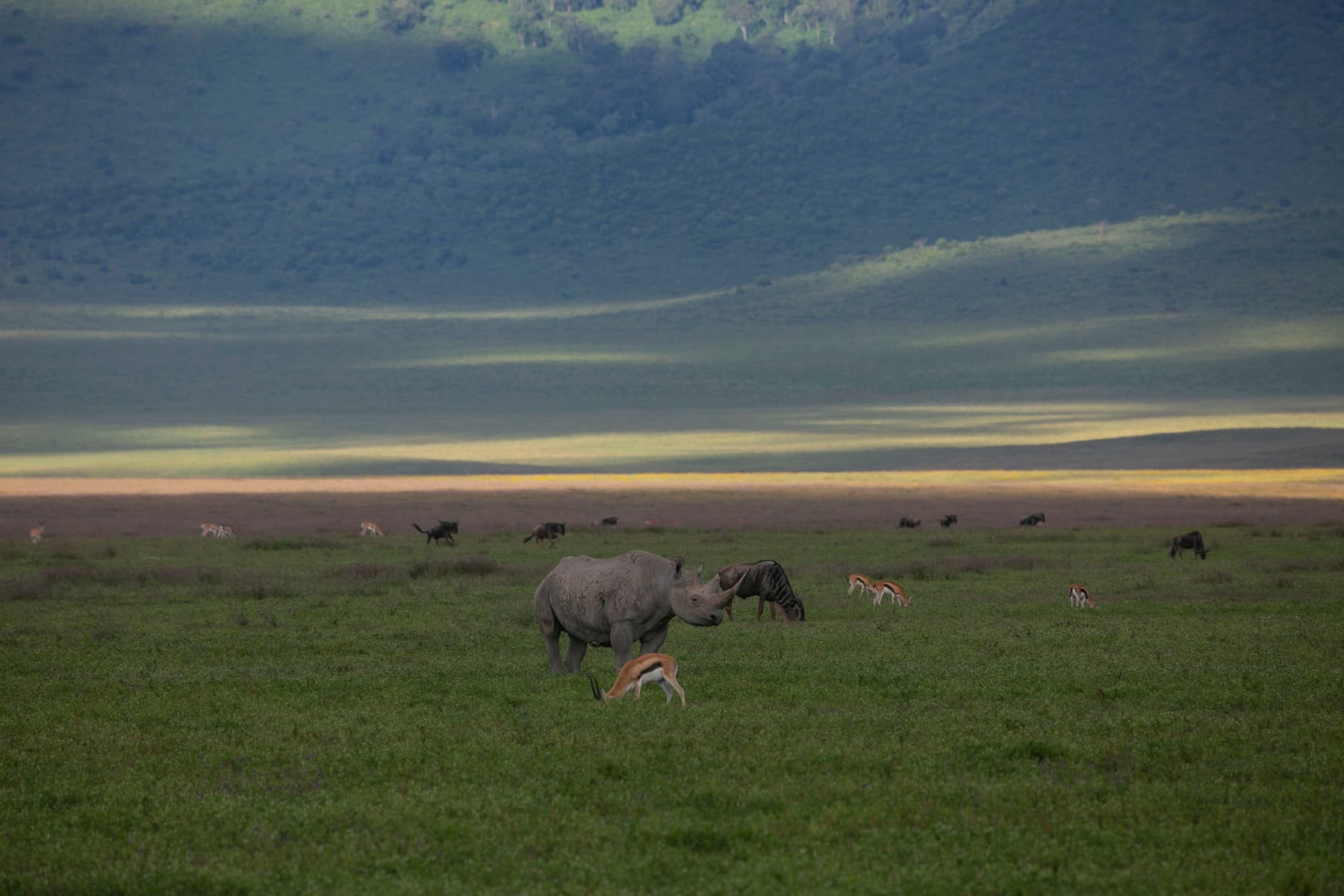
The black rhinoceros tells the same story in a different landscape. The population bottomed out near 2,400 animals in 1995 after poaching removed roughly 96% of the species, and it has since more than doubled through armed protection, translocation, and community conservancies, work the International Rhino Foundation helps fund.
Where conservation is not the same as animal welfare
These two goals overlap most of the time and occasionally point in opposite directions, and it is worth being straightforward about that.
Animal welfare is concerned with the experience of individual animals. Conservation is concerned with the persistence of populations. A sanctuary caring for a permanently injured elephant that will never be released is doing welfare work, and that work is worth funding on its own terms. It is not, strictly, conservation. The distinction matters when you are choosing where to give, which is why our guide to ethical elephant sanctuaries in Thailand separates venues caring for elephants that cannot be released from those selling contact with them.
Most organizations do both. Sheldrick Wildlife Trust hand-raises orphaned elephants, which is welfare, and reintegrates them into wild herds while running anti-poaching operations, which is conservation. Recognizing the difference helps you understand what your money is actually buying rather than assuming every animal charity does the same thing.
The part that is not a science problem
The ten in the worst shape illustrate the range: some need habitat, some need enforcement, and one needs a fishery closed. There are more than 48,000 species currently threatened with extinction on the IUCN Red List. For most of them, we already know what the threat is and what would reduce it. The missing input is rarely knowledge. It is sustained funding reaching the organizations positioned to act, which is why IUCN frames the Red List as a tool for setting funding priorities rather than as a scoreboard.
That is the specific gap Wildlife Connect exists to close. Every organization in our directory of projects lists where it works, which species it works with, and how to support it, so that the distance between caring about a species and funding the people protecting it is as short as we can make it.