What actually separates a turtle from a tortoise
Every tortoise is a turtle. Not every turtle is a tortoise. That is the short answer to turtle vs tortoise, and it is the part that trips people up.
"Turtle" is the name for the whole order Testudines, roughly 360 species of shelled reptiles. Tortoises are one family within it, the Testudinidae, which live entirely on land. So the question is not really turtle versus tortoise. It is whether a particular turtle is a tortoise or one of the aquatic kinds.
Two features settle it immediately.
Look at the feet
This is the fastest reliable check.
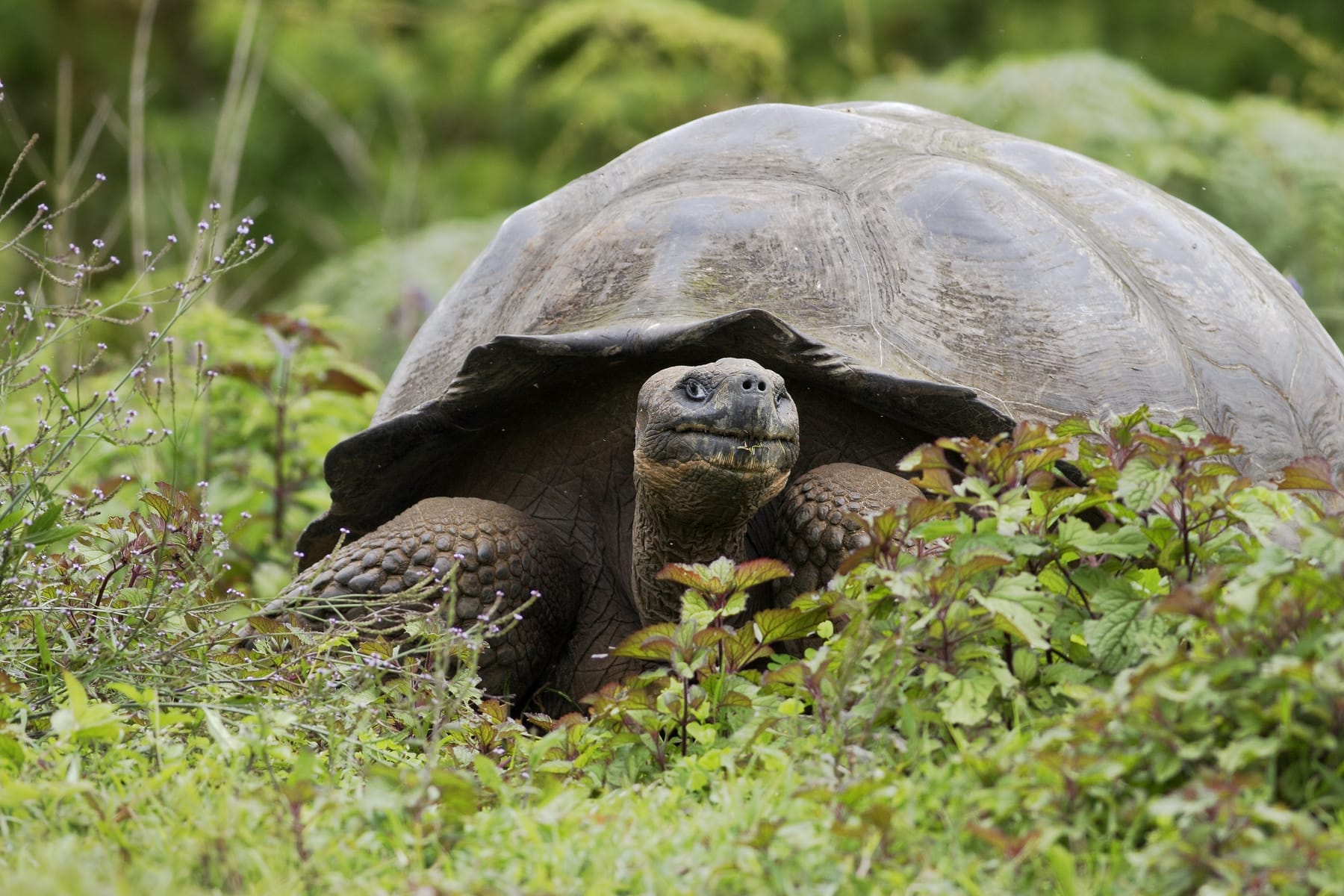
A tortoise has stumpy, round, elephantine feet with short claws, built for walking and digging. No webbing at all.
A sea turtle has flippers. The green sea turtle and the hawksbill turtle both have long paddle-like forelimbs they use to fly through water, and they cannot retract them.
A freshwater turtle, the third group people forget, has webbed feet with distinct claws, which suit both swimming and clambering onto a log.
Feet tell you the habitat, and habitat is the whole difference.
Then look at the shell
The same logic sorts the other reptile pair people confuse, where snout shape rather than shell does the work.
A tortoise shell is domed and heavy, a fortress. It works because a land animal can afford the weight and needs the protection from predators that bite.
A sea turtle shell is flat and streamlined, closer to a wing than a shield. Weight is expensive in water and hydrodynamics matter more than armor, which is why an adult sea turtle's main predator is a shark big enough not to care.
There is a trade-off buried in this. Most tortoises can pull the head and limbs fully inside the shell. No sea turtle can. The flippers do not retract, and the head only partly does, which is one reason sea turtles are so vulnerable to predators as hatchlings and to boat strikes as adults.
Turtle vs tortoise at a glance
| Tortoise | Sea turtle | |
|---|---|---|
| Feet | Stumpy, clawed | Flippers |
| Shell | High-domed, heavy | Flat, streamlined |
| Retracts into shell | Yes | No |
| Habitat | Land only | Ocean |
| Diet | Almost entirely plants | Varies by species |
| Eggs | Buried on land | Buried on land |
| Lifespan | Often 80 to 150 years | 50 to 100 years |
Diet
Tortoises are overwhelmingly herbivores, grazing grasses, leaves, flowers, and fruit. A few take carrion opportunistically, but plants are the rule.
Sea turtles are far more varied, and the variation is ecologically important. Green sea turtles graze seagrass and algae as adults. The hawksbill turtle eats sponges, which keeps reefs structurally diverse. The leatherback turtle eats almost nothing but jellyfish, which is precisely why floating plastic bags kill so many of them. The loggerhead crushes hard-shelled prey like crabs and conch.
Knowing which turtle you are looking at tells you what it is doing to the ecosystem around it.
The one thing turtles and tortoises share
Both lay eggs on land, in a buried nest, and both leave.
This is not a small point. It is the reason sea turtles remain vulnerable despite spending their lives in the ocean: every female must haul herself onto a beach to nest, which is the one moment in the life cycle when a marine animal is exposed, findable, and killable. Nearly all sea turtle conservation happens on beaches for this reason.
Both also have temperature-dependent sex determination. The temperature of the sand decides whether the eggs become male or female, warmer sand producing more females. That makes both groups unusually exposed to a warming climate, because a nesting beach can start producing almost entirely one sex.
What about terrapins
A third word turns up in this question, and it means different things depending on where you are.
In British usage, a terrapin is a small freshwater turtle. In American usage it usually refers specifically to the diamondback terrapin, a species of brackish coastal marshes. Neither is a separate biological group. A terrapin is a turtle, in the same way a tortoise is a turtle.
The useful three-way split is habitat: tortoises on land, sea turtles in the ocean, and freshwater turtles in rivers, ponds, and marshes. Everything else is regional vocabulary, and NOAA Fisheries uses the habitat split rather than the common names for exactly this reason.
Lifespan
Tortoises are the longest-lived land vertebrates. The Galapagos tortoise commonly passes 100 years and the record holders exceeded 175. Sea turtles are long-lived too, at 50 to 100 years depending on species, but they mature slowly, often taking 20 to 30 years to breed.
Tortoise longevity has a practical consequence that is easy to miss: a tortoise bought as a pet will very likely outlive the person who bought it. Rehoming long-lived tortoises is a persistent and growing burden on rescue centers.
That slow maturity is the hidden problem in sea turtle conservation. A beach protected today produces results decades later, which is exactly what happened with the green sea turtle: its global population rose roughly 28% since the 1970s and the IUCN moved it from Endangered to Least Concern in October 2025, on the strength of beaches protected in the 1980s and 1990s.
Why the confusion persists
The vocabulary is genuinely inconsistent, and that is nobody's fault in particular.
American English tends to use turtle as the catch-all and reserves tortoise for the land species, which matches the biology reasonably well. British English often uses turtle for the sea species only, tortoise for land, and terrapin for freshwater, which splits one group into three names and makes the nesting relationship invisible.
Neither usage is wrong, but the American one causes fewer errors, because it reflects the actual structure: tortoises are a branch of the turtle family tree rather than a separate thing standing beside it. If you remember only one sentence from this comparison, make it the first one. Every tortoise is a turtle.
The conservation picture is very different
This is where the comparison stops being trivia.
Sea turtles are threatened by fisheries bycatch, the loss of nesting beaches to coastal development, plastic, and in some regions continued harvest of eggs and adults. Six of the seven species are threatened, and the hawksbill is Critically Endangered largely because of the tortoiseshell trade, banned by CITES in 1977 and still not eliminated. SEE Turtles, Oceanic Society, and the Tortuguero program in Costa Rica all run the nesting-beach work that produces the recoveries.
Tortoises face a different set of problems: habitat loss, collection for the pet trade, and on islands, introduced rats, goats, and pigs that eat eggs and strip vegetation. Island tortoises have been hit hardest, and the IUCN Tortoise and Freshwater Turtle Specialist Group considers turtles and tortoises among the most threatened vertebrate groups on Earth, more so than birds or mammals.
The difference that actually decides their futures
One more difference matters more than any of the anatomy, and it is about us.
A tortoise can be kept alive in a garden for a century, which is why so many end up in private hands and why rescue centers are permanently full of animals that outlive their owners. A sea turtle cannot be kept at all, so its entire conservation effort has to happen on a beach at night, during the few hours a year the animal is reachable.
Two closely related groups, and almost nothing about protecting one transfers to the other. That is the fact worth carrying away from a turtle vs tortoise question: the group as a whole is in more trouble than almost any other, it gets a fraction of the attention large mammals receive, and the two halves of it need completely different work.