What happens to 6 Arctic animals when the ice goes
Arctic animals share a problem no other group faces in quite the same way. The habitat itself is seasonal, and it holds no penguins at all: all 18 penguin species live in the other hemisphere. Sea ice forms, holds for a few months, and breaks up, and the animals that depend on it have to fit an entire year of hunting, breeding, and fattening into that window.
The window is getting shorter. That single fact explains most of what follows.
Polar bear
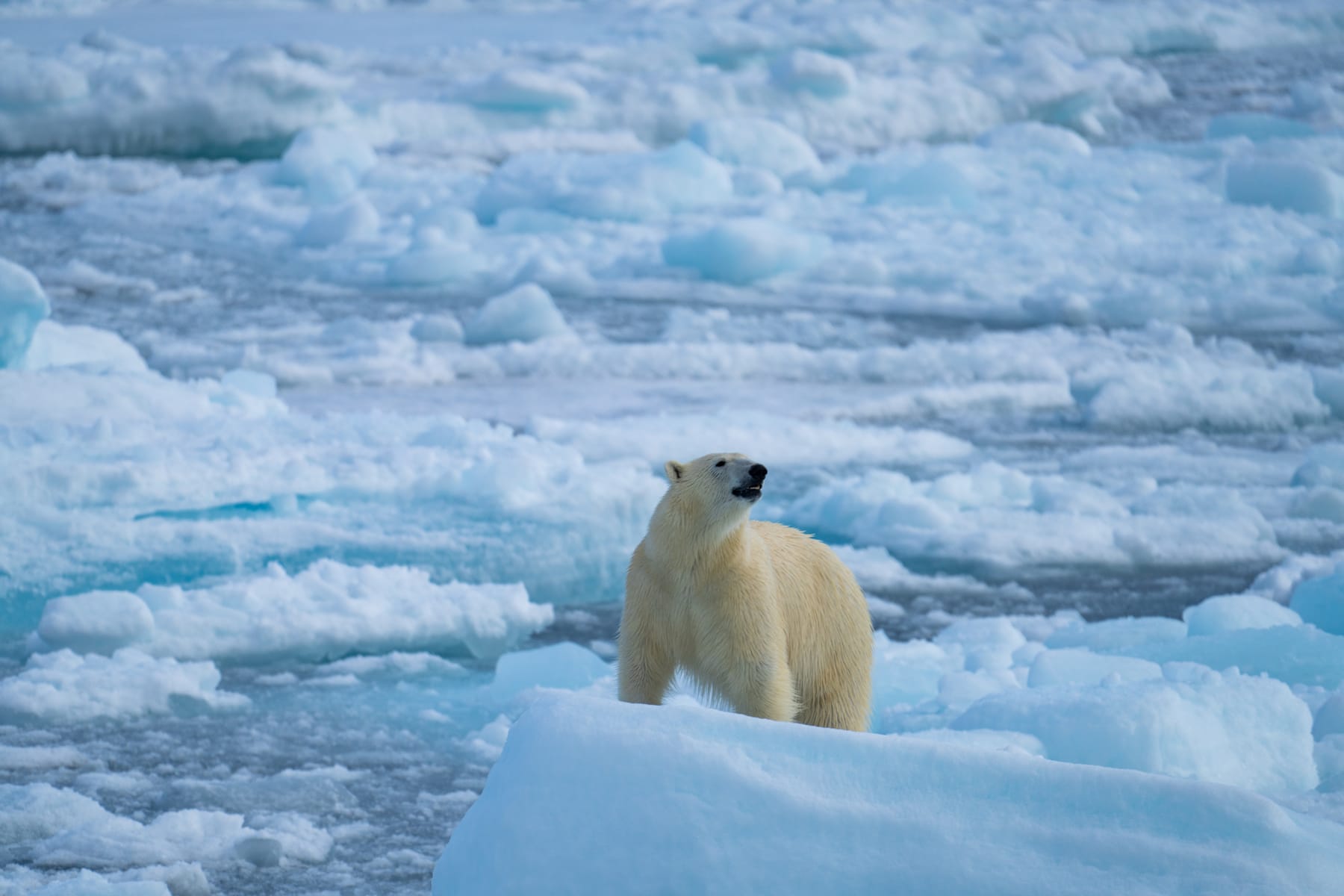
The polar bear is the only one of the eight bear species classified as a marine mammal and the only one that is an obligate carnivore. It hunts seals from sea ice, which is a requirement rather than a preference: without a platform it cannot reach its prey.
It is Vulnerable. Less ice means a shorter hunting season, thinner bears, fewer surviving cubs, and more animals coming ashore where they meet people. Polar Bears International works on both the ice-dependent populations and the conflict that follows them onto land.
Its black skin under translucent hollow guard hairs is a heat trap, and it is so effective that polar bears are close to invisible to infrared cameras.
Arctic fox
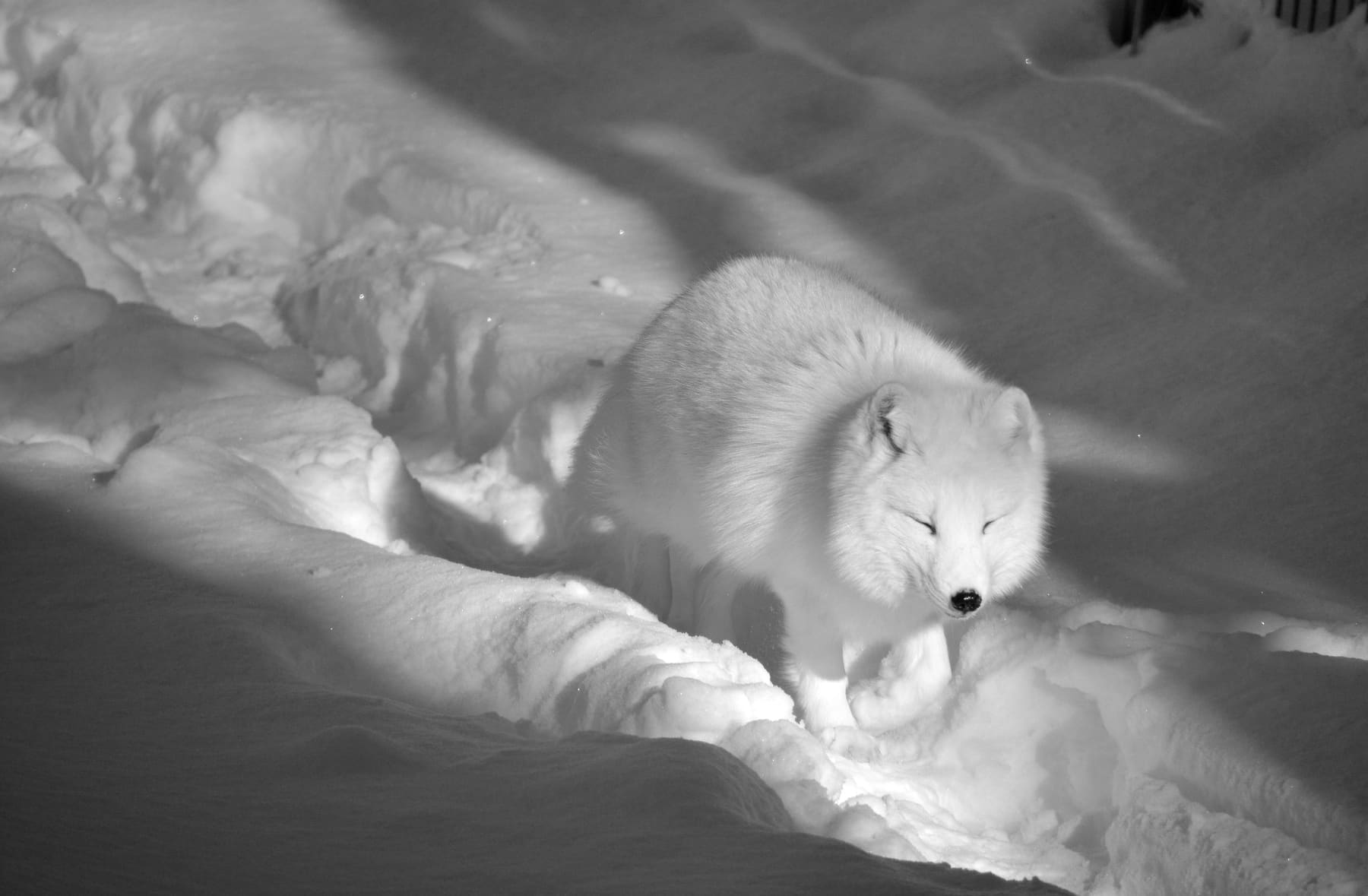
The arctic fox has the warmest fur of any mammal and does not begin to shiver until roughly minus 70 Celsius. It changes coat twice a year, white in winter and brown-gray in summer, which is camouflage rather than insulation.
It is Least Concern overall, but the Scandinavian population is critically small, and the mechanism is worth knowing: as the tundra warms, the larger red fox moves north and displaces it. The arctic fox is being squeezed by a competitor rather than by temperature directly.
In winter it follows polar bears to scavenge seal remains, which ties its fortunes to the ice as well.
Walrus
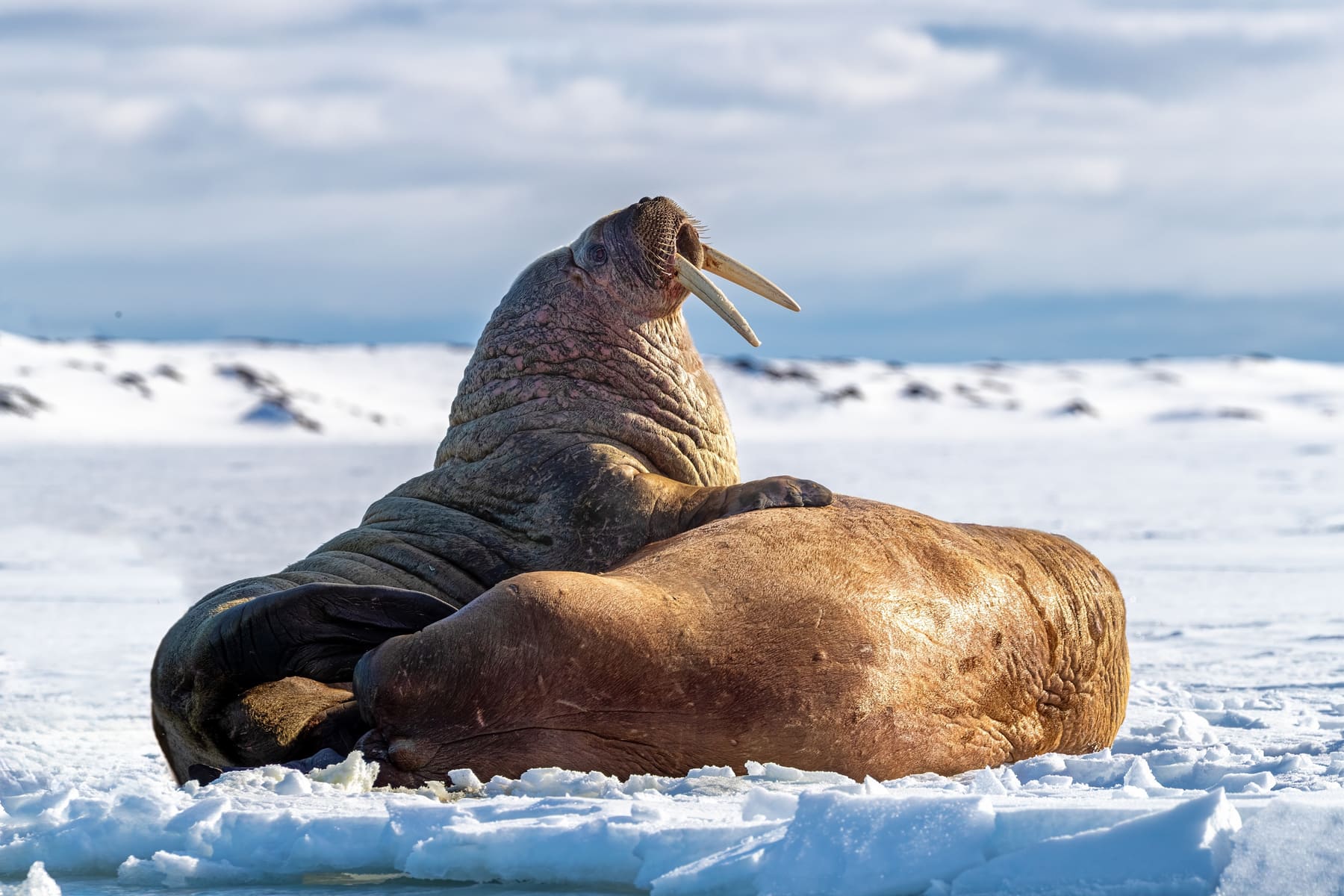
The walrus, which is neither a seal nor a sea lion but the third branch of the pinnipeds, uses sea ice as a resting platform between dives to the seafloor, where it feeds on clams located with its whiskers rather than its eyes. Both sexes grow tusks, used for hauling out onto ice and for display.
It is Vulnerable. Where ice disappears over the shallow feeding grounds, walruses haul out on land instead, in enormous crowded groups. Stampedes in those groups kill calves, and animals must swim much further between rest and food.
Narwhal
The narwhal grows a spiral tusk up to three meters long, which is not a horn but the left canine tooth pushed through the upper lip, packed with around ten million nerve endings.
It is Least Concern and winters under dense pack ice, diving beyond 1,500 meters to feed. That habit makes it unusually exposed to change: narwhals are specialists in a habitat with narrow breathing holes, and they are among the Arctic whales least able to shift range.
Snowy owl
The snowy owl is Vulnerable, and its numbers rise and fall with lemmings. In a good lemming year a pair may raise eleven chicks. In a poor one they may not breed at all.
Unlike most owls it hunts by day, which it has to, because Arctic summer has no night. It is also heavily feathered down to the toes.
Atlantic puffin
The Atlantic puffin is Vulnerable and spends most of the year on the open ocean, coming to land only to breed in clifftop burrows. Its bill is dull gray for most of the year and becomes the famous orange only in the breeding season.
Its problem is food supply rather than temperature. Puffins feed their chicks small fish such as sand eels, and as water warms those fish shift north and deeper. Adults return to the burrow with prey that is the wrong size or the wrong species, and chicks starve in a nest full of fish.
The animals that leave
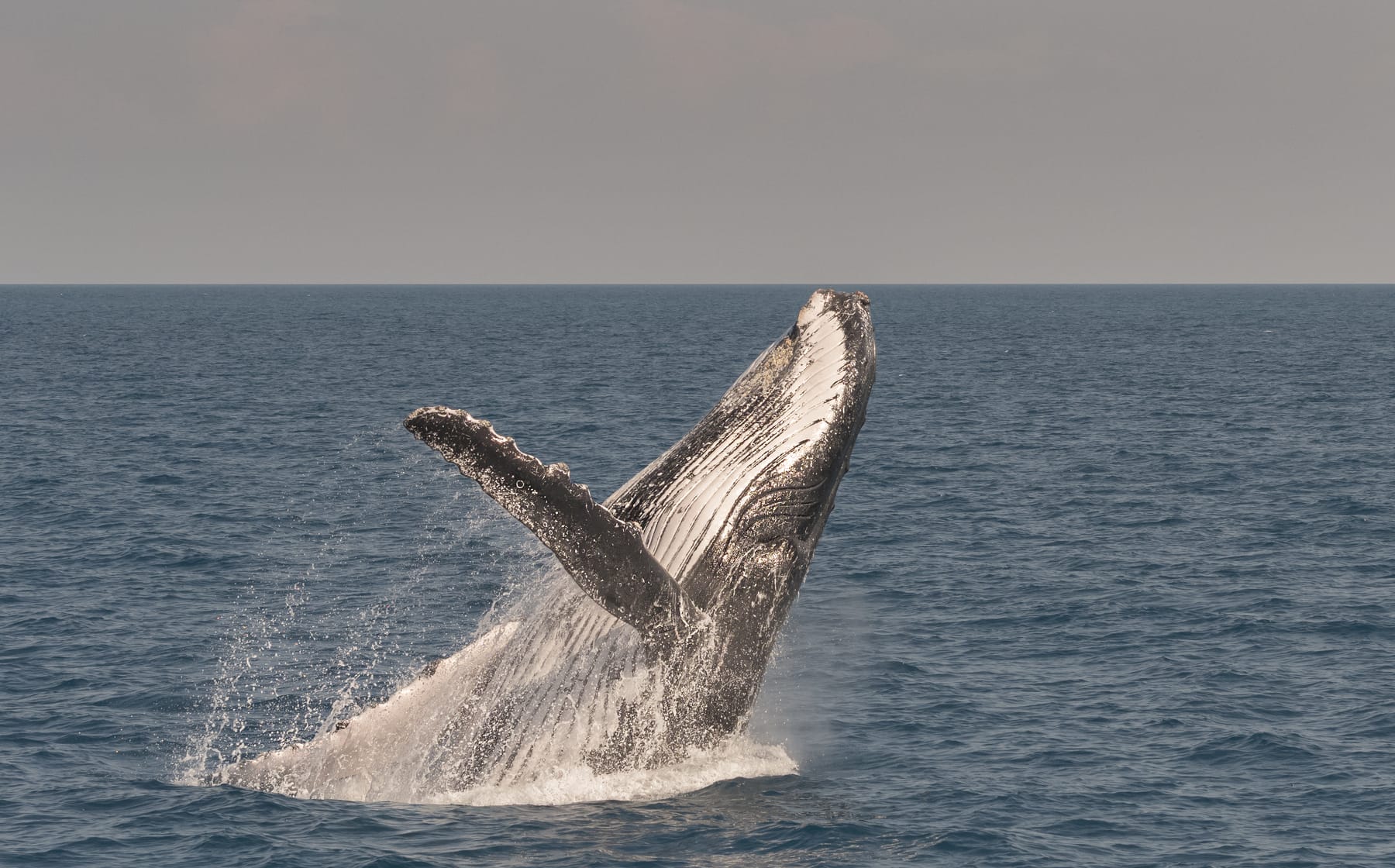
Not every Arctic animal stays. A large share of the species that use the Arctic are seasonal visitors, and the migration itself is one of the more extraordinary things in nature.
Arctic terns fly from pole to pole and back each year, covering roughly 70,000 kilometers and seeing more daylight than any animal alive. Millions of shorebirds arrive to breed on the tundra in a burst of insect abundance that lasts weeks, then leave. Bowhead and beluga whales move with the ice edge, two of the species that split the cetaceans in half.
All of it feeds into the wider ocean system south of the ice edge.
The visitors expose a problem the residents share. Arctic breeding is timed to a narrow pulse of food, and migratory species navigate by day length, which does not change. When the pulse of insects or plankton arrives earlier because the season has shifted, animals cued by daylight arrive to find the peak already passed. Ecologists call it phenological mismatch, and it is one of the least visible ways a warming Arctic harms animals that look otherwise unaffected.
What Arctic animals have in common
Three adaptations recur, and each one becomes a liability when the season changes.
Insulation over bulk. Blubber and dense fur allow a large body to hold heat. That works until an animal has to swim further, because insulation is expensive to carry and the calories have to come from somewhere.
Boom-and-bust breeding. Snowy owls with lemmings, polar bears with seal pups, puffins with sand eels. Arctic species evolved to breed hard in good years and skip bad ones, which is a sound strategy when bad years are occasional and a fatal one when they become normal.
Dependence on a platform, not a place. This is the difference between Arctic and other habitats. A rainforest animal loses forest by the hectare. An Arctic animal loses weeks. The ice still forms, but later, and it breaks up earlier, and the hunting season shrinks from both ends.
NOAA tracks the sea ice extent behind all of this, the National Snow and Ice Data Center publishes the seasonal minimum each September, and the IUCN Red List assessments for these species now cite ice season length directly.
The people who live there
The Arctic is not wilderness in the sense the word usually implies. Around four million people live there, including Inuit, Sami, Chukchi, and many other Indigenous peoples who have hunted these species for thousands of years.
That changes what conservation means in practice. Subsistence hunting of walrus, narwhal, and seal is legal, managed by quota, and central to food security in communities where imported food is expensive and unreliable. Campaigns that treat all hunting as the problem tend to fail there, and deservedly, because they misidentify the cause: these populations were not depleted by subsistence hunting but by commercial whaling and sealing, and they are threatened now by ice loss driven from far outside the Arctic.
Indigenous knowledge is also now part of the science. Hunters have recorded ice conditions, animal movements, and body condition across generations, and that record covers a longer period than satellite data does. Polar Bears International and most serious Arctic research programs now work with communities rather than around them.
Antarctic animals are a different list
One common confusion is worth settling. Penguins are Antarctic and polar bears are Arctic, and they never meet. The emperor penguin does not appear above for that reason, despite turning up in most searches for cold weather animals.
The two poles also work differently. The Arctic is an ocean surrounded by continents. Antarctica is a continent surrounded by ocean. That single structural difference explains why Arctic animals include land predators that walk out onto frozen sea, and Antarctic ones do not.