Animals that went extinct in 2025 (and when they actually died)
On October 10, 2025, at the World Conservation Congress in Abu Dhabi, the IUCN moved six animals and two plants into the category it reserves for species with no individuals left anywhere. The Red List now covers 172,620 species. Of those, 48,646 are threatened with extinction.
Six is a small number against 172,620, and it is worth understanding why it is so small. A species is not declared extinct when it dies out. It is declared extinct when scientists finish proving that it did, which usually takes decades of surveys returning nothing. Almost every animal on this list was already gone before most of us were paying attention.
The slender-billed curlew
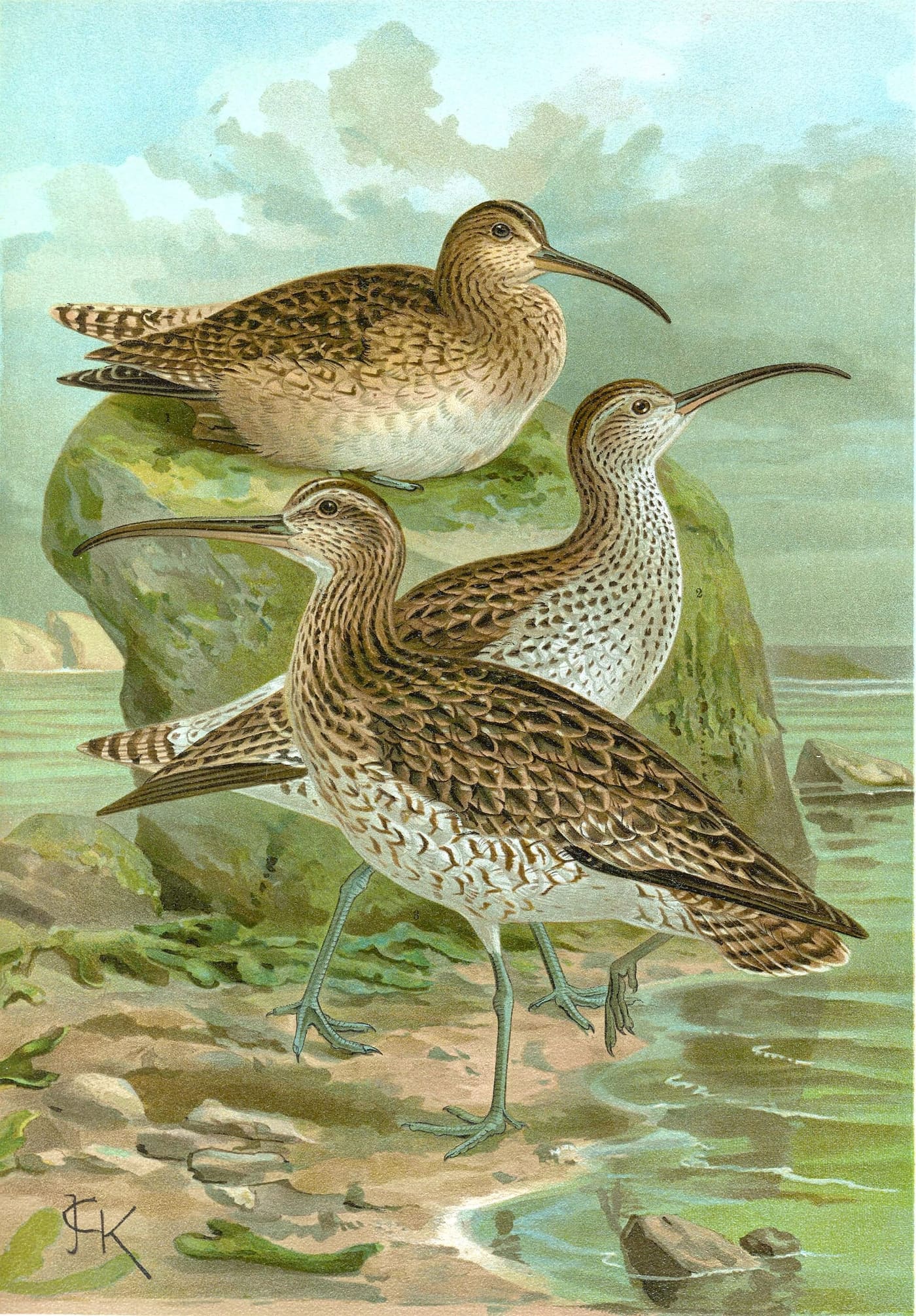
Slender-billed curlew, illustrated by John Gerrard Keulemans. Public domain.
Numenius tenuirostris was a migratory shorebird that bred in Siberia and wintered around the Mediterranean, tracing a route across Europe, North Africa, and the Middle East. It was last recorded in Morocco in February 1995.
This is the loss that carries the most weight, because the curlew was not a single-island endemic clinging to one hillside. It ranged across a continent, and it still went. Wetland drainage removed the stopover sites it depended on, and hunting pressure along the migration route did the rest. A bird that crosses twenty countries needs all twenty of them to work.
The Christmas Island shrew
Crocidura trichura was a shrew the size of a mouse, found only on Christmas Island in the Indian Ocean. It was last seen in 1985.
What killed it is worth naming precisely, because it is not the usual story. The shrew was not hunted and its forest was not cleared. It was almost certainly killed by a blood-borne parasite carried by black rats that arrived on ships. Nobody decided to harm it. An island with no defenses against a mainland disease met the disease anyway, which is the same mechanism that has emptied island faunas from Hawaii to Mauritius.
Three Australian bandicoots
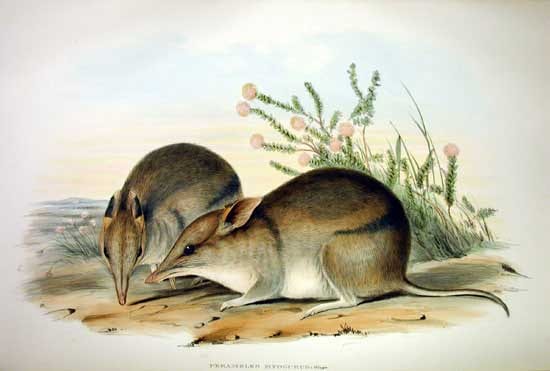
The three bandicoots declared extinct in 2025 are known mainly from museum specimens. This is John Gould's 19th-century plate of a close relative, the western barred bandicoot. Public domain.
Three species went at once: the marl (Perameles myosuros), the south-eastern striped bandicoot (Perameles notina), and the Nullarbor barred bandicoot (Perameles papillon). Bandicoots are small, long-nosed marsupials that dig for insects and fungi, turning over soil as they go.
The last records are from 1907, the late 1800s, and the 1920s respectively. Habitat clearance started the decline and feral cats finished it. These three were recognized as distinct species relatively recently, from museum material, so their entry onto the Red List and their departure from it happened almost together. That is a strange kind of loss: we worked out exactly what they were only after there was nothing left to protect.
A cone snail in Cape Verde
Conus lugubris lived in the shallow coastal waters of the Cape Verde Islands and was last recorded in 1987. Coastal development degraded the narrow strip of habitat it occupied, and it had nowhere else to go.
Cone snails rarely make lists like this one, which is part of the problem. Invertebrates make up the overwhelming majority of animal species and a small fraction of assessed ones, so the extinctions we count skew heavily toward mammals and birds that somebody was already watching.
And two plants
As Mongabay reported in its roundup of the year's losses, two plants went with them. Diospyros angulata, a tree in the ebony family from Mauritius, is known from exactly two herbarium collections, made in 1839 and 1851. Delissea sinuata grew in the Waianae Mountains of Oahu, Hawaii, and was last seen in 1937.
How the IUCN decides a species is gone
Extinct is the hardest category to assign, and the bar is deliberately high.
A species qualifies only when there is no reasonable doubt the last individual has died, which in practice means exhaustive surveys across its known range, at the right season, over a timeframe appropriate to its life cycle. For a long-lived animal that can mean decades of looking. The standard exists because the alternative is worse: declaring a species extinct ends its legal protection and its funding, and species declared gone do occasionally turn up alive.
The cost of that caution is the lag you see in every entry above. The Christmas Island shrew was last seen in 1985 and was declared extinct 40 years later. The marl was last recorded in 1907. By the time a species reaches this list, the window to have done anything closed long ago, usually before anyone realized it was closing.
There is a related category worth knowing: Extinct in the Wild, for species that survive only in captivity. Those animals still have a path back, and the scimitar-horned oryx, reintroduced to Chad from captive herds, is the case that proves it can work.
The number that matters more than the list
The extinctions are the headline, but they are not the finding with the most weight behind it. In the same update, the IUCN reported that 61% of the world's bird species now have declining populations, up from 44% in 2016. Of 11,185 bird species assessed, 1,256 are globally threatened, a figure compiled with BirdLife International, which runs the bird assessments for the Red List.
That shift happened in nine years, and it describes birds in general rather than rare ones in particular. The African penguin is Endangered. Three Arctic seal species moved the wrong way in this same update: the hooded seal from Vulnerable to Endangered, and both the bearded seal and the harp seal from Least Concern to Near Threatened, all of it driven by sea ice that is no longer there when they need it. Polar Bears International works on the same stretch of vanishing ice for polar bears.
Six extinctions is a count of what we have finished losing. Sixty-one percent is a description of what is happening now.
The species that went the other way
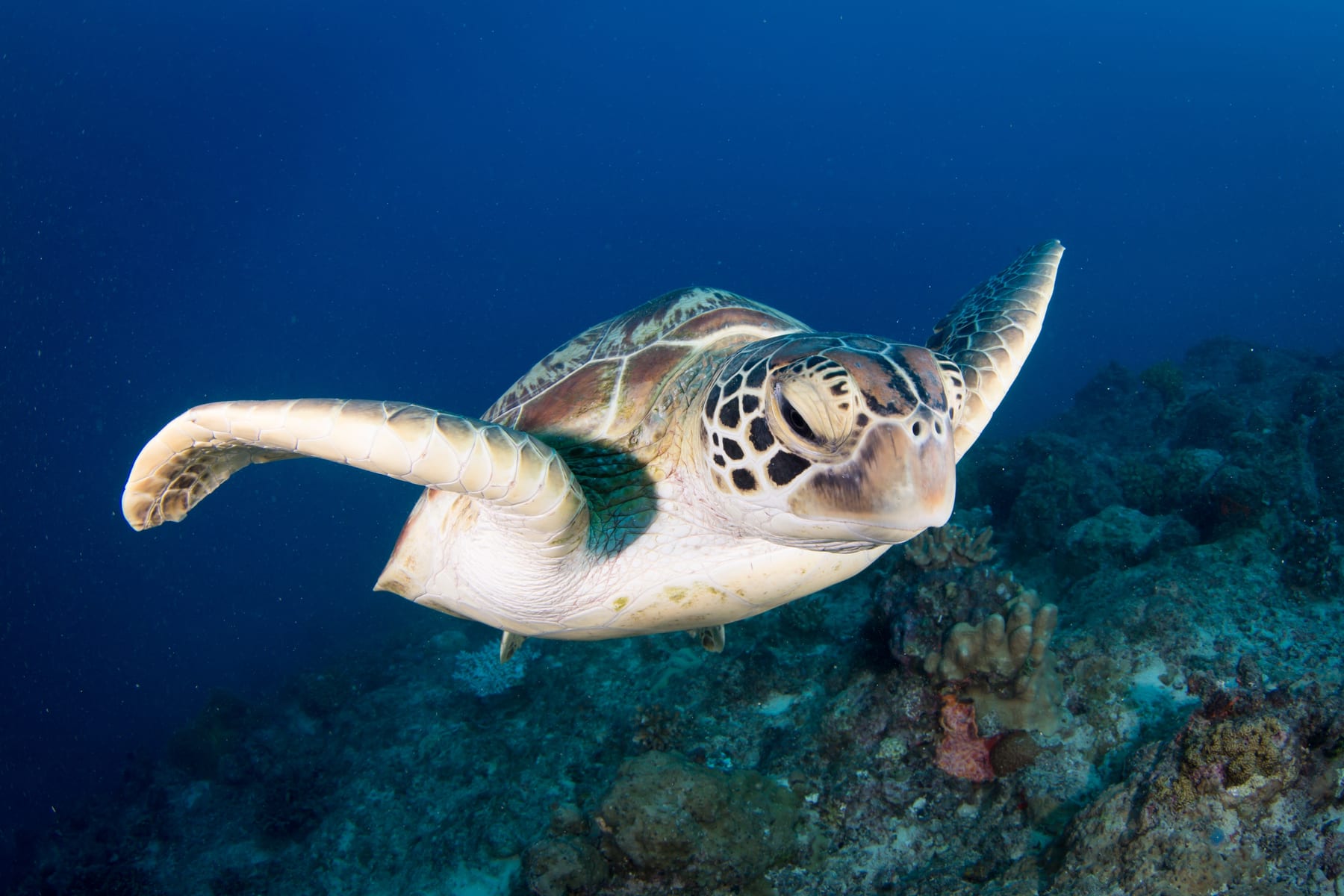
The same October 2025 update moved the green sea turtle from Endangered to Least Concern. The global population has risen roughly 28% since the 1970s. NOAA Fisheries tracks the nesting numbers behind that change.
Nothing clever did that. Countries banned the harvest of eggs and adults, people protected nesting beaches season after season, and fisheries adopted gear that lets turtles escape. Green turtles take decades to reach breeding age, so the recovery reported in 2025 is the result of beaches protected in the 1980s and 1990s by people who could not have known whether it was working. That is the part worth sitting with: the interval between doing the work and seeing the result was longer than most funding cycles.
The hawksbill turtle is still Critically Endangered, and the same organizations protect both. SEE Turtles, Oceanic Society, and the Tortuguero sea turtle program in Costa Rica run the nesting-beach work that produced the green turtle result.
What to take from an extinction list
Every species on the 2025 extinction list was declared gone long after the last one died, and in most cases long after anyone could have intervened. That lag is the argument for paying attention to the species that are still here, which is what our ten most endangered animals covers.
Australia carries more of this record than anywhere else, and our guide to marsupials covers why: around 90% of the mammals that country has lost since 1500 were marsupials, and nearly all of them fell in one narrow band of body size.
The species most exposed to this are the ones that stopped flying, and our guide to flightless birds covers why island endemics have the worst extinction record of any group of birds. For the argument that any of it can be undone, de-extinction looks at what the gene editing can and cannot actually deliver.
The green sea turtle spent forty years climbing out of the same category the slender-billed curlew fell out of. The difference between those two outcomes was not luck. It was whether anybody was funded to show up on the beach.