The spots are the worst way to tell a cheetah from a leopard
Cheetah vs leopard is one of the few wildlife identification questions with a completely reliable answer. The two cats can share the same African grassland and almost never compete, because they hunt in opposite ways. The cheetah runs its prey down in daylight across open ground. The leopard ambushes at night and hauls the carcass up a tree.
Nearly every visible difference between them follows from that split, which makes the cheetah vs leopard question easier than it looks once you know what the two bodies are actually built to do.
Spots versus rosettes
The pattern is the fastest way to tell them apart in a photograph.
A cheetah has solid black round spots, evenly scattered, like ink dots. A leopard has rosettes: irregular dark-edged rings with a tawny center, closer to a flower shape than a dot. Once you have seen the two side by side the difference is obvious and never ambiguous.
If a rosette has a small dark spot inside the ring, you are looking at a jaguar rather than a leopard, which our guide to jaguar vs leopard covers.
The tear marks
The cheetah has two black lines running from the inner corner of each eye down to the mouth. Nothing else looks like it, and no leopard has them.
They are usually explained as glare reduction, working like the black grease athletes wear under their eyes, which would make sense for a cat that hunts in full daylight. The evidence for that is suggestive rather than settled, so treat it as a plausible explanation rather than a proven one. As an identification mark it is completely reliable.
Cheetah vs leopard at a glance
| Cheetah | Leopard | |
|---|---|---|
| Pattern | Solid round spots | Rosettes with tawny centers |
| Face | Black tear marks | No tear marks |
| Build | Light, long-legged | Stocky, heavy-shouldered |
| Weight | 35 to 65 kg | 30 to 90 kg |
| Top speed | ~100 km/h | ~58 km/h |
| Claws | Semi-retractable | Fully retractable |
| Active | Daylight | Mostly night |
| Climbs | Poorly | Expertly, carrying prey |
Two bodies built for different jobs
Stand them next to each other and the cheetah looks like a greyhound while the leopard looks like a weightlifter.
The cheetah is light, narrow-chested, and long-legged, weighing 35 to 65 kilograms. Its claws are only semi-retractable and act like running spikes, which is unique among cats. It has an enlarged heart, oversized nasal passages, and a long tail used as a rudder. Everything about it is built for one sprint.
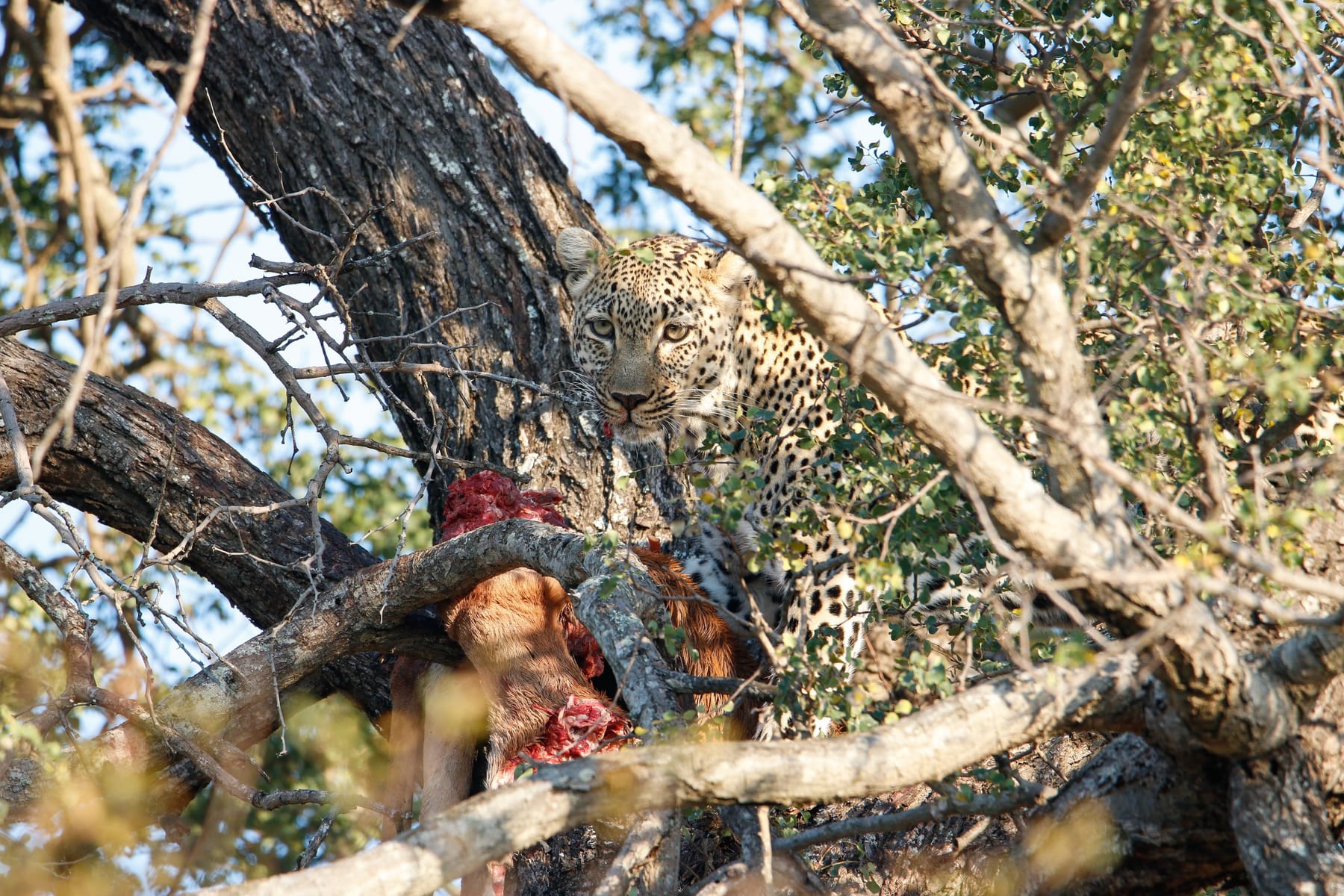
The leopard is shorter, heavier, and vastly stronger, at 30 to 90 kilograms with a thick neck and powerful shoulders. It can carry prey heavier than itself vertically up a tree, which is the single most impressive thing any big cat does routinely. Its claws fully retract.
Speed and what it costs
The cheetah is the fastest land animal, reaching around 100 kilometers per hour, but only for 20 to 30 seconds. The chase overheats it, and afterwards it needs time to recover before it can eat.
That recovery window is a real vulnerability. Cheetahs regularly lose kills to lions, leopards, and hyenas while they are catching their breath, and they rarely fight to keep them. A cheetah cannot afford an injury, because a limping cheetah cannot sprint and a cheetah that cannot sprint starves.
The leopard has no such constraint. It is slower, at roughly 58 kilometers per hour, but it hunts by stealth rather than pursuit, and it protects a kill by removing it from the ground entirely.
The tree-caching behavior is worth appreciating properly. A leopard will drag an antelope carcass heavier than itself up a vertical trunk, using jaw and shoulder strength that no cheetah possesses, then feed on it over several days out of reach of lions and hyenas. It is the single adaptation that most explains why leopards persist in landscapes where other big cats have vanished.
Day versus night
Cheetahs hunt during the day, and often in the middle of it. That is not a preference so much as an avoidance strategy: lions and hyenas are most active at dawn, dusk, and night, so daylight is when a cheetah can hunt without immediately losing the result.
Leopards are largely nocturnal and are the most adaptable big cat alive. They persist close to human settlement, including on the edges of major cities, which is a large part of why they still occupy a range that stretches across Africa and into Asia.
What about black panthers
There is no such species. A black panther is a melanistic individual of an existing species, meaning one carrying a genetic variant that produces excess dark pigment.
In Africa and Asia, a black panther is a leopard. In the Americas, it is a jaguar. Photograph one in good light and the rosettes are still visible underneath the dark coat, because the pattern is there, just harder to see.
Cheetahs do not produce a melanistic form in the wild. The rare cheetah variant people do encounter is the king cheetah, which has blotched and merged markings rather than round spots, and comes from a recessive gene rather than a separate subspecies.
Range, and where they overlap
Both live across much of sub-Saharan Africa, but the leopard's range is far larger, extending through the Middle East, India, Southeast Asia, and into the Russian Far East. The cheetah is now confined mostly to eastern and southern Africa, with a critically small population of the Asiatic subspecies surviving in Iran.
Where they do overlap, the leopard usually wins any direct encounter, and cheetahs avoid them.
That avoidance has a cost that shows up in the numbers. Cheetahs pushed to the margins of protected areas end up on farmland, where conflict with livestock owners becomes the leading cause of death. The cat that loses the competition inside the park dies outside it.
Both are Vulnerable, for different reasons
The IUCN lists both the cheetah and the leopard as Vulnerable, and the causes are not the same.
The cheetah has a genetics problem on top of a habitat problem. The species passed through a severe population bottleneck around 10,000 years ago and carries very little genetic diversity, which shows up as low sperm quality, high cub mortality, and vulnerability to disease. It also needs enormous home ranges, so it does badly in fragmented landscapes and most of its remaining population lives outside protected areas. Cheetah Conservation Fund in Namibia (cheetah.org) works on the conflict with farmers that drives much of the killing, including a livestock guarding dog program that has cut losses enough to change how farmers respond. Panthera (panthera.org) runs range-wide cat conservation.
The leopard is threatened mainly by habitat loss, prey depletion, and the trade in skins and body parts, and the IUCN Red List assessment notes it has lost a large share of its historic range despite still occupying a wide one. Its adaptability disguises the decline: because leopards persist near people, they look more secure than they are, and several subspecies are in serious trouble. The Amur leopard is among the rarest cats on Earth.
The comparison is a useful illustration of something our ten most endangered animals list keeps running into. Two species can share a landscape, a threat category, and a conservation status while needing completely different interventions. Protecting cheetahs means working with farmers across unprotected land. Protecting leopards means stopping a trade. Funding one does not do the other.
Our guide to big cats puts both in context alongside the other nine species, and shows how few of them are actually secure.