A jaguar and a leopard look identical until you know where to look
Jaguar vs leopard is the hardest of the big cat identification questions, because unlike the cheetah these two genuinely do look alike. Both are large, muscular, tawny cats covered in rosettes. Photographed badly, they are easy to confuse.
They are also separated by an entire ocean. Jaguars live only in the Americas, leopards only in Africa and Asia, so in the wild there is no place where you could mistake one for the other. The confusion happens in photographs, zoos, and film.
Look inside the rosettes
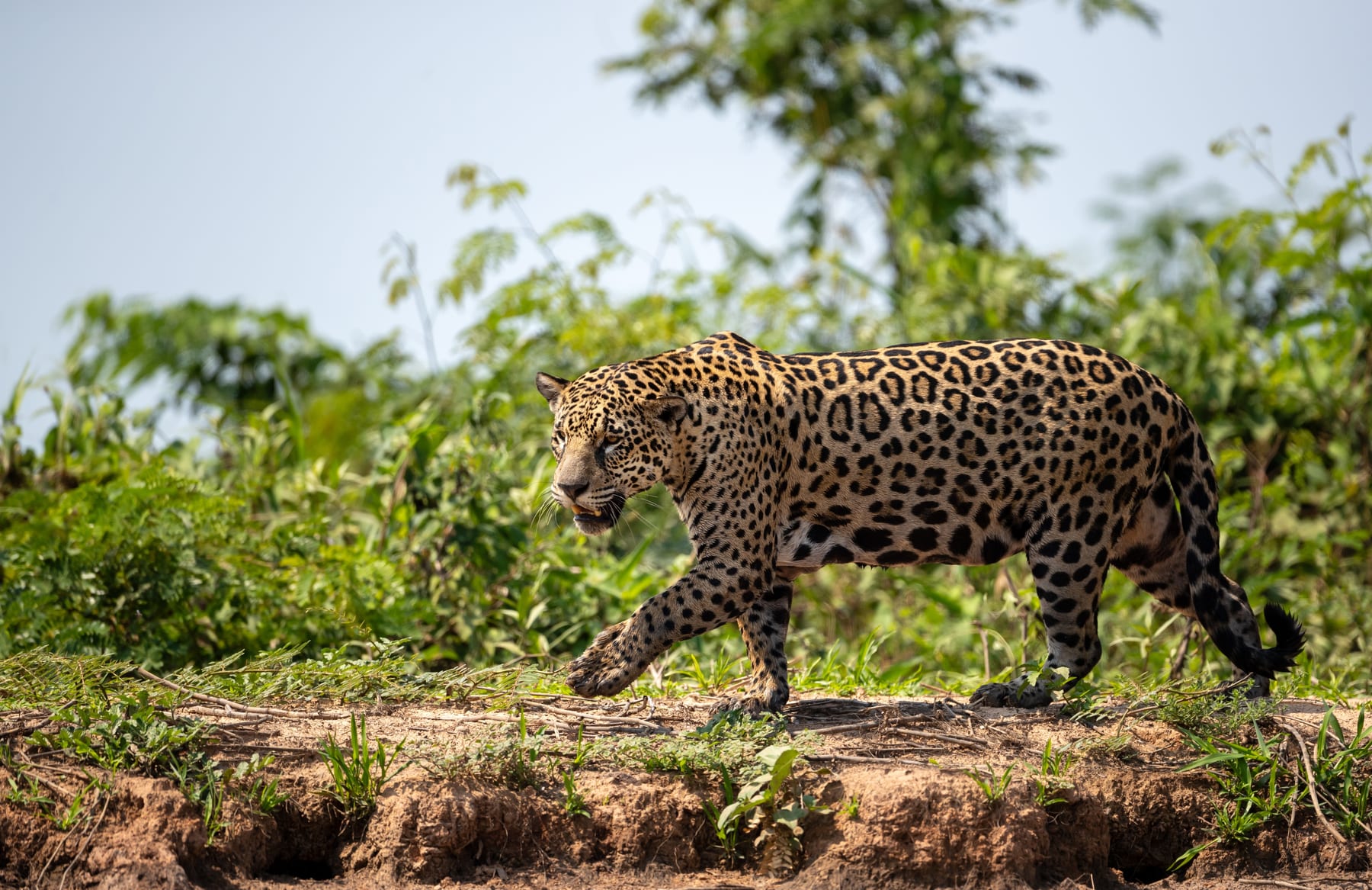
This is the answer, and it is completely reliable.
A jaguar has rosettes with one or more small black spots inside the ring. A leopard has rosettes that are empty, just a dark broken ring around a tawny center.
Jaguar rosettes are also larger, fewer, and more angular. Leopard rosettes are smaller, denser, and rounder. Once you know to look inside the ring you will never get this wrong again.
Jaguar vs leopard at a glance
| Jaguar | Leopard | |
|---|---|---|
| Rosettes | Spots inside the ring | Empty rings |
| Weight | 55 to 100 kg | 30 to 90 kg |
| Build | Stockier, bigger head | Longer, leaner |
| Bite | Strongest of any big cat for its size | Powerful but not exceptional |
| Kill method | Bite through the skull | Throat or nape |
| Water | Swims readily, hunts caiman | Avoids water |
| Range | Americas | Africa and Asia |
| Tail | Shorter | Longer |
Build and bite
The jaguar is the heavier animal, at 55 to 100 kilograms against the leopard's 30 to 90, and the difference in proportion is more telling than the difference in mass. A jaguar has a broader head, a deeper chest, and shorter, thicker limbs. It looks compact. A leopard looks long.
The bite is where the jaguar is genuinely exceptional. Relative to its size it has the most powerful bite of any big cat, and it uses it in a way no other cat does: rather than suffocating prey with a throat bite, a jaguar frequently kills by biting directly through the skull between the ears. That method is why it can take caiman and turtles, whose armor defeats most predators.
The leopard's strength is concentrated differently, in the neck and shoulders, because its defining behavior is hauling a carcass heavier than itself up a tree to keep it from lions and hyenas.
Water and trees
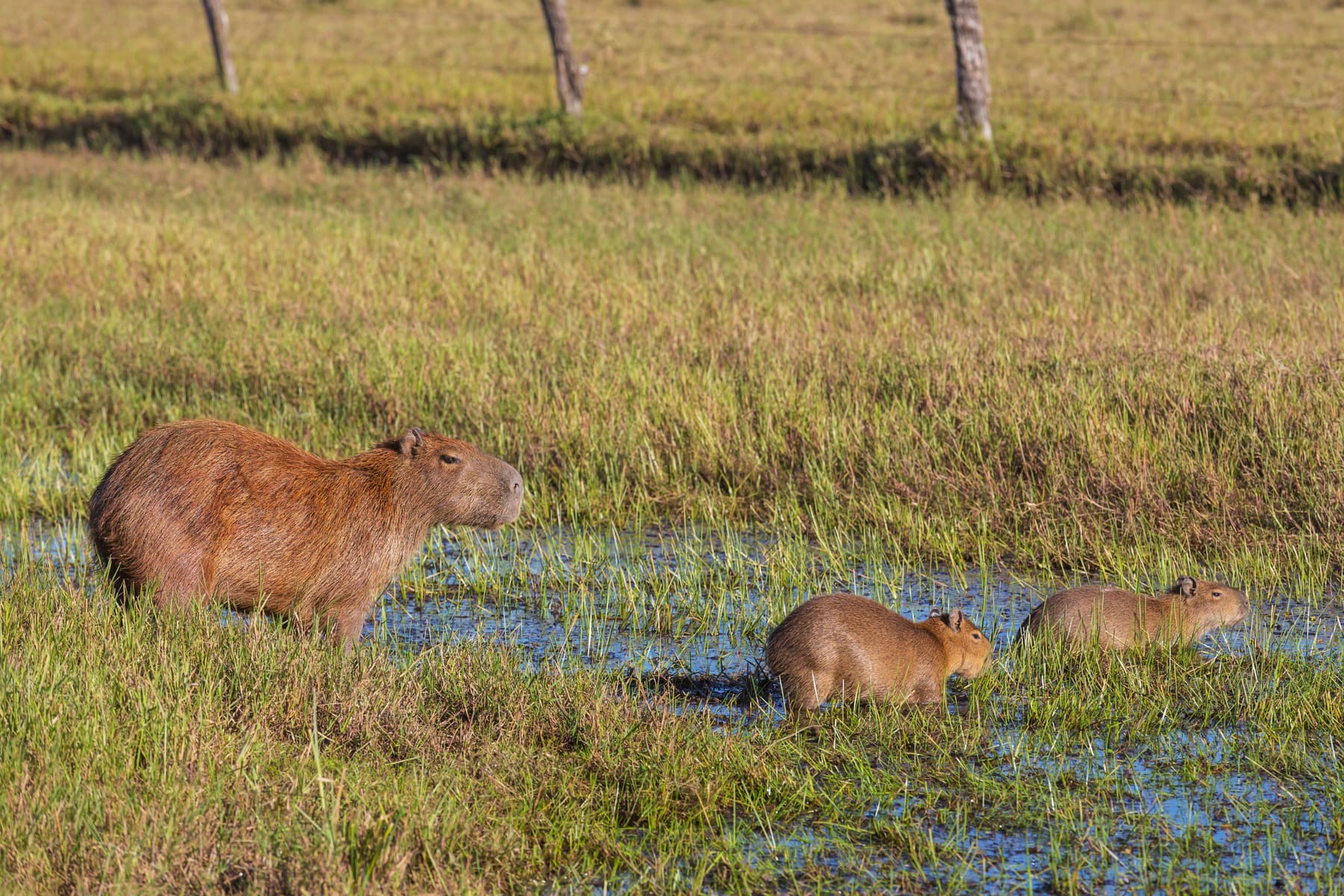
Jaguars like water. They swim well, hunt in rivers, and much of their prey is aquatic or semi-aquatic: caiman, capybara, turtles, fish. Caiman are crocodilians, and the alligator vs crocodile split explains where they sit: broad-snouted, in the alligator family, and native only to the Americas. The Pantanal wetland in Brazil holds one of the densest jaguar populations precisely because it is wet.
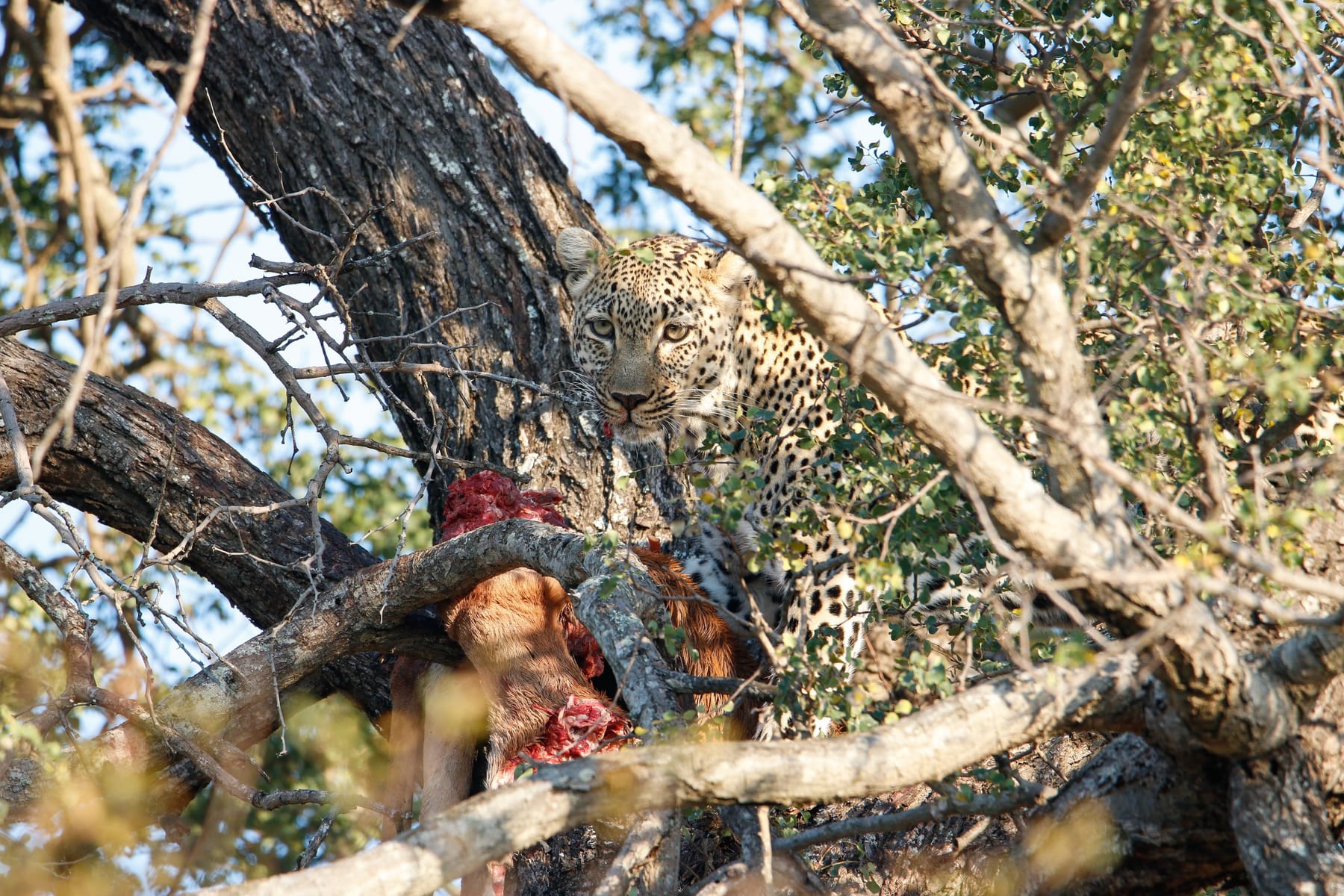
Leopards avoid water where they can, and their signature behavior is vertical. Both cats climb, but only the leopard routinely stores food in trees.
This difference maps onto habitat. Jaguars need dense cover near water and are tied to forest and wetland. Leopards occupy nearly everything: rainforest, savanna, mountains, semi-desert, and the edges of large cities.
Range
Jaguars once ranged from the southwestern United States to Argentina. They have lost roughly half of that, and the surviving stronghold is the Amazon basin, with important populations in the Pantanal and in Central America.
Leopards have the widest range of any big cat, from sub-Saharan Africa through the Middle East and India to Southeast Asia, China, and the Russian Far East.
If the cat is in the Americas, it is a jaguar. There are no wild leopards in the Western Hemisphere, and no wild jaguars outside it.
What each cat does in its ecosystem
Identification is the reason most people arrive at this question, but the more useful difference is what each animal does where it lives.
The jaguar is the apex predator of the Neotropics and the only big cat in the Americas. It eats an unusually wide range of prey, more than 85 species by some counts, and its habit of taking caiman and large river turtles means it regulates animals that nothing else in the system can touch. Where jaguars disappear, the mid-sized predators below them increase, and the effects run down through the food web. The IUCN Cat Specialist Group tracks these range-scale changes across both species.
The leopard plays a different role, because it usually is not the apex predator. It shares landscapes with lions, tigers, and hyenas, and it survives by being flexible: taking smaller prey, hunting at night, and storing food where larger competitors cannot reach. That flexibility is why leopards are still found in places where every other large carnivore has been extirpated, and it is also why their decline goes unnoticed for so long.
The black panther confusion
Both species produce melanistic individuals, and both get called black panthers. There is no black panther species.
In the Americas a black panther is a jaguar. In Africa or Asia it is a leopard. In both cases the rosettes are still present under the dark pigment and become visible in the right light, which means the same identification rule still works: look for spots inside the rings.
Conservation status
The two cats sit in different IUCN categories, and the reasons are instructive.
The jaguar is Near Threatened on the IUCN Red List. Its problems are deforestation, which fragments the forest it needs, and conflict with cattle ranchers, since a jaguar that kills livestock is usually shot. There is also a documented and growing trade in jaguar parts. Because jaguars need large connected territories, the conservation response has focused on corridors rather than isolated reserves, which is the approach Panthera (panthera.org) takes with its Jaguar Corridor Initiative running from Mexico to Argentina.
The leopard is Vulnerable, a worse category, which surprises people who assume the more widespread animal must be safer. The wide range disguises steep local losses. Several subspecies are close to gone, and the Amur leopard of the Russian Far East is among the rarest cats alive.
Rescued individuals of both species end up in sanctuaries when they cannot be released, and The Wild Animal Sanctuary and Turpentine Creek Wildlife Refuge both take in big cats from the exotic pet trade.
Why the comparison matters beyond identification
The jaguar and the leopard are a good illustration of a point our guide to what wildlife conservation is for keeps returning to: range size is a poor proxy for safety.
The leopard occupies more of the planet than any other big cat and is in the worse IUCN category. The jaguar is confined to one hemisphere and sits one rung better. What separates them is not how much space they have but how fast they are losing it, and whether anybody is funding the corridors that keep the remaining populations connected.
That distinction has practical consequences for anyone deciding where to give. A donation aimed at jaguars buys connected habitat and work with ranchers. A donation aimed at leopards more often buys anti-poaching and trade enforcement, and neither of the other nine big cats is quite the same case either. The easier version of this identification question is cheetah versus leopard, where the two animals barely resemble each other once you know what to look at. The two cats look alike and need different money.