Six great apes. Only one is going the right way.
The great apes are seven species, and you are one of them. The other six are the mountain gorilla, the western lowland gorilla, the chimpanzee, the bonobo, the Bornean orangutan, and the Sumatran orangutan.
Every single one is Endangered or Critically Endangered. Not one is secure. That is unusual even among threatened groups, and it is worth sitting with before the species descriptions start.
The great apes are distinguished from monkeys by having no tail, larger brains relative to body size, and shoulder joints built for hanging and rotating rather than running along branches. All of them make and use tools. All of them recognize themselves in mirrors. Several have been taught symbolic communication.
What makes a great ape a great ape
The word ape is used loosely, so it is worth pinning down. Great apes are the family Hominidae: gorillas, chimpanzees, bonobos, orangutans, and humans. Gibbons are apes but not great apes, sitting in their own family, which is why they do not appear here.
The features that separate great apes from monkeys are consistent. No tail. Shoulder joints built for hanging and rotating rather than running along a branch. Larger brains relative to body size. Longer development, with infancy measured in years rather than months.
The behavioral list is longer and stranger. Every great ape makes and uses tools. Every one passes the mirror self-recognition test, which most animals fail. Several have learned hundreds of symbols. Chimpanzees and orangutans both show tool traditions that differ between populations and are learned rather than invented fresh, which is the working definition of culture.
Gorillas
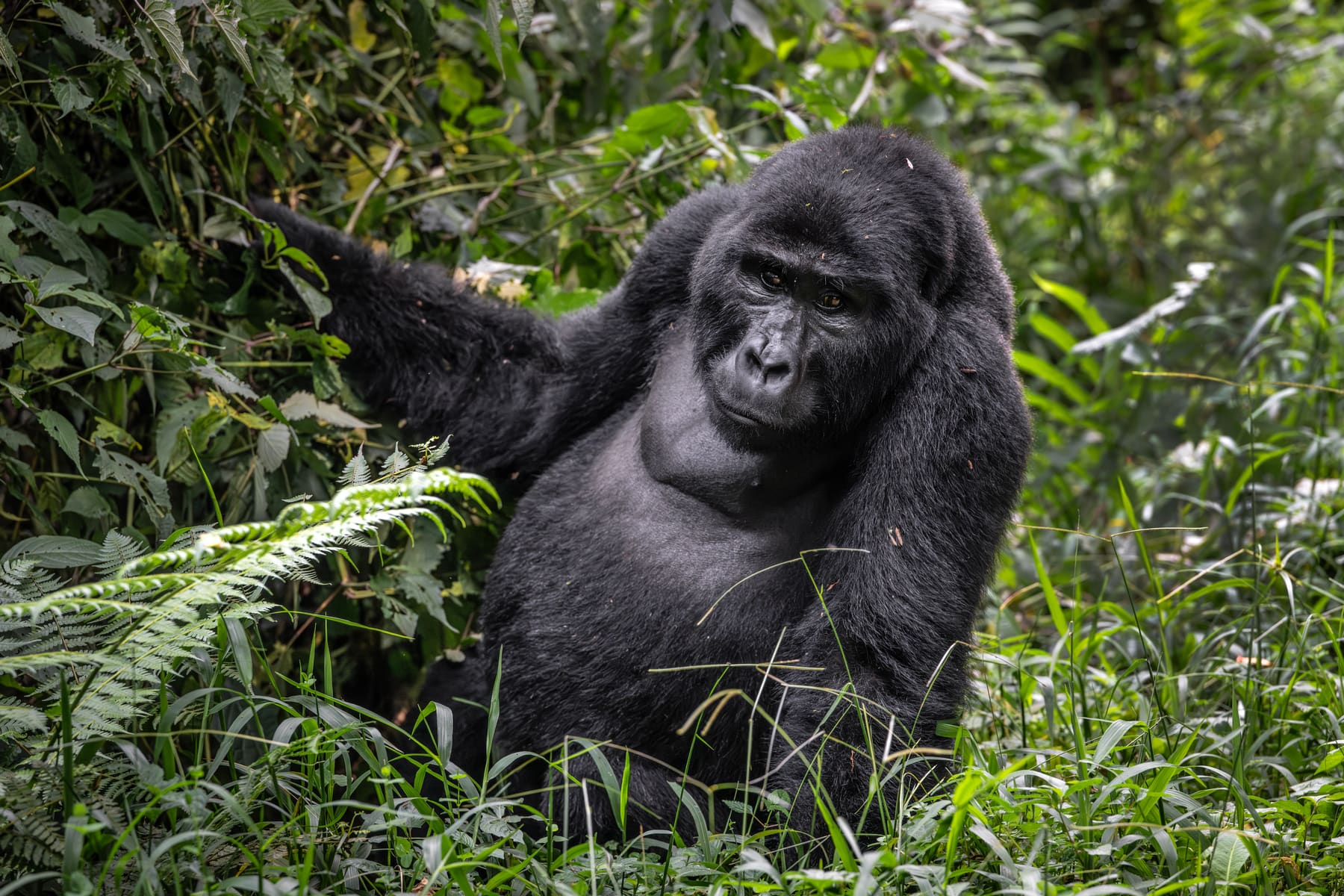
The mountain gorilla is the conservation success story of the group and one of the clearest anywhere. It was down to a few hundred animals and has climbed back above 1,000 through decades of protection, veterinary intervention, and tourism revenue routed to the communities living alongside them. It is Endangered, upgraded from Critically Endangered in 2018. The Dian Fossey Gorilla Fund has run continuous research and protection in Rwanda since the 1960s.
The western lowland gorilla is the opposite case. It is Critically Endangered, far more numerous than the mountain gorilla but declining fast, hit by commercial hunting and by Ebola outbreaks that killed gorillas across central Africa in numbers no anti-poaching patrol could prevent.
The contrast is instructive. The rarer gorilla is doing better than the common one, because a small population in a defined area with sustained funding is a solvable problem, and a large population spread across inaccessible forest with a disease outbreak is not.
Gorillas live in troops led by a silverback, eat mostly leaves and stems, and are the largest primates alive. Adult males reach 200 kilograms and are almost entirely herbivorous.
Chimpanzees and bonobos
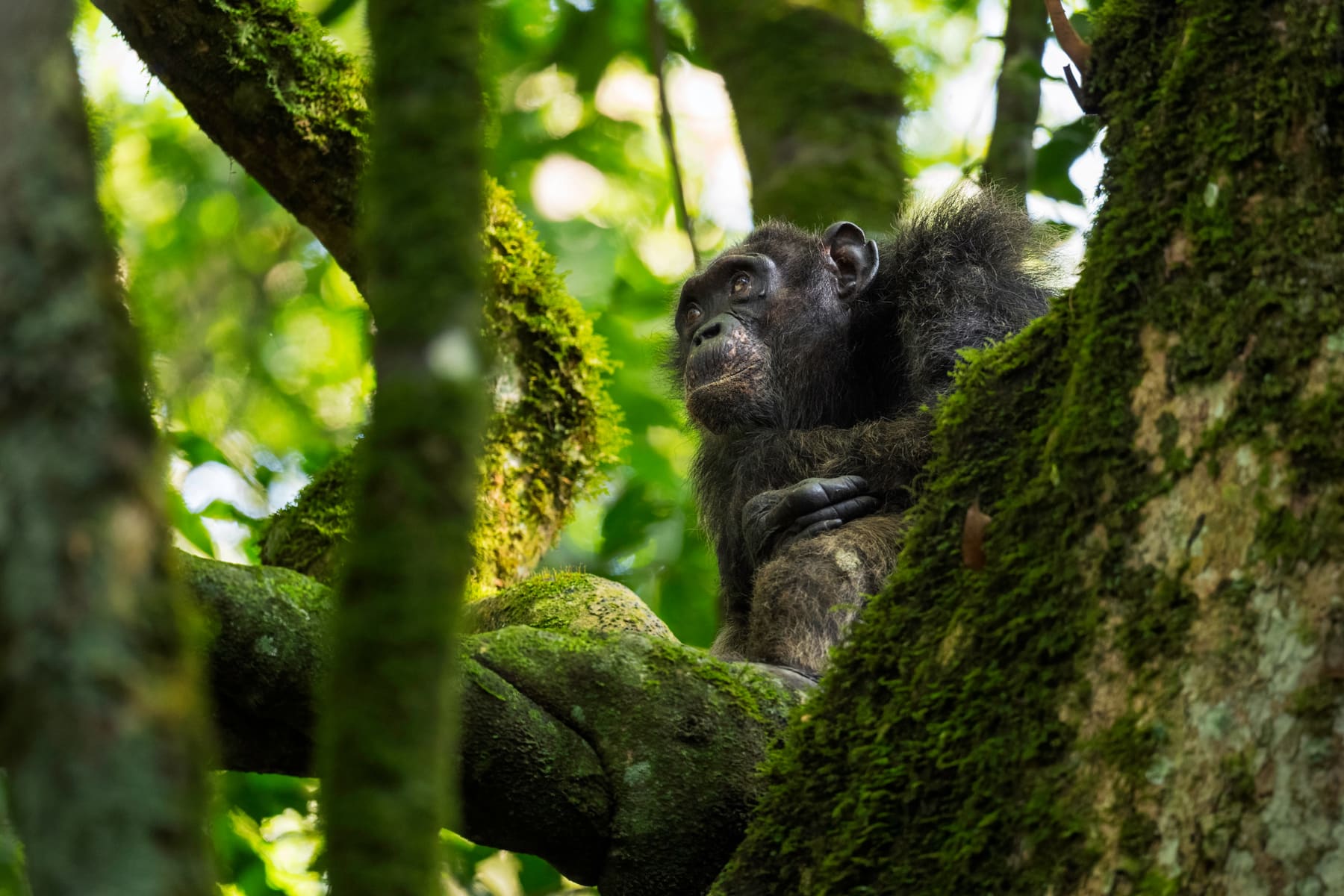
The chimpanzee and the bonobo are our closest living relatives, sharing roughly 98.7% of our DNA, and they are separated from each other by a single river.
The Congo River formed around two million years ago and split an ancestral population in two. Neither species swims. North of the river the chimpanzee evolved; south of it, the bonobo. They have been apart ever since, and they became strikingly different.
Chimpanzees live in male-dominated communities, patrol territory, and are capable of lethal aggression toward neighboring groups. They also make and use a wider range of tools than any animal except us: termite-fishing sticks, leaf sponges, stone hammers for cracking nuts, and spears for hunting bushbabies. Tool techniques differ between communities and are learned, which makes them cultural rather than instinctive. The Jane Goodall Institute grew out of the research that first documented it.
Bonobos live in female-led groups, resolve tension through social bonding rather than fighting, and have never been observed killing one another in the wild. They are found only in the Democratic Republic of the Congo, in one block of forest, which makes them the most geographically restricted great ape.
Both are Endangered.
Orangutans
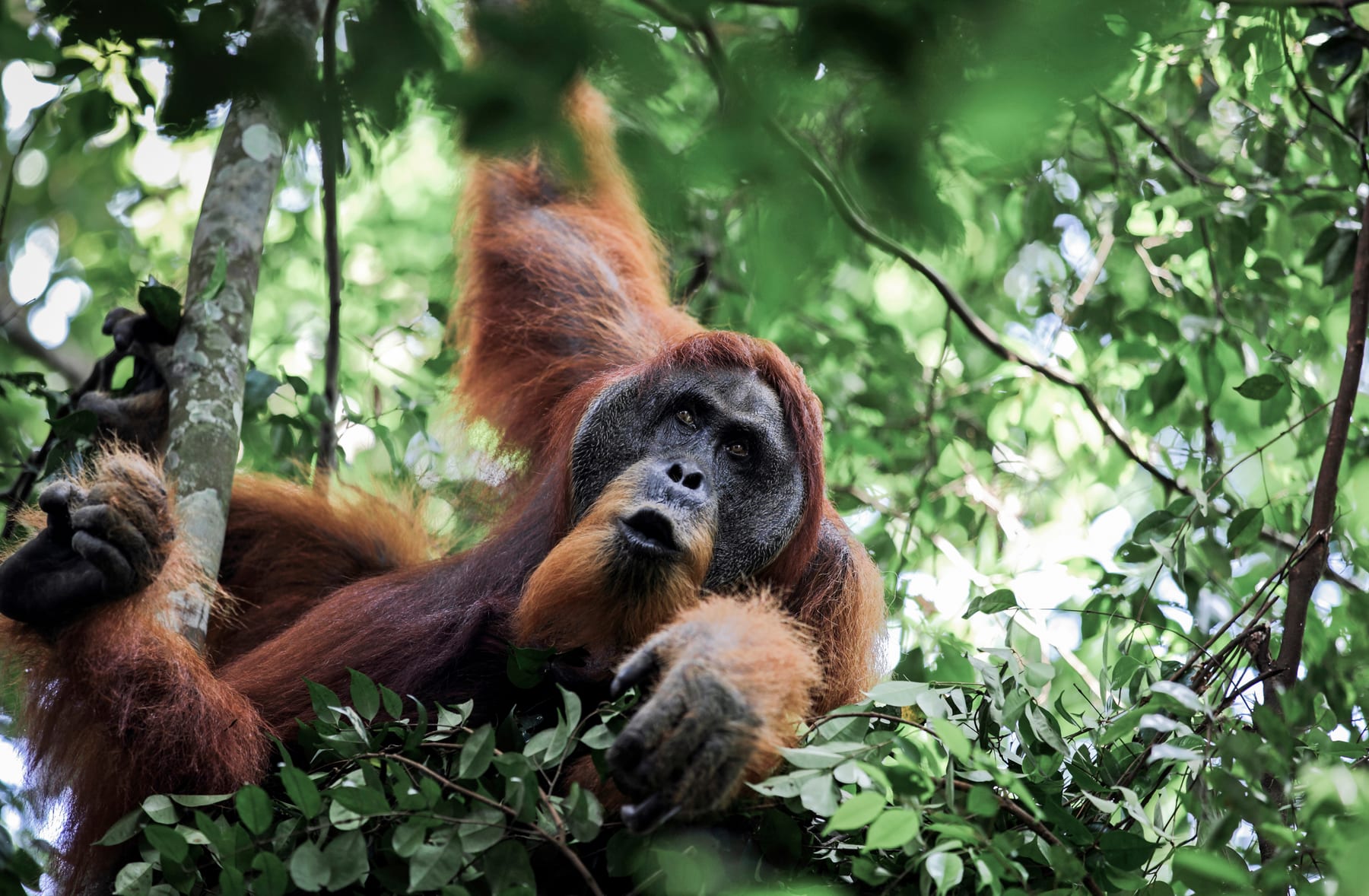
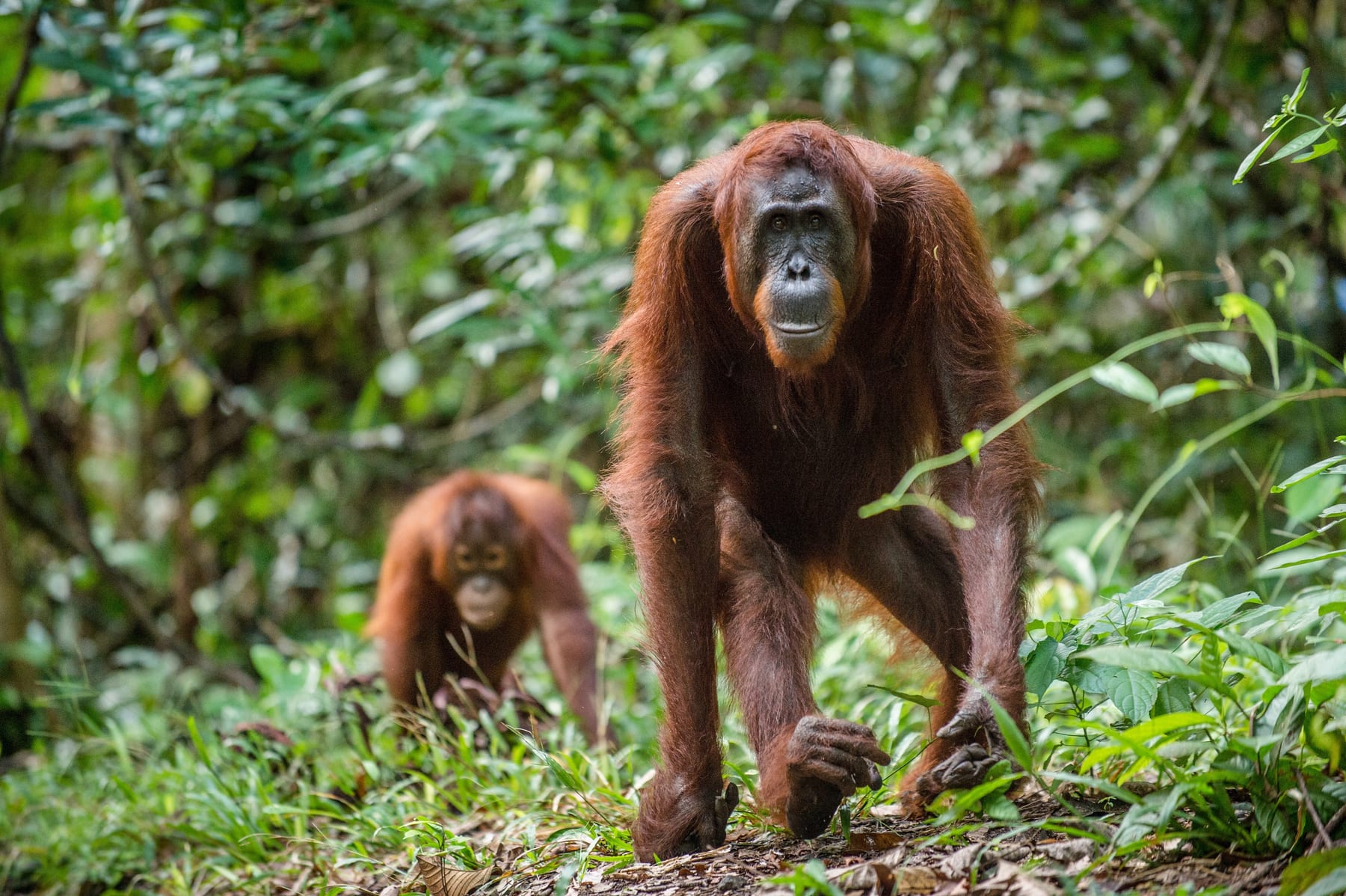
The Bornean orangutan and the Sumatran orangutan are the only great apes outside Africa, and both are Critically Endangered.
They are also the most solitary. Gorillas, chimpanzees, and bonobos all live in groups; adult orangutans, particularly males, spend most of their lives alone. That suits an animal that eats fruit scattered thinly through a forest canopy, and it is why orangutan density is naturally low even in healthy habitat.
The reproductive arithmetic is the hardest fact about them. Female orangutans give birth roughly once every eight years, the longest interval of any land mammal. A population that loses a quarter of its breeding females cannot recover within a human lifetime, regardless of how much forest is protected afterward.
Nearly everything an orangutan knows is learned from its mother over six to eight years: which of hundreds of fruits are edible, when each one ripens, how to build a sleeping nest, how to use leaves as an umbrella. An orphan raised without that education cannot simply be released. Orangutan Foundation International runs the rehabilitation that fills the gap, and it takes years per animal.
Why every great ape is threatened
Four causes recur across all six species, and they compound.
Habitat loss. Palm oil and logging in Southeast Asia, agriculture and mining in central Africa. Great apes need large areas of mature forest, and they do badly at forest edges.
Slow reproduction. Every great ape breeds late and rarely, which is a sound strategy in a stable forest and a catastrophic one under pressure. Populations decline faster than they can rebuild.
Hunting. The commercial bushmeat trade takes adult apes, and the pet trade takes infants, usually by killing the mother first.
Disease. Our closeness is a liability. Great apes are susceptible to human respiratory viruses, and Ebola has killed tens of thousands of gorillas and chimpanzees in central Africa. It is also why responsible gorilla tourism enforces distance rules and mask requirements, and why those rules are not theatre.
The IUCN Red List, the IUCN Section on Great Apes, and the Jane Goodall Institute all track these populations, and the trend lines point the same way for every one except the mountain gorilla.
The great apes, ranked by how threatened they are
| Species | Status | Trend |
|---|---|---|
| Western lowland gorilla | Critically Endangered | Declining |
| Bornean orangutan | Critically Endangered | Declining |
| Sumatran orangutan | Critically Endangered | Declining |
| Chimpanzee | Endangered | Declining |
| Bonobo | Endangered | Declining |
| Mountain gorilla | Endangered | Increasing |
One row differs from the rest, and it is the smallest population on the list. That is the whole argument of this piece in a single table: rarity is not what decides whether a species recovers. Sustained funding in a defined place is.
What the mountain gorilla proves
It is worth ending on the exception, because it is the only great ape whose numbers are rising and the reasons are not mysterious.
Rangers protect specific animals daily. Veterinarians intervene when a gorilla is injured or caught in a snare, which is unusual in conservation and clearly works. Tourism generates revenue, and a meaningful share reaches the communities on the park boundary, which changes the local economics of a forest from something to clear into something worth keeping.
None of that is clever. It is expensive, repetitive, and it has been sustained for sixty years. That combination is rare, and it is why one great ape out of six is going the right way.
None of the six is a monkey, and the distinction is real rather than pedantic: types of monkeys covers the two monkey groups and what separates both from the apes here.
Chimpanzee tool kits differ between neighboring communities that have identical access to the same nuts and stones, which is the clearest evidence of culture in a non-human animal, covered in the smartest animals.
All six live in tropical forest, lowland or montane, and our guide to rainforest animals covers the 22 species that share it and why 12 are disappearing.
Every organization named here has a page on Wildlife Connect with what it does and how to support it, and our ten most endangered animals includes four of these six species.