22 rainforest animals, and why 12 of them are disappearing
Rainforests cover less than 2% of the Earth's surface and hold an estimated 50% of all land species, according to WWF. No other habitat concentrates life that tightly, which is why rainforest animals dominate any list of species in trouble.
In 2025 the world lost 4.3 million hectares of tropical primary forest, a rate 46% higher than a decade earlier, per the World Resources Institute. The animals below are organized by the forest they belong to, because that is the unit that decides their future. None of them can relocate.
How a rainforest is built
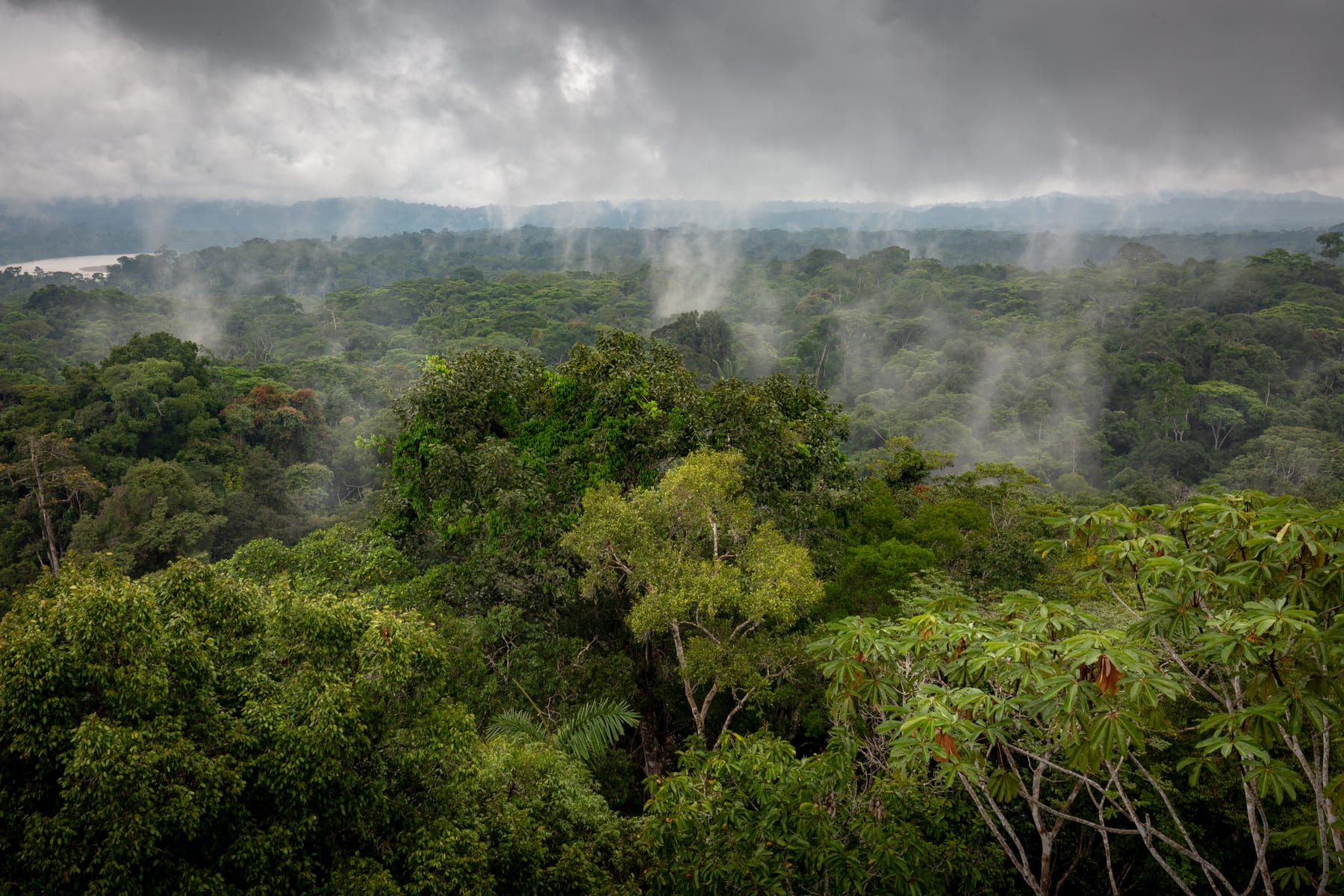
A rainforest is not one habitat but four stacked on top of each other: forest floor, understory, canopy, and the emergent trees that break through the top. Most rainforest species live their whole lives in one of those layers and are built for it.
That specialization is what makes them so exposed. A canopy animal cannot simply walk to the next forest when the trees between are gone, and a species adapted to constant humidity and deep shade does not do well at a forest edge. Fragmentation harms rainforest species faster than the raw hectare count suggests, because the usable interior shrinks faster than the forest does.
Rainforest animals of the Amazon
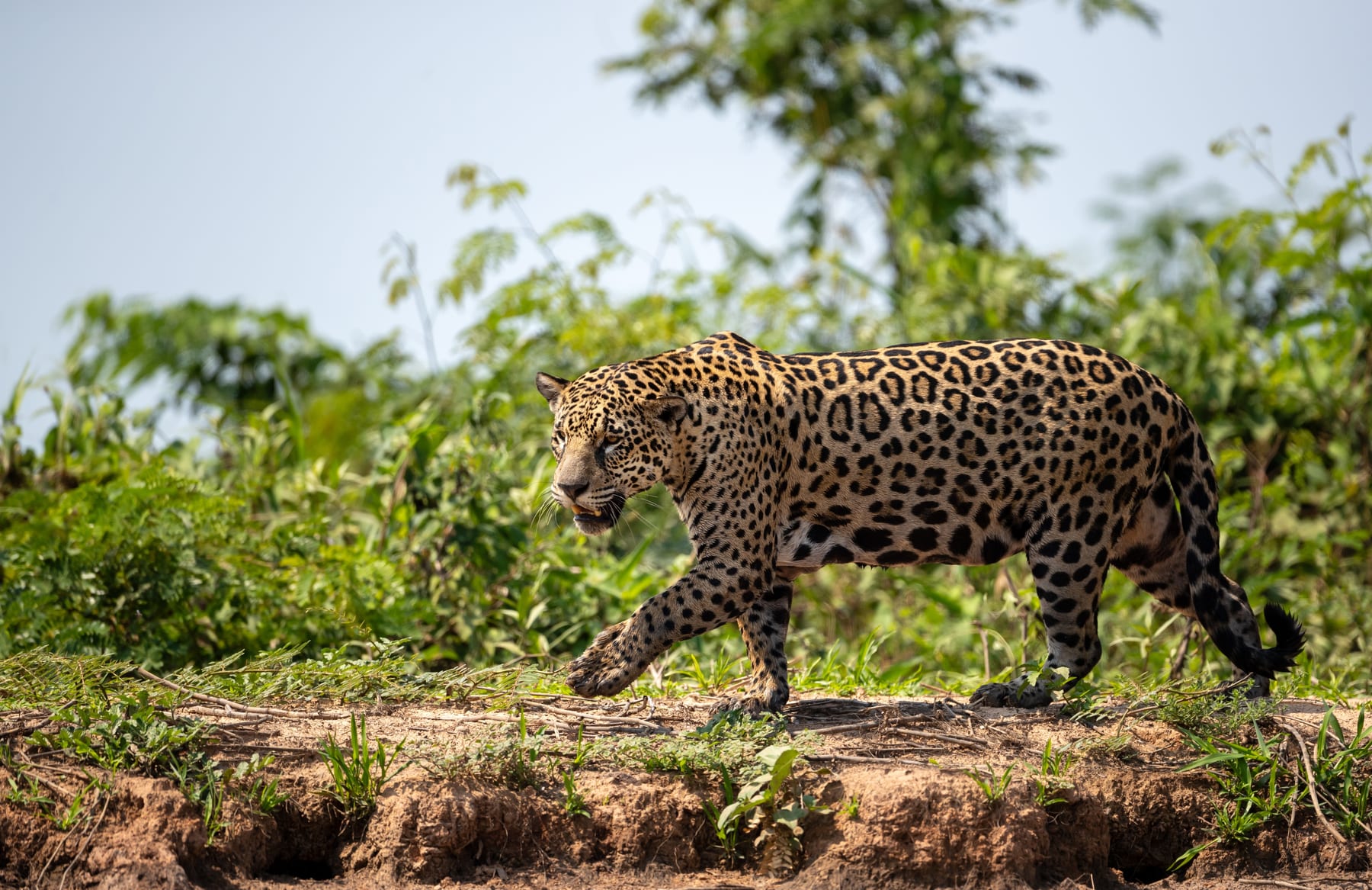
The Amazon holds an estimated 15,000 tree species and around 1,300 described birds.
The jaguar is the apex predator across most of it, and the only big cat in the Americas. Jaguars kill by biting through the skull rather than the throat, and their range has contracted by roughly half. Panthera runs jaguar corridor work across Latin America.
The harpy eagle hunts monkeys and sloths in the canopy with a grip strong enough to crush bone. It needs vast undisturbed territory per breeding pair, which makes it one of the first species to vanish from a fragmented forest.
The hyacinth macaw is the largest flying parrot in the world. Its beak can crack palm nuts nothing else can open, which makes it the main disperser of several palm species. Foster Parrots takes in parrots from the exotic pet trade that drove much of its decline. The scarlet macaw faced the same pressure and has recovered in parts of Central America.
The brown-throated sloth descends from the canopy about once a week and is nearly defenseless on the ground. The Sloth Institute rehabilitates and releases orphans in Costa Rica.
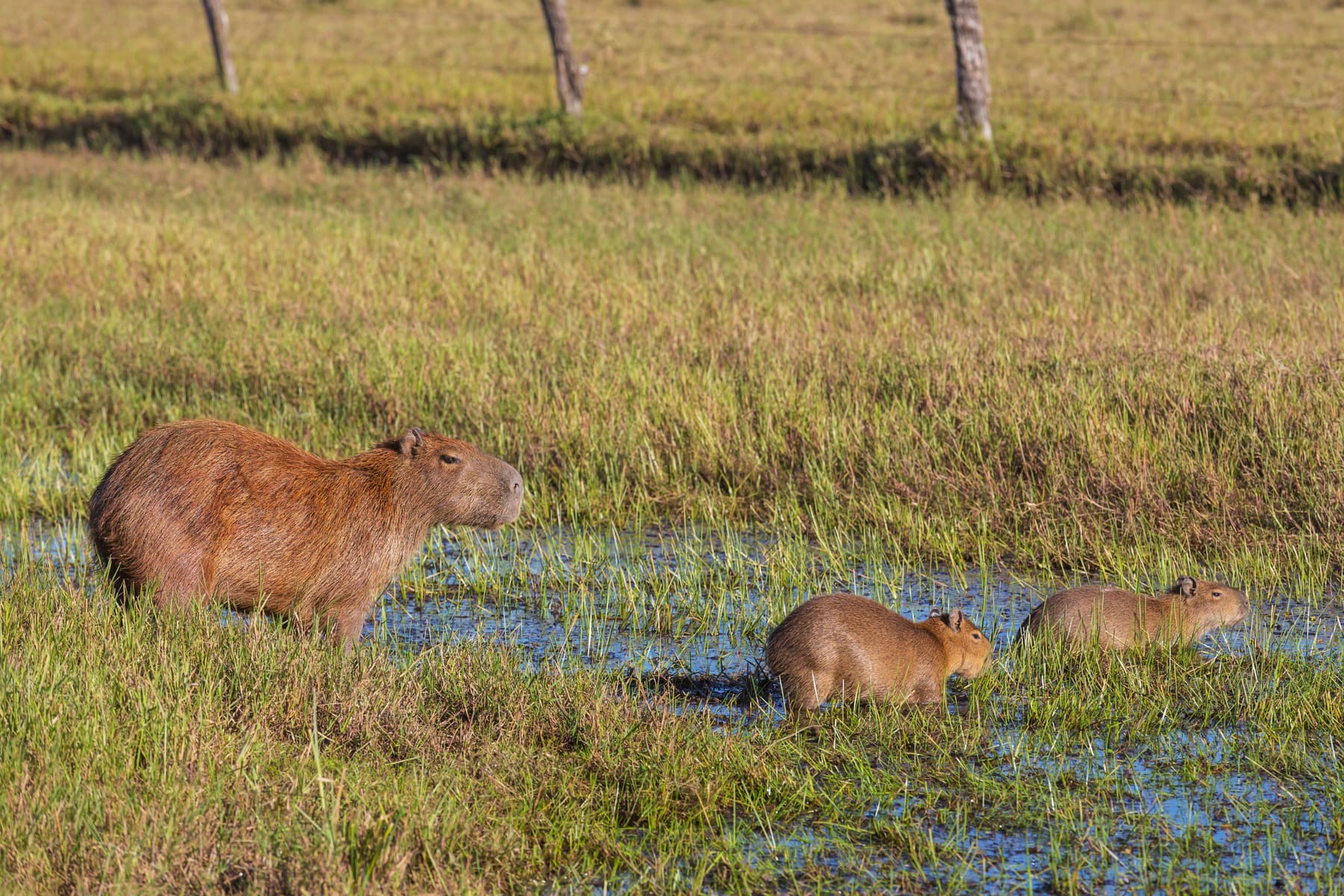
Also here: the giant anteater, which eats up to 30,000 ants and termites a day, the capybara, the world's largest rodent, and the golden poison frog, which carries enough batrachotoxin in its skin to kill several adult humans and gets it from the beetles it eats, so captive-raised individuals are harmless.
The Congo Basin
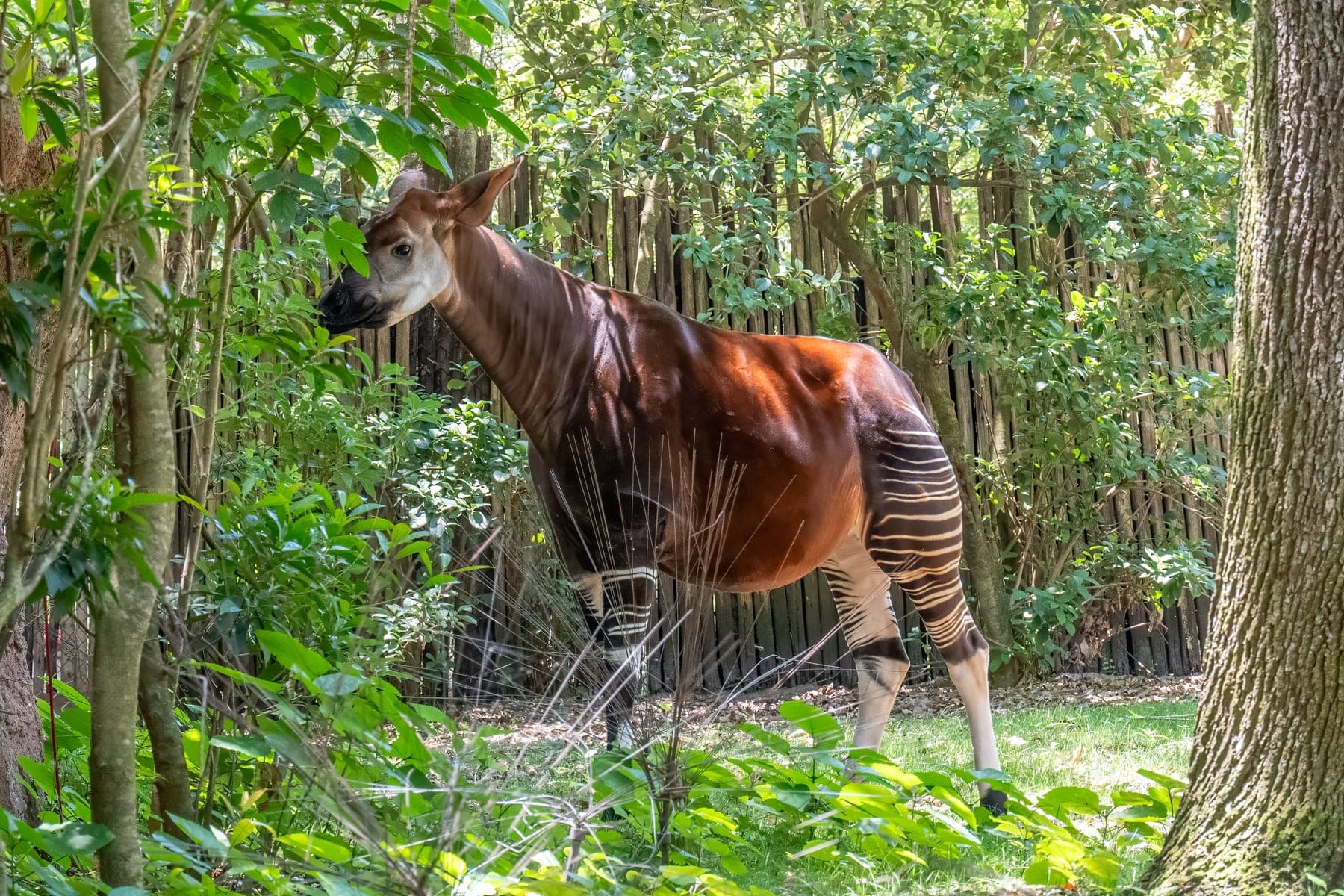
The Congo Basin is the second largest rainforest on Earth and the least visited.
The okapi is its emblem, and one of the strangest animals alive: the only living relative of the giraffe, striped like a zebra, and unknown to science outside central Africa until 1901. It lives alone in dense forest in the Democratic Republic of the Congo and is Endangered.
The bonobo lives south of the Congo River and nowhere else. It shares about 98.7% of our DNA, the same as the chimpanzee, but resolves conflict through social bonding rather than aggression and lives in female-led groups. The chimpanzee occupies the forests north of the river, where the Jane Goodall Institute has worked since the research that established chimpanzees make and use tools.
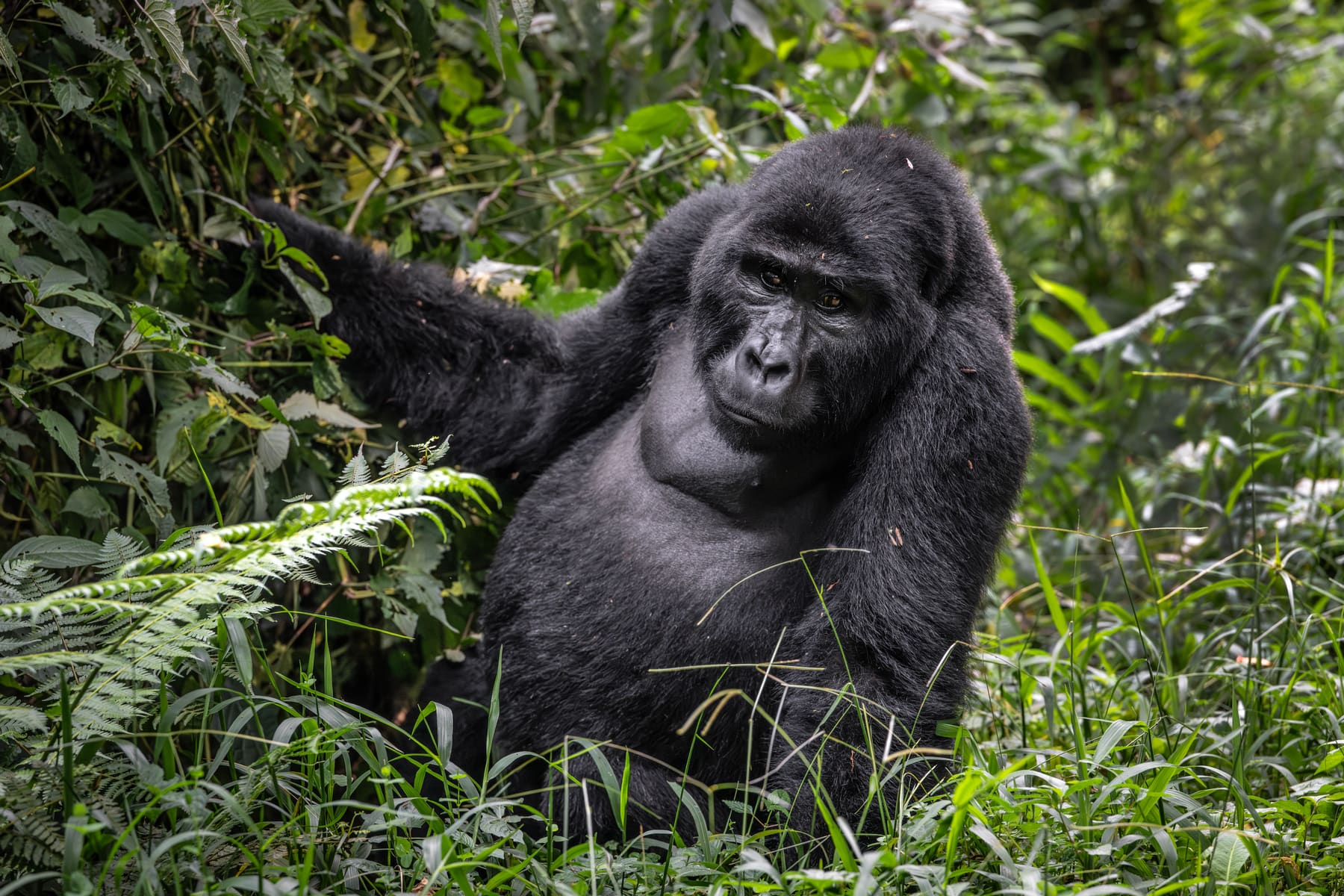
The western lowland gorilla is Critically Endangered, hit by commercial hunting and by Ebola outbreaks that killed gorillas faster than any patrol could prevent. The mountain gorilla is the conservation success story of the group, climbing back above 1,000 animals through decades of protection that the Dian Fossey Gorilla Fund helped build.
The African forest elephant is a separate species from its savanna relative and Critically Endangered, having lost more than 86% of its population in three decades. It disperses the seeds of large forest trees that have no other disperser, so losing it changes the forest's composition for centuries. The giant pangolin is taken for its scales; the African Pangolin Working Group works on the trafficking routes.
Southeast Asia
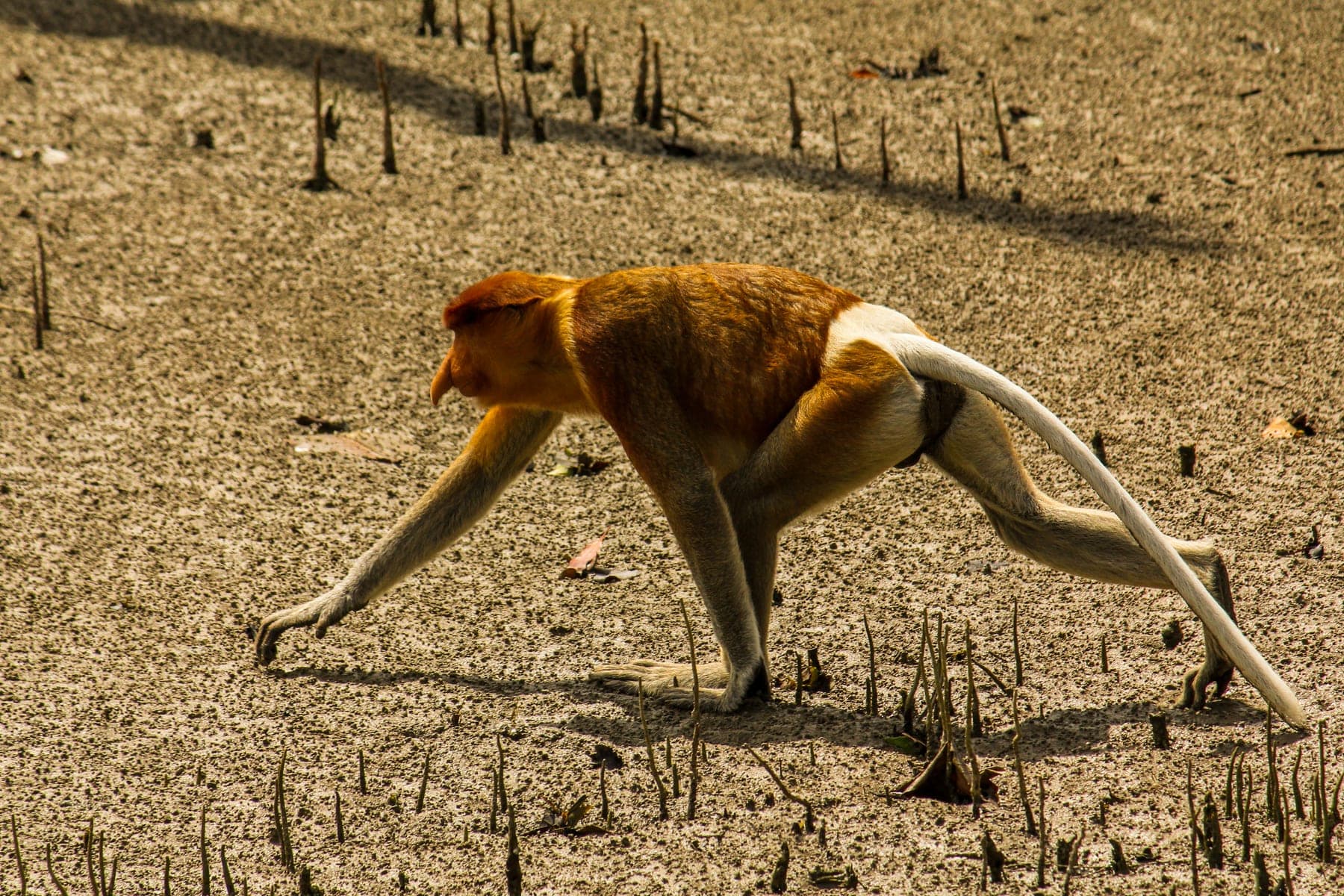
This is where rainforest loss has been fastest, driven by palm oil, logging, and fire, which Rainforest Concern tracks alongside agricultural clearing as the dominant global cause.
The Bornean orangutan and the Sumatran orangutan are both Critically Endangered and are the only great apes outside Africa. Females give birth roughly once every eight years, the longest interval of any land mammal, so a population that loses its females cannot breed back within a human lifetime. Orangutan Foundation International runs rescue and release work in both ranges.
The proboscis monkey lives only on Borneo, in mangrove and riverine forest, and is Endangered. Males grow the pendulous nose that gives the species its name, which amplifies their calls.
The sun bear is the smallest bear in the world and has a tongue up to 25 centimeters long for extracting honey and insects. The clouded leopard has the longest canine teeth relative to skull size of any living cat and can climb down trunks head-first. The red panda is Endangered, lives in Himalayan temperate forest, and is not closely related to the giant panda; it is the only living member of its family.
Further east, the southern cassowary of Australia and New Guinea disperses more large-seeded rainforest plants than any other animal in its range. More than 100 tree species depend on it almost exclusively.
The species nobody has counted
Every animal above is a vertebrate with a name, a photograph, and a conservation status. That describes a rounding error of what actually lives in a rainforest.
Scientists have described roughly 1.2 million species worldwide and estimate the true total at several million more, with the gap concentrated in tropical forest invertebrates. A single hectare of Amazon forest can hold hundreds of beetle species found nowhere else. Most will never be named, and the ones lost to clearing are lost without any record that they existed.
This matters for a practical reason rather than a sentimental one. Conservation funding follows charisma, so assessment effort concentrates on mammals and birds. The IUCN Red List has assessed a large share of the world's vertebrates and a tiny fraction of its insects, which means the extinction figures everyone quotes are drawn almost entirely from the group we happen to watch. The cone snail declared extinct in 2025 was an unusual case precisely because somebody was looking.
When an organization protects forest rather than a species, this is part of what it is buying: the animals nobody has counted, on land that will still be standing when somebody finally does.
Why so many rainforest animals are endangered
Twelve of the 22 species above are Endangered or Critically Endangered. That proportion is not an accident of selection. It follows from three things that rainforest animals have in common.
Small ranges. Many are endemic to one island, one basin, or one side of one river. The bonobo has the Congo River as a hard boundary. Losing habitat inside a small range removes a larger share of the species.
Slow reproduction. Large rainforest animals tend to breed late and rarely. Orangutans, gorillas, and elephants all recover slowly by design, because a stable forest historically rewarded investing heavily in few offspring.
Specialization. A generalist survives disturbance. A harpy eagle that needs thousands of hectares, or a bird that eats one kind of fruit, does not.
The fix is not species-by-species. It is forest, which is why the organizations above spend most of their money on land, patrols, and the communities living alongside these animals rather than on the animals themselves. Our guide to how to protect endangered species covers why habitat work outperforms almost everything else.
For any of the above in more depth: the great apes covers all six species and why every one of them is threatened, jaguar vs leopard settles the spot-pattern question the jaguar above always prompts, types of bears covers the sun bear alongside the other seven, and where to see sloths covers the places a brown-throated sloth is genuinely findable. If you would rather fund one than travel to one, symbolic sloth adoption explains what those donations pay for.
Colorful animals covers why the macaws and poison frogs here are so bright and what that color is actually signaling, types of monkeys sorts the primates above into the two groups that split 40 million years ago, and wetland animals covers the flooded forest and the Pantanal, where the jaguar above does most of its hunting.
Every species named here has a page on Wildlife Connect with its range, status, and the organizations working on it. If you want the shorter and more urgent version of this list, the ten most endangered animals includes four rainforest species that are closer to the edge than anything above.