Two types of monkeys, and one body part tells them apart
There are roughly 260 types of monkeys, and they fall into two groups that have been evolving separately for about 40 million years, on opposite sides of an ocean. The quickest way to tell which group you are looking at is the tail.
A New World monkey from Central or South America may have a prehensile tail that works as a fifth limb, gripping branches and taking the animal's full weight. No Old World monkey in Africa or Asia has one. That single difference sorts most of the species people can name.
New World monkeys: the ones with the gripping tail
New World monkeys live in the forests of Central and South America, have sideways-facing nostrils, and are generally smaller and more arboreal than their Old World relatives. Many rarely come down at all.
Howler monkeys are the loudest land animal in the Americas, audible at five kilometers through dense forest, and they use it to hold territory without fighting for it. Spider monkeys have the best prehensile tail of any primate, with a bare gripping patch on the underside that works like a palm. Capuchins are the tool users of the group, cracking nuts with stones in techniques that differ between troops and are learned rather than instinctive, and are the species most often stolen from the wild for the pet trade.
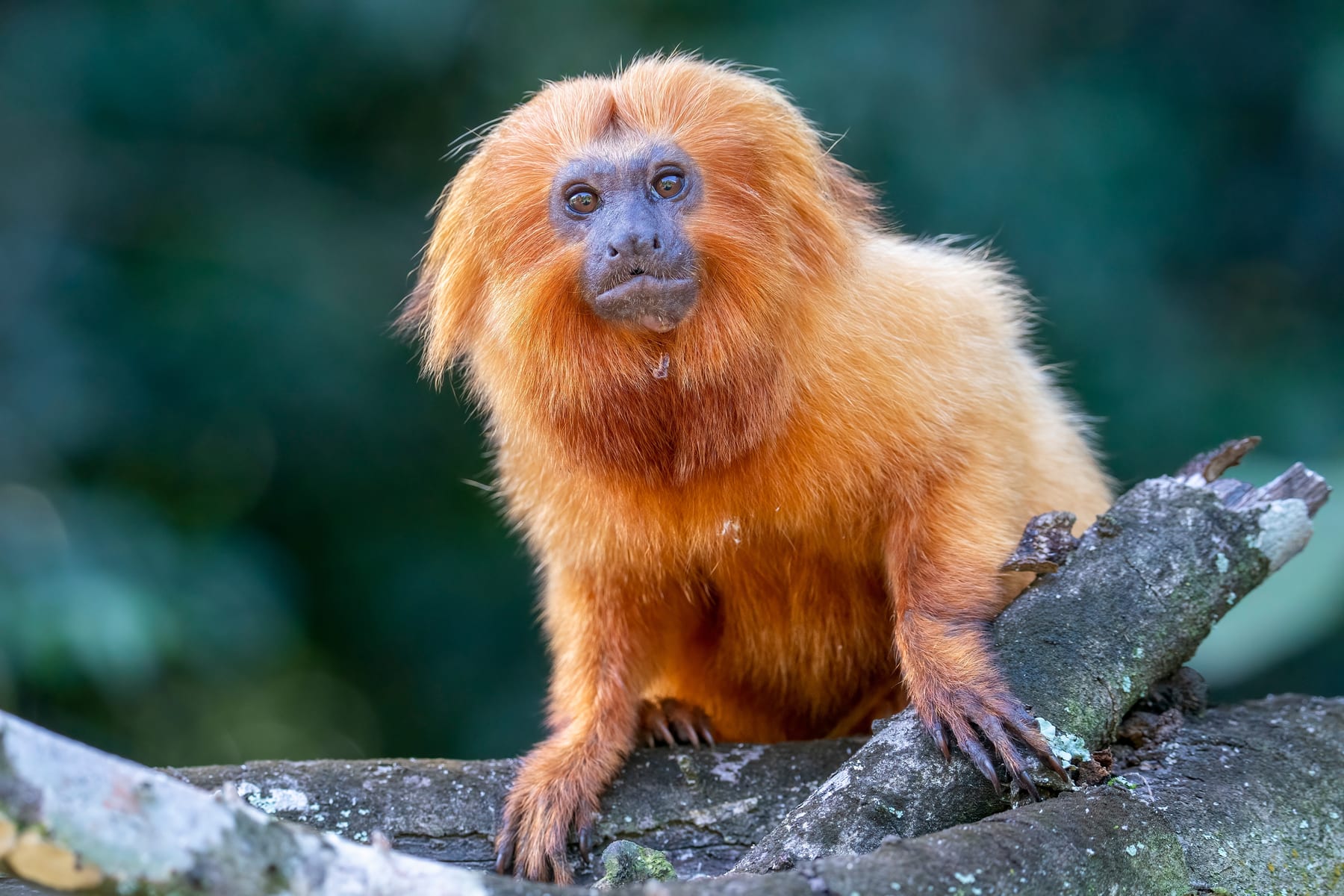
The golden lion tamarin is the conservation case worth knowing. It is Endangered and it fell to around 200 animals in the 1970s, confined to fragments of Brazil's Atlantic Forest. Captive breeding and reintroduction, combined with landowners agreeing to replant forest corridors between fragments, brought it back to roughly 2,500. Corridors did most of the work. A population split across islands of forest behaves like several small populations, and small populations fail.
Old World monkeys: the ones on the ground
Old World monkeys live across Africa and Asia, have downward-facing nostrils, sitting pads, and no prehensile tail. Several have given up trees almost entirely.
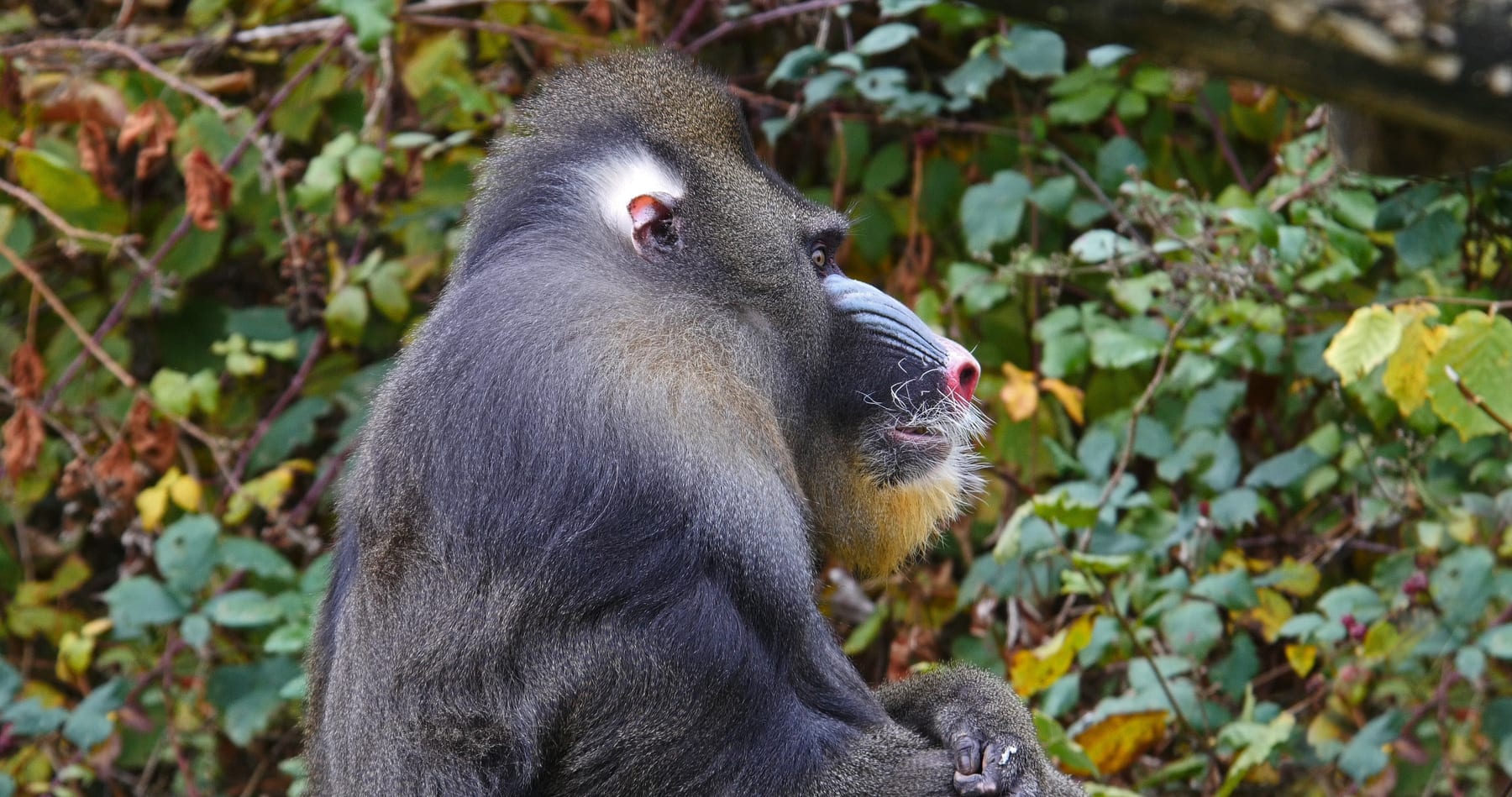
The mandrill is the largest monkey in the world and the most brightly colored mammal on Earth. Males carry blue and red ridges on the face and matching color on the rump, and the intensity tracks rank: the more dominant the male, the stronger the color. It is Vulnerable, hunted for bushmeat across Gabon, Cameroon, and Equatorial Guinea.
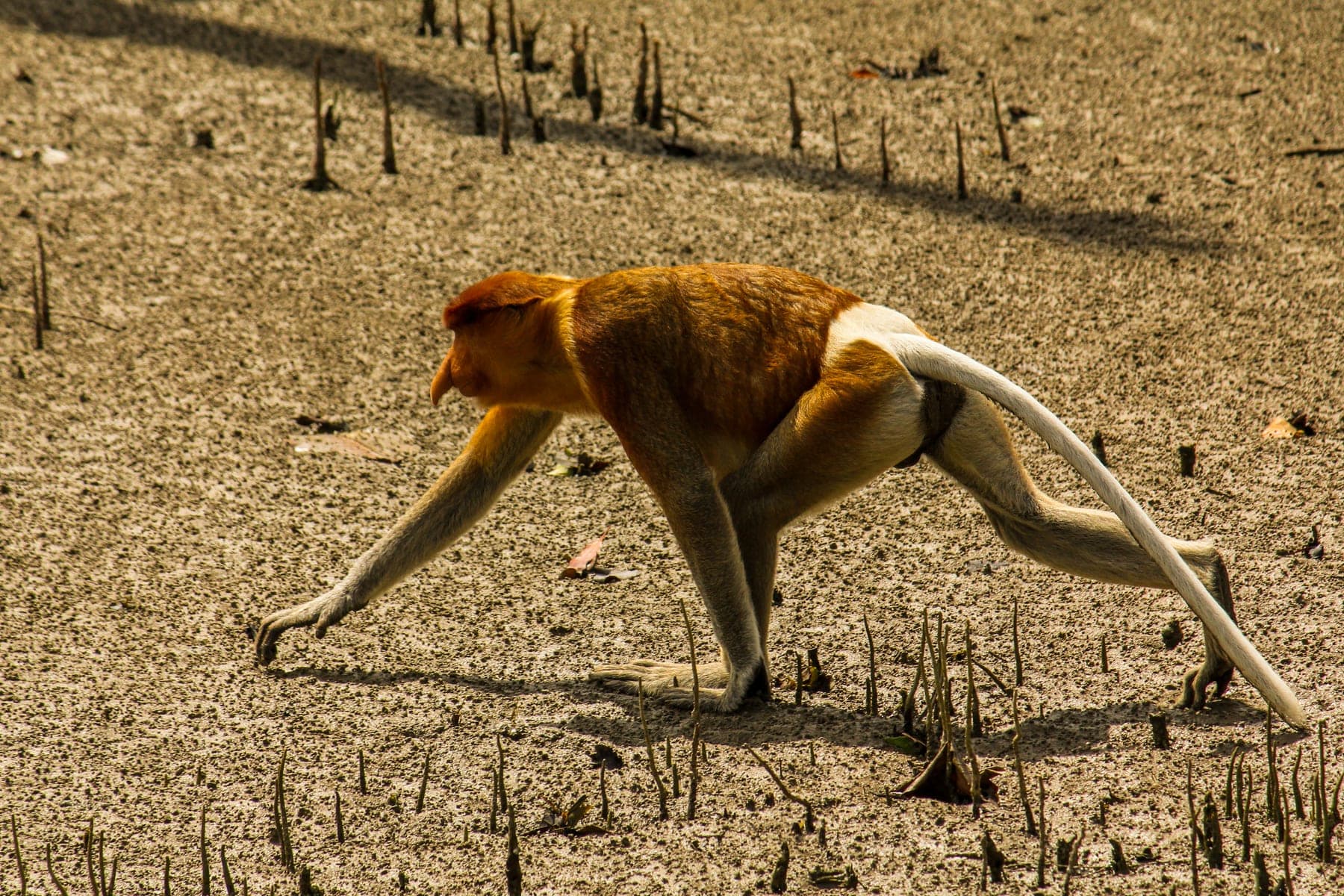
The proboscis monkey is Endangered and endemic to Borneo, where males grow a pendulous nose that amplifies their calls. It is the best swimmer among primates, with partially webbed feet, and it will cross rivers in front of crocodiles to reach mangrove it needs.
Baboons are the most terrestrial monkeys and live in troops of up to a few hundred. Macaques are the most widespread genus after humans, from Japanese macaques bathing in hot springs to the only free-living monkeys in Europe on Gibraltar. Colobus monkeys have a chambered stomach that ferments leaves, which is a cow's solution applied to a tree. They are also the only monkeys with no thumb, which sounds like a loss and is not: a hand reduced to a hook swings through branches faster than one built to grip.
The golden snub-nosed monkey lives higher and colder than any other non-human primate outside the Himalaya, at up to 3,400 meters in Chinese mountain forest, and gets through winters on lichen scraped off bark. The gelada of the Ethiopian highlands is the only primate that lives almost entirely on grass, and it feeds sitting down, shuffling along on its backside while it picks, which is a posture no other monkey uses.
The animals people call monkeys that are not monkeys
This is where most confusion lives, and the distinctions are real rather than pedantic.
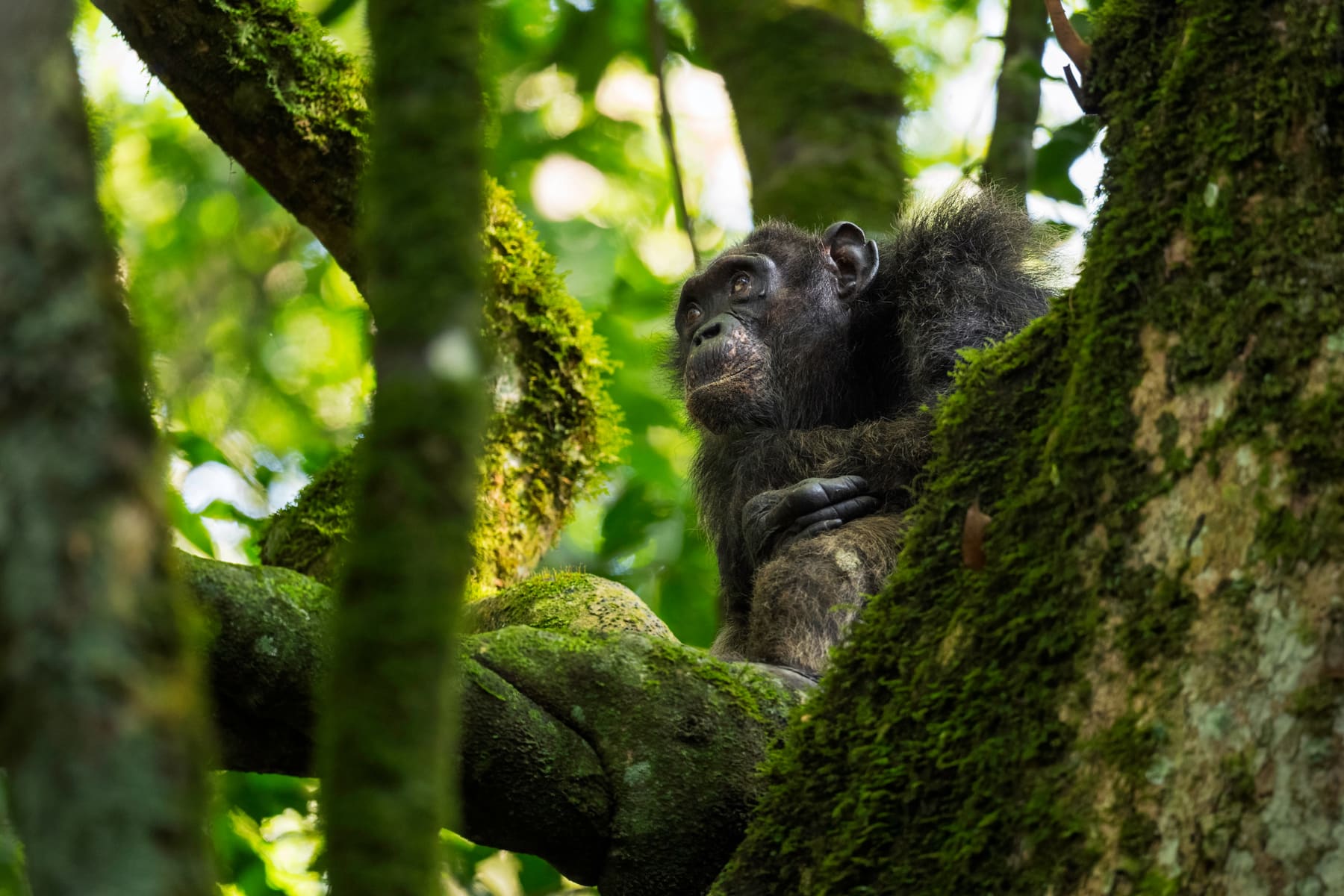
Apes are not monkeys. Chimpanzees, gorillas, orangutans, bonobos, and gibbons have no tail, larger brains relative to body size, and shoulders built for hanging rather than running along branches. Our guide to the great apes covers all six species, every one of which is threatened. Calling a chimpanzee a monkey is roughly like calling a wolf a fox.
Lemurs are not monkeys either. They are prosimians, an older primate lineage that survived on Madagascar because the island separated before monkeys evolved to compete with them. The ring-tailed lemur is Endangered, and Madagascar's lemurs as a group are the most threatened large group of mammals anywhere.
Tarsiers, lorises, and bushbabies are also prosimians. The tarsier has eyes larger than its brain, each one about the size of its entire eye socket, which is why it cannot move them and rotates its head instead.
Which types of monkeys are in the most trouble
The pattern across the group is depressingly consistent, and it is not evenly spread.
Roughly 60% of primate species are threatened with extinction, according to assessments compiled on the IUCN Red List, and the drivers are the same three every time: clearance of the forest they depend on for agriculture, hunting for bushmeat, and capture for the pet trade.
The species in the worst shape are the ones with small ranges. The Hainan gibbon is down to a few dozen animals on one Chinese island. The Tapanuli orangutan, described only in 2017, may be the rarest great ape alive. The golden lion tamarin recovered precisely because its range problem was solvable with corridors on private land.
The wide-ranging generalists are fine. Macaques are thriving to the point of being treated as pests in several cities. That split, between the specialist in one forest and the generalist that will eat anything, decides more outcomes than any other single factor.
What the pet trade does specifically
This deserves its own paragraph because it is the threat people accidentally fund.
A monkey sold as a pet was almost always taken as an infant, and taking an infant usually means killing the mother, because she will not release it alive. The animal then grows into something nobody can keep: capuchins and macaques reach sexual maturity, become aggressive, and are surrendered.
That is the pipeline filling primate sanctuaries. Wild Futures in the UK, Vervet Monkey Foundation in South Africa, and Primarily Primates in Texas all take in animals that cannot be released, which is welfare work rather than conservation and costs decades of care per animal.
The Jane Goodall Institute has spent longer than anyone documenting what the trade does at the source end, and Born Free campaigns on the legality of keeping primates privately, which in much of the world is still permitted.
The short version
If it has a gripping tail, it is from the Americas. If it has a tail it cannot grip with, it is from Africa or Asia. If it has no tail at all, it is an ape and not a monkey. And if it is on Madagascar, it is a lemur and it split from all of them before the question came up.
There is one more distinction worth carrying, because it explains why the list above is so uneven. Monkeys did not spread across two continents by being similar. The New World group arrived in South America on rafts of vegetation across an Atlantic that was already wide, then radiated into a forest with no other primates in it. The Old World group evolved alongside apes, big cats, and eventually us, and the ones that survived that are mostly the adaptable ones. Which is why the monkeys in trouble today skew heavily toward the New World specialists and the island endemics, and the ones thriving skew toward animals that learned to live next to people.
The mandrill's face is the most extreme color on any mammal, and colorful animals covers what that signal is for and why mammals cannot make blue pigment at all.